When I read the _Financial Times_ review of Joris Luyendijk’s _People Like Us: Misrepresenting the Middle East_ last year, I knew it was a book I wanted and needed to read (Australian title is _Fit to Print_). So I placed an order on amazon.uk that very morning. But it never came and I only just got my hands on a second-hand copy. Amazon (US and UK) are both listing it as out-of-print. Which is a pity, because you need to read it too. Some of it will be familiar to intelligent and well-informed people: of course we _know_ things work like that. But it is hard to keep the knowledge one has of the news process in view, when watching TV, reading the papers, listening to the radio over breakfast. Luyendijk will, at the very least, do the necessary job of keeping us sensitized.
[click to continue…]
Posts by author:
Chris Bertram
A bit of mindless surfing had me looking at the execrable Instapundit for the first time in ages … but there was actually something interesting there: a link to Sally Mann, talking about memory, uncertainty and the collodion process. Those 19th-century photographers who managed to produce near-flawless images using the process were really something.
John’s Shakespeare thread, featuring George Scialabba’s somewhat idiosyncratic opinions on the playwright, has reached the point where comments are closed. Not that I specially want to open them. But I was reminded of George’s deployment of Shaw earlier today when reading Hume’s “Of the Standard of Taste”. Here’s Shaw, as quoted by George, seeking in his poets a kind of will to moral improvement:
bq. All that you miss in Shakespeare you find in Bunyan, to whom the true heroic came quite obviously and naturally. The world was to him a more terrible place than it was to Shakespeare; but he saw through it a path at the end of which a man might look not only forward to the Celestial City, but back on his life and say: ‘Tho’ with great difficulty I am got hither, yet now I do not repent me of all the trouble I have been at to arrive where I am. My sword I give to him that shall succeed me in my pilgrimage, and my courage and skill to him that can get them.’ The heart vibrates like a bell to such utterances as this; to turn from it to ‘Out, out, brief candle,’ and ‘The rest is silence,’ and ‘We are such stuff as dreams are made on, and our little life is rounded by a sleep’ is turn from life, strength, resolution, morning air and eternal youth, to the terrors of a drunken nightmare.
And here’s Hume:
bq. Whoever would assert an equality of genius and elegance between OGILBY and MILTON, or BUNYAN and ADDISON, would be thought to defend no less an extravagance, than if he maintained a mole-hill to be as high as TENERIFFE, or a pond as extensive as the ocean. Though there may be found persons, who give preference to the former authors; no one pays attention to such a taste; and we pronounce without scruple the sentiment of these pretended critics to be absurd and ridiculous
Jacob Levy is asking his Facebook friends to nominate their tips for the best political philosophy books (best, most enduring, most interesting) of the decade that Brits are now referring to as “the noughties”. Global justice has obviously been the defining topic, but, whist there have been some good books on the issue, I can’t bring myself to think that any of them will be thought of as essential reading in 20 years or so, in the way that some of the offerings of the 1970s and 1980s still are today. I can’t really think beyond _If You’re an Egalitarian, How Come You’re So Rich?_ (2000) and _Rescuing Justice and Equality_ (2008). But then, as a former Jerry Cohen pupil, I’m biased. Nominations?
Matt Matravers emails and asks me to post for CT readers:
bq. Many of you “posted”:https://crookedtimber.org/2009/03/25/remembering-brian-barry/ very kind and moving messages about Brian Barry when he died. If you knew Brian in the last many years, then you knew Brian and Anni. Since I don’t have any way of contacting people individually, I am posting this. I hope readers will forgive the impersonal nature of the contact.
bq. I learnt today (Thursday) that Anni died overnight at home. She had been feeling unwell with what she thought was a ‘chest infection’. The doctors diagnosed pneumonia and pressed her to go into hospital yesterday, but she resisted saying that she, in any case, was feeling a bit better. A neighbour found her this morning.
bq. I do not have any further details, but I’ll do my best to inform people when I do. Anni was a lovely person, a force of nature, and something special.
Very sad news indeed. I remember visiting Anni and Brian at their flat near the British Museum. There was a great atmosphere, fine conversation, and lots of opera.
UPDATE: The following announcement will appear in the Guardian:
bq. Anni Barry (Anni Parker) of Bury Place, London died peacefully in her sleep on 3rd December 2009 after a short illness.
bq. Her funeral will take place at 2pm on Monday 21st December in the West Chapel at Golders Green Crematorium.
bq. Flowers welcome.
My post yesterday was about how politicians seize on the academic research the suits their agenda rather than being disposed to listen to good arguments. Dog bites man, you might think. A similar phenomenon is at work in the elevation of minor academics who can give a bit of intellectual sheen to some political project or other. I was astounded, watching Newsnight a couple of evenings ago, to hear someone touted as a major British political philosopher. After all, I’ve taught the subject, in Britain, for over twenty years, and I’ve never heard of him. Of course, I might just be ignorant, and he might be a previously overlooked genius. Step forward Philip Blond, formerly a theology lecturer at the University of Cumbria and now being promoted as the philosophical voice behind David Cameron’s “new” Toryism. A brief perusal of what’s available on the web doesn’t suggest to me that I’m missing anything. But I’m often wrong, so I’m open to correction.
The British government recently changed its immigration policy. Well, I say it changed it, but perhaps what it did or, worse, “signalled”, was to intensify its existing policy. Immigration to the UK from outside the EU is, henceforth, to be driven by the needs of the labour market. People will only be allowed in if they compensate for some skills shortage. Indeed, the committee which advises the British goverment on immigration policy is now composed exclusively of economists whose role is to tell politicians and bureaucrats when “UK plc” needs computer programmers or nurses. Of course these won’t be the only immigrants, since the UK remains a signatory of the UN Convention on Refugees, and the British government will not be able to evade its obligations in all cases of people fleeing persecution. And there will be some illegals who get through and, for one reason or another, will be able to avoid deportation.
British policy is therefore, like the policy of many other countries, based on the idea that sovereign states have the right to exclude whoever they like and that they can therefore limit inward migration to people who can benefit “us”. There’s no thought given to the rights human beings have to freedom of movement, to the benefits of allowing people to escape poverty and build new lives. No, this is our place, and we’ll let in those whom we choose to. The poor, the huddled masses, can get stuffed.
I’ve been thinking about these issues from within political philosophy for a while now. I’m not an “open borders” advocate in a completely unqualified sense, but, compared to current policy, I am as near as makes no difference. Compare me then to some other, hypothetical academic, who argues in favour of the current policy, or that Britain is “too crowded”, or that the right of freedom of association that citizens have implies the right to exclude would-be immigrant foreigners. Now there may be some intellectually respectable arguments that can be put on such lines (though I doubt it). It isn’t hard to see whose research is more likely to be picked up by politicians and cited as a rationale for what they want to do. Which brings me to the issue of “impact” and to another decision of the British government. Henceforth, research in the UK will be funded not just for its intrinsic quality but also for the benefits it is expected to bring to the wider society. Ministers and higher-education funding bureaucrats have been keen to point out that they don’t simply mean economic benefits and commercial spinoffs. No, they also want to reward research which makes a difference to public policy. Of course, I’d love it to be the case that senior politicians and civil servants read work in political philosophy and theory and, convinced by good arguments, adjust their ideas accordingly. But the cynic in me says that this isn’t what happens. Rather, the attitude that politicians have to research is to latch onto it when it supports the view they already hold and to ignore (or punish) it when it tells them something uncomfortable. Research that supports tighter border controls (or harsher drug laws) will have “impact” and research that favours more immigration or legalizing weed won’t. And the money will follow.
Via Kevin Jon Heller and Una Vera, I just came across Jeremy Scahill’s Nation piece about Blackwater’s operations in Pakistan. Nasty stuff, not the least of which is the allegation that Blackwater operatives are masquerading as aid workers. The predictable consequence will be that aid workers (and not just in Pakistan) will be targeted for assassination, kidnap and torture to a greater degree than at present. Hard to exaggerate just how bad this is.
Ten types of commenter, of which the last are the rarest.
-
The commenter who has not read the post properly, decides they know what it says anyway, and fires off a series of disgusted observations.
-
Commenter who applies the most uncharitable possible interpretation to the post, and goes straight into rant mode.
-
The commenter who takes the opportunity to make some sarcastic remarks highlighting his (99% of cases are male) own superior scholarship/intelligence and damning the CT author. “If only Chris has read the second treatise of Heinrich von Pumpkin in the original German, he’d be aware ….”
-
The commenter who uses every comment as a peg on which to hang his (yes, “his”) own obsessions about, e.g. analytical philosophy, populism, Palestine, etc
-
The commenter who simply wants to make nasty personal remarks about the CT author, often about female members of the collective, often using an alias.
-
The commenter with a sense of grievance against CT following their treatment in some comment thread back in 2004.
-
The commenter who notices that a CT author said P in 2005 and not-P in 2008, and who gives every impression of compiling an archive of such contradictions.
-
The commenter who has posted in the thread in error, and angrily denounces literary theory in a discussion of Irish cuisine.
-
The spambot.
-
The commenter who reads what we write, tries to have a conversation, is occasionally appreciative, points out mistakes helpfully rather than as “gotchas”, brings their own knowledge to the table.
I saw Michael Haneke’s new film, The White Ribbon (Das weiße Band) last night. A beautiful and disturbing evocation of childhood and evil in a small German village on the eve of World War 1. It really cements Haneke’s reputation as one of the greatest film-makers working today. The central thread of the film concerns a series of vindictive and increasingly sadistic attacks, first on the village doctor, then on small children, starting in the summer of 1913. Haneke doesn’t do “closure” (hooray for that!) , so, as with Hidden, we can never be quite sure what happened and who was responsible for what, though at the end of the film there is a very strong suggestion as to the identity of the culprits. Though such events provide the narrative thread, the real substance of the film is its exploration of the repressive family relationships that pervade the village: most prominently, the pastor’s rule over his children, but also the doctor’s vicious treatment of his mistress, and the cold of the Baron’s marriage.
Heimat is bound to be a point of comparison, though, of course, the action in Edgar Reitz’s work beings with a return to a village in the immediate aftermath of Germany’s defeat in 1918. Haneke’s characters are, with a few exceptions, much less sympathetically portrayed that Reitz’s.
Watching the film, which despite its length, was sufficiently engrossing to pass quickly, I was led to reflect on how close we are in time to the events depicted and how impossibly distant we are from them (two world wars and massive technological and social change stand between us and those villages of feudal deference and agrarian drudgery). A year ago seems nothing, but, iterate 96 times or so, and little remains in common. Still, the real-life counterparts of the smallest of Haneke’s child characters might still be living today.
One small semi-technical note. I believe that the film was shot in digital colour and then converted to black and white. The monochrome imagery is often superb, but a definite digital flavour remained in the tonality: a very small flaw in a terrific movie.
I watched Paolo Sorrentino’s quite extraordinary film Il Divo last night. It is remarkable in so many ways, but especially, as a portrait of evil in the form for Giulo Andreotti (as depicted by Toni Servillo) and also, in terms of the most marvelous cinematography. In a recent post I attracted hostility from some by doubting the West’s commitment to individual rights. No doubt I overgeneralized a little, but post-war Italy would be a part of any case for the prosecution. Andreotti as portrayed in the film, is prepared to go to almost any lengths, to inflict evil in pursuit of what he takes to be the good, to deal with the Mafia, to sacrifice his colleagues (I’d say his friends, but it isn’t clear that he had any). I wonder if it isn’t possible that Italy between some date in the 1970s and the fall of the Berlin Wall, wasn’t the European state where a person was most likely to be the victim of political murder? (Actually, I’m guessing that Romania might take that prize.) Not to be missed.
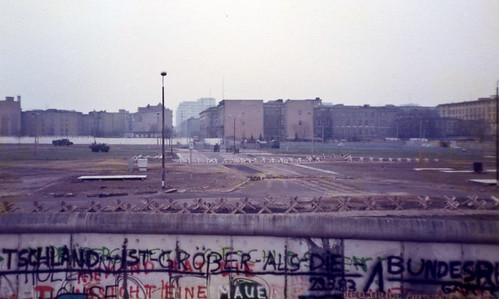
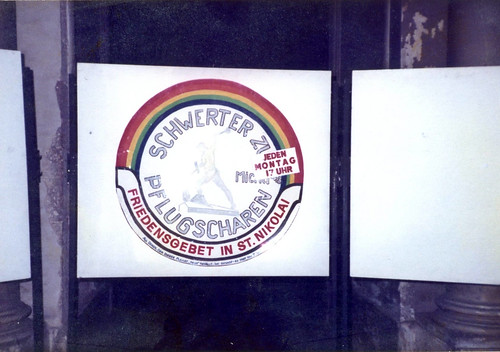
Two photos today. My partner, Pauline Powell and I visited East Germany and West Berlin in 1984. The first picture is a shot of the Berlin Wall from the western side, and seems appropriate as tomorrow is the 20th anniversary of its fall. The second shot, taken inside the Nikolaikirche in Leipzig, announces one of the prayers for peace meetings that helped to build the popular movement that would eventually contribute to the fall of the regime. (Some details of this are on the St. Nikolai Church website.)Both pictures are Pauline’s, not mine (all rights reserved etc). We believe the swords into ploughshares picture is unique on the web, though perhaps others exist as prints. As such, it is something of a historic document.
Fred Halliday writes, as part of a (not unsympathetic) twenty-year retrospective on communism:
bq. … underpinning these three ideas – “state”, “progress”, “revolution” – lay a key component of this legacy: the lack of an independently articulated ethical dimension. True, there was a supposedly ethical dimension – whatever made for progress, crudely defined as winning power for a party leadership, and gaining power for a, mythified, working class – was defended. However, the greatest failure of socialism over its 200 years, especially in its Bolshevik form, was the lack of an ethical dimension in regard to the rights of individuals and citizens in general, indeed in regard to all who were not part of the revolutionary elite, and the lack of any articulated and justifiable criteria applicable to the uses, legitimate and illegitimate, of violence and state coercion. That many of those who continue to uphold revolutionary-socialist ideals, and the potential of Marxist theory, today appear not to have noticed this, that they indeed reject, when not scorn, the concept of “rights”, is an index of how little they have learned, or have noticed the sufferings of others.
There is a difficulty, or at least, so it seems to me, in making this point as part of a diagnosis of what was wrong with the communist movement _in particular_. It is that the very same disregard for, or scepticism about, the rights of individuals, the same willingness to sacrifice individual lives for valuable goals (or even in the name of “progress” broadly conceived) has usually characterized communism’s enemies and competitors too. Consequentialism was the dominant philosophy of government pretty much everywhere throughout the twentieth century.
We announced a while back that we’d be doing a regularish photo slot on Sundays, so here’s an offering for today, sparked by no better reason than that I was leafing through a large compendium of photos of the 20th century yesterday (some famous, some not) and I was arrested by Aleksander Rodchenko’s portrait of Lilya Brik. Reused, recycled, copied, imitated, parodied, the original still has the capacity to make me stop and wonder at it. Such energetic, dynamic composition in the picture, and such optimism and vigour in the woman depicted.

Back in June, I excoriated Gordon Brown for his appointment of Alan Sugar as his “enterprise czar”. Since then, I’ve sometimes wavered in my determination not to vote for NuLab again, particularly when I consider the appalling nature of their replacements (even if Rory Stewart does sound slightly exciting). After all, I sometimes say to myself, Gordon Brown did do pretty well when faced with teh end of the world, and that ought to count for something … But the latest bit of populist meddling, sacking David Nutt for saying that drugs policy should be guided by science, reminds me of why they deserve to be beaten (and establishes why Alan “the minister” Johnson is unfit to succeed Brown), Oh for someone decent to vote for.