Posts by author:

Henry

APT on Nussbaum

by Henry Farrell on June 8, 2011

The new Association for Political Theory blog is running a roundtable on Martha Nussbaum’s _ Not for Profit: Why Democracy Needs the Humanities_ at the moment. From the first post:

bq. I agree with pretty much everything Martha Nussbaum is saying. She’s preaching to the academic-robed choir in which I’m a full-throated member. Most days these days I share her alarmist mood regarding cutbacks in the humanities and the liberal arts overall. … But I must if I must say: the book, too often, bores me. I read certain passages, they sound like buzzwordy boilerplate, they sound like declaimed mini-lectures, they sound like cut-and-paste clip-jobs from longer Nussbaum tomes, they sound like academic blah blah blah (with citations), and my eyes gloss over. … It’s too preachy. Its form of presentation is didactic, not Socratic, even as it explicitly celebrates Socratic interactions. … After a few head scratches, I found myself recoiling at such lines as “The future of the world’s democracies hangs in the balance” (p. 2) or that a humanities-educated person approaches problems as a “citizen of the world” (p. 7). … I would never get away with that missionary language in a small seminar of sly undergraduates (they would mock: what’s the difference between a world citizen and an intergalactic one?).

This is not a unique perception – George Scialabba has a lovely review of a similar Nussbaum text from a decade or so ago, demonstrating that she has been apotheosized into that ineffable blandness which is usually reserved for cross-university faculty taskforces and other such higher entities. Myself, I’ve always been reminded of the description of President Robbins in Randall Jarrell’s Pictures from an Institution.

bq. About anything, anything at all, Dwight Robbins believed what Reason and Virtue and Tolerance and a Comprehensive Organic Synthesis of Values would have him believe. And about anything, anything at all, he believed what it was expedient for the president of Benton College to believe. You looked at the two beliefs, and lo! the two were one. (Do you remember, as a child without much time, turning to the back of the arithmetic book, getting the answer to a problem, and then writing down the summary hypothetical operations by which the answer had been, so to speak, arrived at? It is the only method of problem-solving that always gives correct answers – that gives, even, the typographical errors at the end of the book).

She did write well once, so perhaps better yet to compare this book (which I started, but emphatically failed to finish) to what New York would have looked like, had Bill Murray failed in his mission in _Ghostbusters I_ – a wasteland of gelatinous marshmallow, beneath which the ruins of once tall buildings can vaguely be discerned. I probably shouldn’t be as annoyed as I am by Nussbaum’s bad prose and inability to say anything interesting or original. There is a useful social function in repeating the obvious, again and again, in technocratic language. But it surely doesn’t make for fun reading.
Fritz Scharpf on the Eurozone mess

by Henry Farrell on June 7, 2011

This recent lecture by Fritz Scharpf provides the most compelling analysis of the political fallout of the eurozone mess that I have yet seen. Readers who aren’t familiar with political science debates on democratic legitimacy may find the opening pages hard going. But they should persevere. The synthetic analysis of the initial politics of the euro, and of the roots of the German monetary regime are excellent (although for my money he puts too much of the blame on the ECB, and too little on the governments of countries like Ireland, which were, as Niamh has noted less models of fiscal rectitude than temporarily lucky), and provide a lot of detail that is poorly understood among US commentators. But his conclusions are even more interesting and depressing. I quote at length, because blog readers are disinclined to read PDFs, and because this piece deserves wide circulation.

bq. The opposite is true under the “rescue-cum-retrenchment” program that is presently being enacted. Here, all cruelties must be proposed, defended, adopted and implemented over an extended period by the national government. In fact, the program amounts to a greatly radicalized version of the supply-side reforms adopted in Germany during its (much milder) recession before 2005 – which destroyed the political support of the Schröder’s Red-Green government. But whereas Schröder had the chance of developing and defending self-chosen reforms, governments in Greece, Ireland and Portugal must implement policies which are likely to be seen as dictates of Commission bureaucrats and of self-interested foreign governments trying to protect their own banks, investors and export industries.

bq. If these are extremely difficult political conditions, they will be exacerbated by the distributional implications. … As was true in Germany, the inevitable result will be a rise of social inequality and social protest. …. EMU member states cannot expect any help from the European level in managing the macroeconomic imbalances that are induced by European monetary impulses that do not fit the specific conditions of the national economy. Instead, they are expected to deal with potential imbalances through the use of their remaining policy instruments − but in doing so, they will be constrained by the rules of the Excessive Deficit Procedure and they will be controlled by the Commission’s discretionary interventions under the Excessive Imbalance Procedure.

bq. … member states in the reformed Monetary Union will indeed find themselves in the worst of three worlds. Like the provinces or cantons in a federal state, they lose control over the instruments of macroeconomic management, and they are likely to suffer from uniform national policies that do not fit their regional economy. At the same time, however, the EU budget is miniscule in comparison to the budget of federal states, there are no European taxes and there is no European social policy to alleviate interregional imbalances. Instead, member states are expected to cope with all economic problems by relying entirely on their own policy resources. In contrast to members of the earlier EMS, however, EMU member states cannot use these policies autonomously, but are subject to the intrusive supervision and potential punishment imposed by supranational authorities – which are not themselves democratically accountable and have no reason to be politically responsive to the citizens affected by their policies. In fact, no democratically accountable national government in a federal state has ever claimed such control over the fiscal, economic and social policy choices of its constituent provinces, states, Länder or cantons.

bq. From the perspective of citizens in Greece, Ireland and Portugal, the European and international agencies imposing the “rescue-cum-retrenchment” program are not, themselves, supported by democratic legitimacy. … political resignation, alienation and cynicism, combined with growing hostility against “Frankfurt” and “Brussels”, and a growing perception of zero-sum conflict between the donors and the recipients of the “rescue-cum-retrenchment” programs, may create the conditions for anti-European political mobilization from the extremes of the political spectrum. In the worst case, therefore, the attempts to save the Euro through the policies presently enacted may either fail on their own terms, or they may not only undermine democracy in EU member states but endanger European integration itself.

Tom Slee on Adapt

by Henry Farrell on June 6, 2011

An excellent and provocative review. The nub of the critique:

bq. Tetlock divided his experts into foxes (good at many things) and hedgehogs (good at one thing) and argued that hedgehogs are over-confident because they “reduce the problem to some core theoretical scheme’… and they used that theme over and over, like a template, to stamp out predictions”. And that’s exactly what Harford does here. He sees evolution as a fox-like strategy (trying many things and selecting a few) but doesn’t notice that at the level of individual species, evolution gives us both foxes and hedgehogs, and both do perfectly fine. Once the contradiction at the heart of the book is clear, it is not surprising that the book itself cherry picks examples where trial-and-error has succeeded, or where eggs-in-one-basket has failed. But such stories, while entertaining, make a notoriously shaky foundation for any kind of general structure, and so it proves here.

Or, to put it a little more abstractly, mechanisms of evolutionary selection and processes of wilful experimentation are not the same thing. Read the whole thing. I’m also looking forward very much to Tom’s forthcoming take on Duncan Watts’ _Everything is Obvious: Once You Know the Answer_, which I liked a lot (although I suspect that Kieran might have some sharp words to say about Watts’ discussion of the effect of presumed consent defaults on organ donations).

The Blank #Slatepitch

by Henry Farrell on June 4, 2011

Via the ICCI blog, some sixty-odd evolutionary psychologists have published a collective letter, disassociating themselves from Satoshi Kanazawa.

bq. We have previously pursued the usual scientific channels open to us to counteract what in our view is Kanazawa’s poor quality science by reviewing and rejecting his papers from scientific journals, and by publishing critiques of his papers in the scientific literature. This has not stopped him from continuing to produce poor quality science and promoting it directly to the public. We have therefore taken the unusual step of making this statement to counteract the damage we believe he is doing to the perception of our discipline in the media and among the public. … Many of these critiques completely undermine the work: the statistician Andrew Gelman, for example, has re-analysed the data Kanazawa used in 2007 to suggest that “Beautiful people have more daughters” and has demonstrated that Kanazawa’s conclusions are simply not supported by the data. Despite this, Kanazawa has not withdrawn the critiqued paper nor published a correction. … The peer review process is not perfect and appears to have failed when dealing with Kanazawa’s poor quality work.Those of us who have reviewed his papers have had experiences where we have rejected papers of his for certain journals on scientific grounds, only to see the papers appear virtually unaltered in print in other journals, despite the detailed critiques of the papers given to Kanazawa by the reviewers and editors of the journals that rejected his papers.

I’ve no doubt that Kanazawa’s work is bad by the commonly accepted standards of evolutionary psychology. But as the ICCI blog politely suggests, there is a broader problem with the field that the collective letter doesn’t address as directly as it should. Evolutionary psychology has benefited from media attention, but also been distorted by it – there are significant incentives to produce ‘shocking’ and ‘contrarian’ findings. I saw this first hand a few years ago when I got involved in an email discussion with the co-editor of an evolutionary psychology journal which had published one of Kanazawa’s more egregious stinkers. When I pushed the person in question on how obviously bad the piece was, the response was that:

bq. I happen to think it is a great thought provoking document, and one of the few in the last ten years that have actually gotten people to talk about issues. … I would rather have an article that causes people to think and talk and yes, argue and criticize than to publish an article that is one more facet of the same old thing.

There’s something to be said for stirring it up every once in a while. But there’s also something to be said for trying to get things right. Typically, academic journals are supposed to emphasize the latter rather than the former. It’s beyond dispute that Kanazawa can produce “thought provoking”1 articles that get people to “argue and criticize.”2 But the peer review process is supposed to do a bit more than to verify that your ideas are daring and controversial. That at least one journal editor (and surely more than one, given Kanazawa’s publication record) in the field don’t seem to understand this suggests that there is a problem.

1 If “thoughts” can be taken to encompass internal queries-to-self along the lines of ‘how the fuck did this ever get published?’

2 The joint letter mentions some 24 critiques of his papers by 59 social and natural scientists. If Satoshi Kanazawa did not exist, theorists and methodologists would have to invent him as a cautionary example.

Update: I should probably link manually to Cosma’s webpost responding to this since, you know, that whole Trackback thing doesn’t work so well anymore. I should also say that while I am no very great fan of Stephen Pinker’s work, the title of this post should not be read in any way as implying that it’s on a level with Kanazawa’s ( I just don’t think of halfway decent puns often enough that I can easily junk them).

Ghostwriters of Science

by Henry Farrell on May 27, 2011

Via Randolph Fritz, a very interesting article about how extensive the pharmaceuticals ghostwriting industry is:

bq. The planning companies are paid to implement high-impact publication strategies for specific drugs. They target the most influential academics to act as authors, draft the articles, and ensure that these include clearly-defined branding messages and appear in the most prestigious journals. … There are now at least 250 different companies engaged in the business of planning clinical publications for the pharmaceutical industry … Current Medical Directions, a medical communications company based in New York, promises to create “scientific content in support of our clients’ messages”. … n a flow-chart drawn up by Eric Crown, publications manager at Merck (the company that sold the controversial painkiller Vioxx), the determination of authorship appears as the fourth stage of the article preparation procedure. That is, only after company employees have presented clinical study data, discussed the findings, finalised “tactical plans” and identified where the article should be published. … “We’ve never done ghostwriting, per se, as I’d define it”, says John Romankiewicz, president of Scientific Therapeutics Information, the New Jersey firm that helped Merck promote Vioxx with a series of positive articles in medical journals. “We may have written a paper, but the people we work with have to have some input and approve it.”

I used to think that political scientists were lucky, in that no-one cared enough about what we had to say to try to suborn our reputations via dubious endorsements. And then I read about the Gadaffi and political science scandal …

The Bernstein Singularity

by Henry Farrell on May 20, 2011

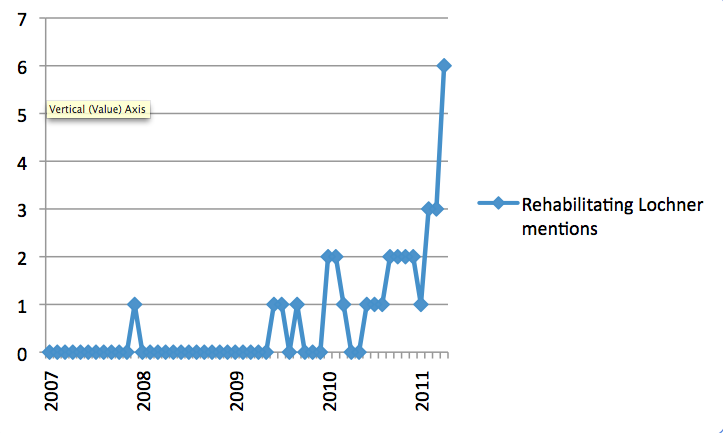
David Bernstein, who clearly worries that he didn’t promote his last book quite enough, is offering various special deals on the new one over at the _Volokh Conspiracy._ The worrying thing is not that this is the 34th post that he has written touting the book in some way. It’s the rate at which the frequency of mentions appears to be increasing. For your collective edification, I have graphed the number of mentions of the book by month between 2007 and the end of April 2011.


As is immediately apparent, the number of mentions is now increasing exponentially. Should this frightening trend continue, reliable back-of-the-envelope calculations suggest that by September 2011, the publishing output of the _Volokh Conspiracy_ will consist entirely of book plugs for David Bernstein.

Would that it ended there. Some thirty-four months after that (numerologists take note of this significant coincidence), the entire Internet will be made up of blogposts lauding the virtues of _Rehabilitating Lochner_ (and offering t-shirts to every lucky fifth buyer). Not all that long after that, these posts will start straining the theoretical information-storage capacity of the planet, and, sometime within my expected lifetime, that of the galaxy. Even Charlie Stross couldn’t have predicted this one.

Pedants, potato-counters and other such folk will no doubt point to the dangers of making extrapolations from apparent hyperbolic growth processes. But if anything, I suspect my predicted growth-curve is a gross under-estimation. After all, the book hasn’t _even been officially released yet._ One can only imagine how much further the process will accelerate once there are book tours, right-wing radio talkshow appearances and the like to chronicle exhaustively in repeated updates. And _please!_ don’t anyone tell tell him about Twitter.

The Conservative War against Sheep

by Henry Farrell on May 18, 2011

What is it that the right has against sheep? Newt Gingrich’s press secretary today.

bq. The literati sent out their minions to do their bidding. Washington cannot tolerate threats from outsiders who might disrupt their comfortable world. The firefight started when the cowardly sensed weakness. They fired timidly at first, then the sheep not wanting to be dropped from the establishment’s cocktail party invite list unloaded their entire clip, firing without taking aim their distortions and falsehoods. Now they are left exposed by their bylines and handles. But surely they had killed him off. This is the way it always worked. A lesser person could not have survived the first few minutes of the onslaught. But out of the billowing smoke and dust of tweets and trivia emerged Gingrich, once again ready to lead those who won’t be intimated by the political elite and are ready to take on the challenges America faces.

It’s a relief to know that Newt has emerged unscathed from his gunfight with the clip-of-smoking-tweets-unloading cocktail-quaffing literati-sheep. But, to be frank, they don’t sound very hard. Would he be able to take on tougher ungulates, such as David Brooks’ squadrons of venom-unleashing rabid command-lambs? Or, for that matter, Carly Fiorina’s evil red-eyed demon-sheep thing in conservative's clothing? Your guess is as good as mine, but I imagine that there’s a Jeff Minter video game in it.

Update: Chris Y composes a villanelle in comments.

In times when coward literati must
Send armed sheep minions into the attack,
A man emerges from the smoke and dust.

A lesser person could not take the flack,
The tweets and trivia put him to the rack
In times when coward literati must.

See him rise up above the snapping pack!
The ovine hordes, confounded, must fall back.
A man emerges from the smoke and dust.

Except it’s not like that at all. In fact
No air time, column inches did he lack
In times when coward literati must.

With all their aid and comfort, out of whack,
He couldn’t keep his damned campaign on track.
A man emerges from the smoke and dust.

I just don’t understand this wretched hack.
Perhaps he’s using PCP or crack?
In times when coward literati must
A man emerges from the smoke and dust.

The Sustainability of Europe

by Henry Farrell on May 13, 2011

Matt Yglesias

bq. I’m not intimately familiar with the details of Greek public finance, but it does occur to me that sage words I keep reading in the American press about how Europe’s leaders can’t just keep kicking the can down the road and need to deal with Greece’s basic insolvency strike me as unwarranted. In general, the capacity of large wealthy societies to allow festering problems to go un-addressed seems perennially underrated. … as I can remember people have been talking about how the United States needs to address entitlement spending and trade imbalances … Presumably at some point something will happen. But in practice we’ve managed a great deal of can-kicking, seem to have more can-kicking in us, and actually the public and the political elite alike are quite averse to the kind of steps that would address these issues. Is Greece so different?

On the economics of can-kicking, I think this is right. On the politics of can-kicking, not so much. The difference between the US and the European Union is that the US is a relatively robust political entity. Americans may vigorously dislike this or that aspect of their government, but their political arguments are mostly about what the US should do, or be, not whether the US should exist at all (even die-hard we-were-screwed-in-the-Northern-War-of-Aggression-ers mostly seem to think of themselves as patriots; Alaska and the commonwealth of Puerto Rico are the only parts of the US I can think of with significant secessionist movements). Europe is quite different. The EU’s legitimacy is relatively fragile. Very few people indeed think of themselves as more European than French or German. Even fewer feel that they have any strong allegiance e.g. to the European Council or the European Commission.

So my worry is straightforward. Greece is not so big a problem that it cannot be kicked down the road by the Europeans indefinitely. So too, Ireland and Portugal, and perhaps even (with more straining) Spain. But the specific _manner_ in which the can is being kicked down the road has consequences for European legitimacy. Greeks, Portuguese and Irish people don’t like being at the sharp end of imposed austerity. They have obvious villains to blame for it – the EU (in particular the ECB and the Commission) and the ‘Germans.’ But Germans, Dutch people etc don’t have much reason to like the EU these days either. For them, it is associated with a giant sucking noise pulling frugal German taxpayers’ savings into the gaping maw of Greek pensioners. Neither those on the receiving or those on the giving end of current policies is very happy. And both have good reason to associate their unhappiness with the EU. And the EU does not have much legitimacy to spare in any event.

I don’t think that this will lead to the collapse of the European Union. I do think that it is likely to result in very long-lasting institutional stagnation, if it continues. Ad hoc decisions, none of which seem unjustifiable at the time, may have long term fallout for European integration (for one: can we see Irish people voting through any new Treaty changes any time soon?). And kicking the can down the road at best does nothing to solve these problems (which I do not think are likely to go away of their own accord), while doing a lot to exacerbate them. NB though that this is my personal view – I suspect that at least one CTer disagrees, and is more optimistic.

Count Me In With the Unsophisticated Six Year Olds

by Henry Farrell on May 10, 2011

Kindred Winecoff doesn’t like Paul Krugman’s elite-focused account of politics (see also Daniel Drezner for a rather milder version).

bq. If Greenspan’s “with notably rare exceptions” deserves internet infamy, and it does, then surely Krugman’s less notable exceptions should too. As Drezner notes, Krugman’s examples — the Bush tax cuts and the Iraq war, mainly — were supported by majorities of the population. … What interests me about this isn’t that Krugman is playing fast and loose with his factual claims, or even stacking the deck in a blatantly partisan way. That’s par for his course. It’s that he thinks that a simple political explanation is just not feasible. Instead, some moral lesson is needed. If something bad happens, it must be because bad people are doing it. This is the political sophistication of a six year old. … Occam’s Razor can help us here. If there are tax cuts, maybe it’s because people wanted tax cuts. If there is Medicare Part D, maybe it’s because people wanted Medicare Part D. If there is a housing bubble, maybe it’s because public policy was skewed in ways that home ownership attractive, because that’s what people want. This might not work all the time, but as a first approximation this sort of thinking holds up fairly well. In the examples Krugman gives, it’s batting 1.000.

Um, getting away from the invective, not so much. I like much of Winecoff’s blogging on IPE, but the relevant political science here seems to me to support Krugman far more than it does Winecoff. International political economy scholarship (the field that Winecoff specializes in) tends to have an extremely stripped down, and bluntly unrealistic account of how policy is made. Typically, modelers in this field either assume that the “median voter” plays an important role in determining national preferences, or that various stylized economic interests (which they try to capture using Stolper-Samuelson, Ricardo-Viner and other approaches borrowed from economic theory) determine policy, perhaps as filtered through a very simple representation of legislative-executive relations.

However, actual work on how policy gets made suggests that this doesn’t work. On many important policy issues, the public has no preferences whatsoever. On others, it has preferences that largely maps onto partisan identifications rather than actual interests, and that reflect claims made by political elites (e.g. global warming). On others yet, the public has a set of contradictory preferences that politicians can pick and choose from. In some broad sense, public opinion _does_ provide a brake on elite policy making – but the boundaries are both relatively loose and weakly defined. Policy elites can get away with a hell of a lot if they want to.

The result is that the relevant literature on policy making (located largely within comparative political economy and a growing debate within American politics) argues that elites play a very strong role in creating policies. Take one of the issues where Winecoff argues that Krugman is wrong – the Bush tax cuts. Here, the arguments in the political science literature do not start from the proposition that these cuts were driven by public desire for lower taxes. Instead, they involve debate between those who suggest that the cuts were deliberately crafted in ways that distort public perceptions and those who claim that this was unnecessary, since American public opinion on taxation is so inchoate as to give elites wide room for maneuver. More generally, in Andrea Campbell’s words,

bq. Tax policy, regulatory policy—the laws and rules that have been key in fueling the rising share of national income claimed by the very rich—are extraordinarily complex. The public has no idea what to think of these policies (one reason pollsters don’t ask about them—to do so would merely elicit “nonattitudes”). There is for example considerable confusion about the incidence of various taxes across income groups.

and

bq. One chief problem is that citizens simply don’t pay attention to such complex policies; another is that even if they did, they can’t figure out what their stances should be, and no one is helping them. Low salience and great ignorance make for a disastrous democratic brew.

A similar argument can be made about Medicare Part D. It is fair to say that the Medicare changes _began_ in a shift in partisan patterns of competition over issues. However, it surely didn’t end there. In Andrea Campbell and Kimberly Morgan’s description.

bq. The mobilization strategy of Republicans, and opening of the door to a major expansion of Medicare, also increased the activism and influence of organized interests. The collapse of bipartisan support for government cost controls in Medicare, coupled with the emergence of a budget surplus, eroded legislators’ discipline with regard to provider reimbursements. In addition, the determination of Republicans to enact a reform that relied heavily on private actors created an opening for those groups to extract benefits for themselves. For example, managed care companies could argue that they would not participate as insurance providers if reimbursement levels were not high enough, and employers could demand subsidies to assure their continued willingness to provide retiree drug benefits. All of this added to the cost of the bill. More generally, gaining the support of powerful interest groups was essential in passing a reform that was likely to garner little Democratic support and was viewed skeptically by more conservative Republicans.

I don’t know about the politics of housing policy – perhaps one can make a similar claim, perhaps not (political scientists, and political economists in particular have tended to overlook housing). But I suspect that one can. There is very wide variation in rates of home ownership across democracies. This may reflect differences in underlying preferences (maybe in an ideal world Germans don’t want to own their houses the same way that Americans do). But it also plausibly reflects huge differences e.g. in mortgage regulation which are largely driven by interest groups rather than voters themselves.

More generally, the point is clear. One can certainly make a reasonable case that electoral politics plays a more important role than Krugman acknowledges. But one cannot make a good case that policies of the kind that Winecoff describes are a simple reflection of public preferences. Or, at least, if one wants to make this case, one is going to have to make a detailed counter-case against a substantial body of research which seems to demonstrate the opposite. Elites play an extremely important role in US policy making, and to make an elite-centered argument is not to think like a six year old. It is to think in ways which accord with the relevant political science literature, as best as I know it.

Let me make it clear that I don’t want to bag on Winecoff in particular. He doesn’t like Krugman, and describes him in pretty harsh terms – but then Krugman’s own revealed preferences suggest that politesse is not a necessary condition for good debate. The problem here is a more general problem with the field of international political economy, which frankly (and I say this as someone who writes in the field and teaches it) has an extremely weak understanding of how policy is made. I’d like to see IPE and IR scholars and students being forced to read some of the relevant literature in comparative political economy. For example, Pepper Culpepper’s Quiet Politics and Business Power has some very nice discussion of the interplay between interest group clout and electoral considerations in policy making processes. Books like this don’t make it onto IPE core syllabi, but they really, really should. And as long as they don’t, IPE scholars will continue to make claims which fit badly with what we know about national level policy making.

Justice Like the Hawk

by Henry Farrell on May 9, 2011

Obama’s interview yesterday evening is being interpreted by Jeffrey Goldberg as an implicit rebuke to Kenneth Roth (or perhaps, at a pinch, to people like Kenneth Roth) who questioned whether the killing of Osama Bin Laden was, in fact, justice. Roth had tweeted

bq. Ban Ki-moon wrong on Osama bin Laden: It’s not justice for him to be killed even if justified; no trial, conviction.

Jonathan Chait professes himself similarly bemused.

But what Roth was arguing is entirely clear and internally consistent. What _is_ unclear is the way that many commentators (including Obama) are conflating just in the sense of ‘just deserts,’ (or ‘he deserved to get it’) and justice in some procedural sense.
[click to continue…]

David Hume’s Birthday

by Henry Farrell on May 7, 2011

David Hume was born 300 years ago today. His influence on philosophy is well recognized. His influence on the social sciences, rather less so. Dan Sperber proposes that readers of his blog celebrate this anniversary by selecting particularly relevant quotes. Sounds like a good idea – let me start the ball rolling by stealing a particularly appropriate one from Cosma Shalizi.

NOTHING appears more surprizing to those, who consider human affairs with a philosophical eye, than the easiness with which the many are governed by the few; and the implicit submission, with which men resign their own sentiments and passions to those of their rulers. When we enquire by what means this wonder is effected, we shall find, that, as FORCE is always on the side of the governed, the governors have nothing to support them but opinion. It is therefore, on opinion only that government is founded; and this maxim extends to the most despotic and most military governments, as well as to the most free and most popular. The soldan of EGYPT, or the emperor of ROME, might drive his harmless subjects, like brute beasts, against their sentiments and inclination: But he must, at least, have led his mamalukes, or prætorian bands, like men, by their opinion.

Opinion is of two kinds, to wit, opinion of INTEREST, and opinion of RIGHT. By opinion of interest, I chiefly understand the sense of the general advantage which is reaped from government; together with the persuasion, that the particular government, which is established, is equally advantageous with any other that could easily be settled. When this opinion prevails among the generality of a state, or among those who have the force in their hands, it gives great security to any government.

Right is of two kinds, right to POWER and right to PROPERTY. What prevalence opinion of the first kind has over mankind, may easily be understood, by observing the attachment which all nations have to their ancient government, and even to those names, which have had the sanction of antiquity. Antiquity always begets the opinion of right; and whatever disadvantageous sentiments we may entertain of mankind, they are always found to be prodigal both of blood and treasure in the maintenance of public justice. There is, indeed, no particular, in which, at first sight, there may appear a greater contradiction in the frame of the human mind than the present. When men act in a faction, they are apt, without shame or remorse, to neglect all the ties of honour and morality, in order to serve their party; and yet, when a faction is formed upon a point of right or principle, there is no occasion, where men discover a greater obstinacy, and a more determined sense of justice and equity. The same social disposition of mankind is the cause of these contradictory appearances.

It is sufficiently understood, that the opinion of right to property is of moment in all matters of government. A noted author has made property the foundation of all government; and most of our political writers seem inclined to follow him in that particular. This is carrying the matter too far; but still it must be owned, that the opinion of right to property has a great influence in this subject.

Upon these three opinions, therefore, of public interest, of right to power, and of right to property, are all governments founded, and all authority of the few over the many. There are indeed other principles, which add force to these, and determine, limit, or alter their operation; such as self-interest, fear, and affection: But still we may assert, that these other principles can have no influence alone, but suppose the antecedent influence of those opinions above-mentioned. They are, therefore, to be esteemed the secondary, not the original principles of government.

For, first, as to self-interest, by which I mean the expectation of particular rewards, distinct from the general protection which we receive from government, it is evident that the magistrate’s authority must be antecedently established, at least be hoped for, in order to produce this expectation. The prospect of reward may augment his authority with regard to some particular persons; but can never give birth to it, with regard to the public. Men naturally look for the greatest favours from their friends and acquaintance; and therefore, the hopes of any considerable number of the state would never center in any particular set of men, if these men had no other title to magistracy, and had no separate influence over the opinions of mankind. The same observation may be extended to the other two principles of fear and affection. No man would have any reason to fear the fury of a tyrant, if he had no authority over any but from fear; since, as a single man, his bodily force can reach but a small way, and all the farther power he possesses must be founded either on our own opinion, or on the presumed opinion of others. And though affection to wisdom and virtue in a sovereign extends very far, and has great influence; yet he must antecedently be supposed invested with a public character, otherwise the public esteem will serve him in no stead, nor will his virtue have any influence beyond a narrow sphere.

A Government may endure for several ages, though the balance of power, and the balance of property do not coincide. This chiefly happens, where any rank or order of the state has acquired a large share in the property; but from the original constitution of the government, has no share in the power. Under what pretence would any individual of that order assume authority in public affairs? As men are commonly much attached to their ancient government, it is not to be expected, that the public would ever favour such usurpations. But where the original constitution allows any share of power, though small, to an order of men, who possess a large share of the property, it is easy for them gradually to stretch their authority, and bring the balance of power to coincide with that of property.

McLemee on the Twitter

by Henry Farrell on May 2, 2011

“It sure seems like Obama’s job as secret Muslim operative imposing Sharia law on the US just got a whole lot harder.”

We probably should have an open thread on Bin Laden’s death. Consider this that thread.

Hard Keynesianism in the European Union

by Henry Farrell on April 26, 2011

John Quiggin and I have a piece on the eurozone mess in the new issue of _Foreign Affairs._ The piece is subscriber-only, but we’re allowed to post it (in Web format) for six months or so on a personal or institutional website. Accordingly, the piece can be found below the fold. The piece was finished some weeks ago, but I think it holds up quite well.

Four things worth noting. First – I suspect we would put our argument that the politics are more important than the economics even more strongly in the light of current events. It looks as though demonstrations against the austerity agenda are beginning to take on a European dimension. In addition, a dimension of the politics that we did not discuss – the rise of nationalist resentments in countries that are on the giving rather than receiving end of loans-linked-to-brutalism – has come more obviously to the fore with the success of the True Finns in the recent election.

Second – Paul de Grauwe has a new paper which points to a complementary mechanism through which monetary union plausibly damages political legitimacy at the national level (although his discussion is largely framed in terms of the economics).

bq. Once in a bad equilibrium, members of monetary union find it very difficult to use automatic budget stabilizers: A recession leads to higher government budget deficits; this in turn leads to distrust of markets in the capacity of governments to service their future debt, triggering a liquidity and solvency crisis; the latter then forces them to institute austerity programs in the midst of a recession.

Third: the Daniel Davies qualification. We refer to BIS data on bank holdings in the article – but as we specifically note (and as dsquared has pointed out in comments here and elsewhere), this data is biased by tax avoidance wheezes and similar. It is plausible to infer that e.g. German banks have some considerable exposure to PIIGS from the way that they are behaving, and the numbers are the best that there is, but they should be treated with caution.

Finally – the piece is written in the rhetorical style of US policy articles. This differs from that of blogposts and academic articles, in that it encourages emphatic claims rather than cautions and caveats, and self-assurance rather than social-scientific humility. Please read accordingly.

[click to continue…]

The Anniversary

by Henry Farrell on April 22, 2011

And so the year rolls around yet again to Krauthammer Day, the day on which we all celebrate Charles Krauthammer’s confident assertion eight years ago that:

bq. Hans Blix had five months to find weapons. He found nothing. We’ve had five weeks. Come back to me in five months. If we haven’t found any, we will have a credibility problem.

Or _nearly_ all of us celebrate it anyway. Charles Krauthammer himself seems to prefer to mark the occasion with an entirely unrelated Run, Paul Ryan Run! column. Which is a little sad – after all it has been five months plus five months plus five months plus five months plus five months plus five months plus five months plus five months plus five months plus five months plus five months plus five months plus five months plus five months plus five months plus five months plus five months plus five months plus five months plus thirty days or so since he first put his, and his friends’ credibility on the line. It would be nice to see him (and others) mark the occasion more formally.

Perhaps the problem is that we have never _fixed on exactly how_ to celebrate Charles Krauthammer Day. Easter, Christmas, Hannukah, Festivus etc all have their associated and time-honored rituals, but Krauthammer day has none. Combining suggestions from George W. Bush and Hugh Hector Munro, one possibility might be an Exploding Easter Egg Hunt. But then, this would perhaps prove simultaneously too dangerous to be very attractive to participants, and not dangerous enough to really mark the occasion properly. Better suggestions invited in comments.

Update: On the basis of a genuinely insane reading of this post, the execrable Glenn Reynolds gravely deplores my incivility. I don’t read Reynolds these days, for all the obvious reasons, but have quite clear and unfond memories of his own contributions to civil conversaton back in his heyday, such as this denunciation of Chris Hedges as a ‘flat-out racist’ for suggesting that Iraq was likely to be a ‘cesspool’ for the US invasion. How this claim comported with his approving quote of a correspondent a couple of years later, arguing that

bq. The ball is in the Iraqis’ court. We took away the obstacle to their freedom. If they choose to embrace death, corruption, incompetence, lethal religious mania, and stone-age tribalism, then at least we’ll finally know the limitations of the people in that part of the world. The experiment had to be made.

and his own conclusion that:

bq. On the other hand, it’s also true that if democracy can’t work in Iraq, then we should probably adopt a “more rubble, less trouble” approach to other countries in the region that threaten us. If a comparatively wealthy and secular Arab country can’t make it as a democratic republic, then what hope is there for places that are less wealthy, or less secular?

has always been a mystery to me. The only plausible way in which Reynolds could have been promoting the cause of civil conversation here was by helpfully denouncing himself in advance as a ‘flat out racist’ so that right minded people could know not to associate themselves with him. Perhaps there’s another explanation – but if so, he has as best I know (as I say I don’t read him these days) been shy about advancing it.

Against studying the Internet

by Henry Farrell on April 19, 2011

I’ve been meaning to respond to this very interesting Tom Slee post for weeks and weeks.

bq. Maybe we should stop talking about “information and communication technologies” or “the Internet” or “new and social media” as a single constellation of technologies that have key characteristics in common (distinctively participatory, or distinctively intrusive, for example), and that are sufficiently different from other parts of the world that they need to be talked about separately. The Internet is still pretty new, so we tend to look at it as a definable thing, but digital technologies have now become so multifaceted and so enmeshed in other facets of our lives that such a broad brush obscures more than it reveals.
[click to continue…]