by Henry Farrell on April 14, 2011
Matthew Yglesias points to research showing that many white Southerners still refuse to concede on the Confederacy.
roughly one in four Americans said they sympathize more with the Confederacy than the Union, a figure that rises to nearly four in ten among white Southerners. […] When broken down by political party, most Democrats said southern states seceded over slavery, independents were split and most Republicans said slavery was not the main reason that Confederate states left the Union.
This is perhaps, not entirely surprising. What is more surprising to me is that this version of events is officially accepted by the United States. I became a US citizen yesterday, after spending some time over the previous few days reading the US civics study guide to study for the citizenship exam (since I am a political scientist, it would have been particularly embarrassing for me if I had failed it). For better or worse, it’s hard for me to switch off my inner social scientist. Hence, I started paying a different kind of attention when I read that ‘states rights’ is one of three acceptable answers to the civics question ‘name one problem that led to the Civil War’ (slavery and economics are the other two). My understanding, perhaps mistaken, is that ‘states’ rights’ is typically employed as an explanation by those who would prefer to forget (as Ta-Nehisi Coates notes; also here – it was one particular right, the right to own slaves – that was was really at stake in the conflict). The study guide goes on to elaborate that:
The Civil War began when 11 southern states voted to secede (separate) from the United States to form their own country, the Confederate States of America. These southern states believed that the federal government of the United States threatened their right to make their own decisions. They wanted states’ rights with each state making their own decisions about their government. If the national government contradicted the state, they did not want to follow the national government.
after which it does get into a discussion of the relationship between slavery and economic systems in North and South, and its relationship to the Civil War.
This – of course – was only a very small part of the event in question (and in any event I got asked a completely different set of questions on the day) – but it was interesting. Tests of this kind are a very useful way of gauging what is accepted, and what is not accepted as part of the official national narrative, especially when, as in the US, there is no national history curriculum. I was surprised that this was part of the accepted (or at least acceptable) narrative, alongside the expected questions on Martin Luther King, and the origins of slaves in Africa. But perhaps there is a different history of the role of states’ rights in the conflict than the limited one I know (I am obviously not an expert on US history, or on the origins of the Civil War).
by Henry Farrell on April 11, 2011
A piece I wrote on China Miéville’s _The City and the City._ has come out in the _Boston Review_. The nub of my argument:
bq. Miéville brings these quotidian practices into stark perspective. He uses slips of perception and movement back and forth between cities to highlight the contingency of many of the social aspects of the real world. The City & the City draws no hard distinction between the world of fantasy and our own. Instead, Miéville seems to suggest, the real world is composed of consensual fantasies of varying degrees of power. The slippage isn’t between the real world and the fantastic, but between different, equally valid, versions of the real. As the title makes explicit, neither city has ontological priority over the other—Besźel is not a simple reflection of Ul Qoma, or vice versa.
I mentioned Farah Mendlesohn’s Rhetorics of Fantasy in the piece, but I wasn’t able to make clear how great a debt I owe to it (since Farah is an occasional CT reader, I hope this post can serve as both thanks and public acknowledgment). _Rhetorics of Fantasy_ allowed me to figure out what I thought about the book (some have suggested that it’s indeed one of the texts behind TCATC. Its argument – brutally simplified – is that the different modes in which fantasy authors represent the relationship between the world they have created and the real world has important rhetorical consequences. Thinking about fantasy in this way highlights just what is most interesting about TCTATC – that it is a fantasy of superimposed worlds, none of which is entirely fantastic (the genuinely fantastic elements of the book are extremely limited, and are a kind of macguffin), and each of which is just as rooted (or unrooted) in reality as the other. This allows Miéville to make the familiar strange – to treat something (or somethings) that closely resembles real life as if it was fantastical in the same way that your imagined-world-of-choice is fantastical. It is a very interesting shift in perception, and one which I do not think I would have been able to decode, at least to my own satisfaction, had I not read Farah’s book.
by Henry Farrell on April 11, 2011
Ireland’s _Sunday Business Post_ informs us that the country’s bishops have come out with a startling admission.
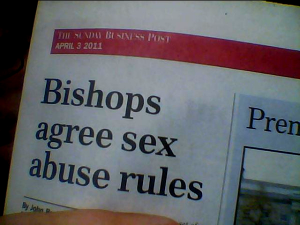
From LanguageLog.
by Henry Farrell on April 8, 2011
Both recommended:
First: Kevin O’Rourke’s more general take (PDF) on the trilemmas facing the eurozone.
bq. What we have seen instead is a series of ineffectual moves on financial regulation, and now a complete unwillingness to confront the European banking crisis head-‐on. Rather than promoting pan-‐European growth strategies, the institutions of the Union have been enthusiastically promoting pro-‐cyclical fiscal adjustments in the periphery, even as they insist that heavily indebted governments repay private creditors of private banks in full. Not only is the policy incoherent, making sovereign default more likely on the one hand, while preaching austerity on the other; the insistence that taxpayers rather than investors pay for bank losses is also setting the stage for a potentially very damaging confrontation between core and periphery taxpayers. The political consequences of this are unknowable, but in Ireland, just three months after the troika’s intervention, the political party that had been dominant since the 1930s was annihilated at the polls, with the radical and Eurosceptic Sinn Féin now sniffing at its heels: and this in one of the most conservative, and Europhile, countries in Europe. What three or four years of the current policy mix will do is anybody’s guess.
The paper is particularly interesting in its focus on the _politics_ of Eurozone governance, which does not get nearly as much attention as it deserves. John Quiggin and I have a piece forthcoming in _Foreign Affairs_ which talks to the medium-term consequences of institutionalized austerity at the European level – O’Rourke’s piece provides a good general take on the same set of issues, as well as discussing topics (class and distributional divides) that we don’t get into. The paper is being presented at INET – there is much other interesting looking material available here.
Second, Kate McNamara’s more topical piece arguing that the European Union needs to take the plunge and become more like a state.
bq. In the eyes of markets and skeptical observers, the European Union is more than an intergovernmental organization but not yet a state. When the European Union bickers and dithers, the markets have no idea what may happen. The euro is the only single currency in history that has not been tightly linked to broader state- and nation-building efforts (often following wars, during which military action required budgeting and taxation). Although the euro is an extraordinary peacetime achievement, it suffers from a lack of supporting political institutions that can make broader macroeconomic policy. The European Union needs to change that and move beyond the structure of its current economic and monetary union — which were seemingly designed for a world in which private and public actors never over-borrow and financial markets never question their ability to repay — to real political and economic cohesion, something international markets would recognize as parallel to a nation state.
As she recognizes (and O’Rourke argues too) there is little enthusiasm among European leaders (let alone publics) to make this jump. This obviously generates normative objections (some perhaps fundamental) as well as practical ones. But equally, it is not at all clear that the European Union can survive as it is, as a kind of ungainly half-way house between an international organization and a genuinely federal system.
by Henry Farrell on April 5, 2011
Mark Blyth has a somewhat different approach to the Greenspan op-ed of last week, which looks to be emerging as the fruit fly genome/Enron email corpus/Zachary’s karate club of theories about post-crisis bogus rationalization.
bq. Rather than deal with the crisis as it happened, or even address what it cost, Greenspan dealt with the crisis on a purely rhetorical level. I mean rhetorical in the sense that Albert Hirschman identified twenty years ago in his fabulous book The Rhetoric of Reaction. (Really, if you haven’t read it, read it now – it’s like a Dan Brown crypex for crisis-newspeak). Hirschman pointed out that conservative arguments come in three distinct theses. First is the “Perversity thesis” where any well meaning reform produces its opposite outcome: ‘welfare makes you poor’ – that sort of thing. The second is the “Jeopardy thesis” where reforms put at risk more than they can ever deliver– the fear of extending the suffrage is typical. Third is the “Futility thesis” where reforms are simply pointless – fill in any and all opposition to global warming. Greenspan begins with a few vignettes concerning Ford’s inability to get a credit rating on an ABS and how the banks will suffer if their ATM card fees are regulated, but he soon hits his stride. I gave him a “Hirschman Scorecard” of four perversities, three jeopardies, and two futilities in one column …These ranged from bemoaning how “consequences cannot be readily anticipated” (Jeopardy), to noting how prop-trading rules will force operations abroad (Futility), and hand waving about complexity regarding “undesirable repercussions that might happen” (Perversity).
The rest is also well worth reading, but quite depressing.
by Henry Farrell on March 30, 2011
Alan Greenspan is back as free market evangelist, and it’s rather wonderful.
Today’s competitive markets, whether we seek to recognise it or not, are driven by an international version of Adam Smith’s “invisible hand” that is unredeemably opaque. With notably rare exceptions (2008, for example), the global “invisible hand” has created relatively stable exchange rates, interest rates, prices, and wage rates.
It’s best not to interpret this as an empirical claim, but a carefully-thought-out bid for Internet immortality. It has the sublime combination of supreme self-confidence and utter cluelessness of previously successful memes such as “I am aware of all Internet traditions” and the “argument that has never been made in such detail or with such care,” but with added Greenspanny goodness. I tried to think of useful variations on the way in to work this morning – “With notably rare exceptions, Russian Roulette is a fun, safe game for all the family to play,” and “With notably rare exceptions, (the Third Punic War for example), the Carthaginian war machine was extremely successful,” but none do proper justice to the magnificence of the original. But then, that’s why we have commenters. Have at it.
by Henry Farrell on March 26, 2011
More here. In an ideal world, she would have had the recognition that J.K. Rowling has gotten and more; still, she did quite well, and wrote books that were adored by many, many children, and by adults (such as myself) who bought them purportedly to read aloud for their offspring. Her _Tough Guide to Fantasyland_, in its original and updated edition, is a very funny and accurate guide to the cliches of the genre.
by Henry Farrell on March 25, 2011
Via Alex Tabarrok, this Wall Street Journal article is very interesting.
bq. Some U.S. furniture makers and their lawyers have found a reliable way to extract cash from Chinese competitors deemed by U.S. officials to have “dumped” their products in the U.S., selling them at unfairly low prices. Each year since 2006, they have asked the Commerce Department to review the U.S. duties paid by Chinese manufacturers on imports of wooden bedroom furniture. Many Chinese firms, fearing a steep rise in duties, agreed within months each time to pay cash to their U.S. competitors in return for being removed from the review list. “Everybody in the industry in the U.S. and China understands that these payments are clever shakedowns,” said William Silverman, a lawyer representing U.S. furniture retailers, big importers of Chinese products, at an October hearing of the U.S. International Trade Commission. … About $13 million was paid to a group of 20 U.S. furniture makers from 2006 through 2009, according to a November ITC report. The U.S. firms told the ITC that a much larger, but unspecified, amount of money went to pay the U.S. firms’ lawyers.
Not many people realize how much of US trade policy is effectively set by private industry groups, whose interest in free trade, for better or worse, is largely opportunistic. This is especially obvious in the area of property rights. I recently finished reading an excellent report edited by Joe Karaganis on the politics of the piracy debate, which has a good chapter on just this topic by Sean Flynn and Karaganis [click to continue…]
by Henry Farrell on March 23, 2011
They close tomorrow. I’m not eligible to vote, but if I was, I’d be nominating the following.
* Felix Gilman – The Half-Made World. See here for my thoughts, and here for Cosma Shalizi’s.
* Ian McDonald – The Dervish House. Very good and interesting near-future book on Turkey – blending together historical conspiracy, complexity theory, theories of religious experience and politics. It somehow works. “True wisdom leaks from the joins between disciplines.”
* China Mieville – Kraken. Not his most intellectually challenging book, and a little bit baggy, but enormous fun.
I’d also recommend Francis Spufford’s Red Plenty (which has surely _already_ won the Hugo in the alternate reality that spun off when _Gravity’s Rainbow_ won the award in 1973 (ok – it was the Nebula – but Artistic Licence!)), but I would prefer to wait on that recommendation until its US publication (sometime this year, I think). I also enjoyed Hannu Rajaniemi’s _The Quantum Thief_ (which also gets published in the US this year), but not as much as many others – the intellectual pyrotechnics are dazzling, but it’s still a fairly straightforward caper novel underneath it all. Feel free to add others, agree/disagree etc in comments.
by Henry Farrell on March 20, 2011
Conor Foley has kindly agreed to come back to write about the Libya intervention, international law, and topics related thereto. He has blogged on these topics before, and I recommend again his excellent book on the topic, The Thin Blue Line: How Humanitarianism Went to War. We’re really happy to have him back with us for a bit.
by Henry Farrell on March 17, 2011
Ryan Avent and Matt Yglesias ponder whether the degree of disagreement among economists is exaggerated in public debate. The classic statement of this argument, of course, is Alan Blinder’s dictum in Hard Heads, Soft Hearts that:
Economists have the least influence on policy where they know the most and are most agreed; they have the most influence on policy where they know the least and disagree most.
But ever since reading this argument, I’ve wondered whether it was quite right. Blinder’s observation helps explain a readily observable empirical correlation between (a) disagreement among economists and (b) apparent prominence of economists’ arguments in public debate. But _prominence_ is not the same thing as _influence_ – and I can’t help wondering whether the causation goes the other way, so that economists are only middling influential at most when they disagree. Consider the following model (for _extremely_ casual senses of the term ‘model’). [click to continue…]
by Henry Farrell on March 16, 2011
by Henry Farrell on March 9, 2011
Niamh Hardiman, who has been blogging for us and off, has very kindly agreed to come on board as a permanent member of CT. She is a senior lecturer at University College Dublin (where both Maria and I did our degrees), working on a variety of issues in European and Irish political economy. We’re really happy to have her join us.
by Henry Farrell on March 9, 2011
The great “what will we do when the machines take over” debate continues, but surprisingly little attention has been paid to the arguments of licensed speculative economists science fiction writers, who have been engaged in this debate for some decades at least. The Bertram/Cohen thesis receives considerable support from Iain Banks’ repeated modeling exercises with slight parameter variations, which find that the advent of true artificial intelligence will free human beings to spend their time playing complicated games, throwing parties, engaged in various forms of cultural activity (more or less refined), and having lots and lots of highly varied sex. With respect to the last, it must be acknowledged that extensively tweaked physiologies and easy gender switching are important confounding factors.
But it isn’t the only such intellectual exercise out there. Walter Jon William’s Green Leopard Hypothesis (update: downloadable in various formats here – thanks to James Haughton in comments) suggests, along the lines of the Cowen/DeLong/Krugman argument, that a technological fix for material deprivation will lead to widespread inequality and indeed tyranny, unless there be root and branch reform to political economy. But perhaps the most ingenious formulation is the oldest – Frederik Pohl’s Midas Plague Equilibrium under which robots produce consumer goods so cheaply that they flood society, and lead the government to introduce consumption quotas, under which the proles are obliged to consume extravagant amounts so as to use the goods up (the technocrats fear that any effort to tinker to the system will risk reverting to the old order of generalized scarcity). This is a world of conspicuous non-consumption in which the more elevated one’s social position the less possessions one is obliged to have. Crisis is averted when the hero realizes that robots can be adjusted so that they want to consume too, hence easing the burden. One could base an entire political economy seminar around Pohl’s satirical stories of the 1950’s and 1960’s – he was (and indeed arguably still is, since he is still alive and active ) the J.K. Galbraith of the pulps. If, that is, J.K. Galbraith had been a Trotskyist. I’m sure that there are other sfnal takes on this topic that I’m unaware of – nominations?
by Henry Farrell on March 7, 2011
Over the last few months, Sean Aday, Marc Lynch, John Sides and I have been talking a lot (and organizing a project with the US Institute of Peace) on the relationship between social media and civic unrest in non-democratic societies. Obviously, this has recently become a salient topic of debate. Clay Shirky, who has guestblogged with us before, and who was at a meeting that we organized in Stanford the week before last along with a number of other very smart people, has a post talking to some of these issues that I am just about to put up. I’m hoping that this can help get some interesting debate started.


