Posts by author:

Henry

Markets in Everything: Political Deniability Edition

by Henry Farrell on July 7, 2010

The Washington Monthly‘s piece on the US Chamber of Commerce has a killer quote.

bq. It also established a branch of a front group, the Campaign for Responsible Health Reform, and hired a Little Rock Republican strategist to run it. The strategist, Bill Vickery, told me that his activities were “backed solely” by the Chamber. In other words, a large part of what the Chamber sells is political cover. For multibillion-dollar insurers, drug makers, and medical device manufacturers who are too smart and image conscious to make public attacks of their own, the Chamber of Commerce is a friend who will do the dirty work. “I want to give them all the deniability they need,” says [US Chamber of Commerce President and CEO] Donohue. That deniability is evidently worth a lot. According to a January article in the National Journal, six insurers alone—Aetna, Cigna, Humana, Kaiser Foundation Health Plans, UnitedHealth Group, and Wellpoint—pumped up to $20 million into the Chamber last year.

It’s a very good piece on the Chamber’s business model and how Donahue in particular benefits from it.

Center for Ethics: Update

by Henry Farrell on July 7, 2010

I’ve received the below from my former colleague, Joe Carens, responding to the boilerplate letter that has been sent to anyone who has written to University of Toronto officials deploring the proposed closure of the Center for Ethics.

————————————————-

I want to respond briefly to the standard letter that the Provost, Cheryl Misak, is sending to those who write in support of the Centre for Ethics at the University of Toronto. Her letter was posted previously on this blog. Cheryl is an eminent philosopher and a friend, but I think that her communication on this issue is misleading. One gets the impression from Cheryl’s letter that the Centre for Ethics had been expected to raise funds to sustain its activities and failed to do so, and also that the closure of the Centre is a regrettable necessity due to the financial crisis within the university. Neither is accurate.

The Centre was created five years ago under a university initiative to spark innovation. It was one of a few projects to which the university committed base funding, not “seed” money. It was always the plan that the Centre should raise major endowment over the long term, but the previous Dean who approved the Centre agreed that it would not be expected to do this in the first five years. The Centre has been very successful in raising funds for particular projects.

In the current climate, it may be necessary (if regrettable) for the University to close research centres that cannot pay for themselves, but it seems unreasonable to do so out of the blue, especially with one that has been as successful as the Ethics Centre at doing what it was previously asked to do. It would be far more reasonable to continue to support the Centre with university funding for a few years, perhaps at a reduced level, while expecting it to raise endowment or face closure.

Reading Cheryl’s letter you might think that the University of Toronto cannot afford even this temporary reprieve. I agree that the budget crisis is serious. There is a $50 million deficit in the Faculty of Arts and Science that has to be eliminated. However, the Dean is not proposing to save the Centre’s $308,000 budget. Rather he is proposing to redeploy much or all of it.

The University of Toronto faces a choice about how to use the “significant resources” that it plans to devote “to support the research and teaching of ethics” to use Cheryl’s words. We could, on the one hand, spend those resources to preserve an already existing and thriving research centre, recognized as one of the three or four best in the world in the area of ethics, or we could, on the other hand, spend those resources on whatever “ethics-based educational initiatives” are eventually proposed by the committee that the Dean plans to construct. The Dean does face some hard decisions in balancing his budget but this should not be one of them.

Joe Carens
University of Toronto

Center for Ethics

by Henry Farrell on July 6, 2010

The University of Toronto’s Faculty of Arts and Sciences has decided to close down its Center for Ethics for budgetary reasons. This is a _really_ terrible decision. I spent two very happy years at U of T. When I was there, the university had superb faculties in political theory, philosophy and legal theory, but had difficulty in building bridges between them (the university, for a variety of historical and organizational reasons, is quite decentralized). The Center for Ethics opened shortly after I left – I’ve been following its work ever since. It has brought these faculties together and built a genuinely world class institution. I know that other universities view University of Toronto’s Center for Ethics as a model to be emulated. Now, the U of T is proposing to junk it summarily, for entirely short sighted reasons.

If this goes ahead, I can’t help but think that it’s going to seriously hurt the University’s international reputation. When universities face tough budgetary times, they have to make hard decisions. But they should not gut their core strengths and competences. It is indisputable to anyone in the field (and to sympathetic outside observers to me), that the Center gives a body and an organized presence to one of the University’s most important areas of strength. Below the fold, I have a letter that I’m sending to the relevant university officials (President David Naylor [david.naylor@utoronto.ca], Provost Cheryl Misak [cheryl.misak@utoronto.ca], Dean Meric Gertler [meric.gertler@utoronto.ca]). I suggest that other people who are disturbed by this write letters to these officials too (be polite but clear). There’s also a Facebook protest group here, which has gathered nearly 450 members in less than 24 hours.
[click to continue…]

Nothing succeeds like success

by Henry Farrell on July 6, 2010

The discussion in the comments section to my last post has turned to the old disagreement over the respective contributions of innate quality (however you want to try to measure it) and external circumstances to economic ‘success.’ Matthew Salganik and Duncan Watt’s research on cultural markets provides some very interesting insights into this question. This paper is the best overall survey of their findings that I know of. What they do is to set up a set of discrete artificial cultural markets, in which large numbers of experimental subjects listen to pop music, and rate it for whether they like it or not. All of these markets have the same music. Most of them have an effective recommendation system (in which subjects can see which are the more popular, and which the less popular tunes); two do not provide this information. Subjects are randomly assigned to different markets.
[click to continue…]

The Lies of the Creative Class

by Henry Farrell on July 4, 2010

Evidence that history happens the first time as a Doug Henwood book and the second time as farce.

“the only way to keep your job nowadays is to constantly re-invent it”

This rather sad article in the New York Times about long-term, middle class unemployment got me thinking…

Got me thinking about the cartoon above, in fact.

Any long-time blogger knows this: The only way to keep people reading your blog is by “Constant Re-Invention”. Keep on finding new things to talk about. Keep on DOING and CREATING new things worth talking about.

i.e. Creativity. Yes. That. Exactly.

And what has always been true for bloggers is now true for anyone hoping to live above the basic subsistence level.

The only way to keep your job nowadays is to constantly re-invent it.

Again, Creativity.

And that’s your responsibility, not your boss’. If your boss won’t let you do that, then quit. Right now. Do something else. It’s your move. Nobody else’s. Sorry.

It isn’t rocket science. But sadly, it’s something far too few of us ever think really hard about.

Formatting preserved from the original, which you should read if only to see the sorry-ass cartoon that it is based around. Although the offensiveness of the post is partially mitigated by the stink of desperation that wafts through despite the author’s best efforts. If this post had an XKCD mouseover it would be something like ‘oh god, please. maybe if I can just somehow be creative enough, I’ll make it through while the rest of the fuckers drown. please. god. please.’

On Tight Deadline

by Henry Farrell on June 29, 2010

trying to get a policy piece on the Europe mess finished, but if I was blogging, I’d be blogging on the following:

(1) Eric Rauchway’s ‘Tom Buchanan’s Schooldays’ follow-up, _Banana Republican_ is out ( Amazon, Powells). The publisher asked me to blurb it, but then never used the blurb (on account of I’s not famous, I suspect) – what I said was:

Harry Flashman VC – make room for Tom Buchanan. Eric Rauchway’s anti-hero is more caddish, more craven and more enjoyably despicable than his English predecessor as he swaggers and bluffs his way through the seedier parts of the American Imperium. Enormously entertaining.

(2) A Fine Theory on Debreu and how to think about economic models (via Cosma’s delicious feed ).

bq. The problem lies at the heart of the difference between social science and mathematics. In an axiomatic mathematical system, the axioms are by assumption true – there is no sense in which an axiom can be false, since it is merely an abstract statement used to derive implications. … Social science is not this way. We know, pace the arguments of Lionel Robbins, that our assumptions are false, though we hope that they are in some sense “good enough” to derive implications … If axioms are only approximate, though, as in the standard Humean problem of induction, we have no way of knowing whether conclusions will also be approximate; there is no “universal continuity”. I think economists would be better served to think of axiomatization as the formalization of analogies. That is, an axiomatic deduction when axioms are imprecise may tell us nothing about the real world, but it tells us as much as a qualitative analogy, and does so in a formal way that deemphasizes the rhetorical ability of the author.

(3) Dan Sperber pwns Frans de Waal.

(4) Teresa Nielsen Hayden on Ireland’s economic problems. “If there’s anything I keep wishing the economic bloggers would explain in terms comprehensible to the general public, it’s that taxes are not the only way that government policies can cost them money. “

Do we really want to know what they were pouring?

by Henry Farrell on June 28, 2010

The FT today (I wonder how long this will stay uncorrected).

Awesome design decisions

by Henry Farrell on June 23, 2010

So my university just got me a replacement Dell printer for my office desktop, which is a Mac. When I went to Dell’s site to download it, I found that they have the necessary .dmg files readily available – compressed as an .exe file. Looks as though this has been an issue for quite a while. You might think that someone at Dell would know that Macs can’t read .exe files. You might think it. Still, this doesn’t match my personal-nominee-for-worst-software-design-decision-of-all-time – the wonderful Windows XP tool you had to use to log laptops onto ‘secure’ wireless networks. This asked you to enter in the secure key in a masked text box, so you couldn’t see what you were typing – which is annoying, but in principle justifiable for security reasons. Then, it asked you to enter it in _again_, as far as I can make out, for no logical reason whatsoever that I could make out, and booted you back to the beginning of the process if the two passwords didn’t match. When you have long randomly generated passwords (as you should), there is a not insignificant chance that you are going to type it in incorrectly. Being forced to type it in twice doubles this chance for no apparent gain.

While I’m on a roll, I’m also peeved at Google’s recent decision to randomly challenge you to enter in your password again every couple of days, even if you are already logged in – since I use a long randomly generated password that is impossible to memorize, this usually involves a couple of minutes of searching for the password while swearing profusely. So that’s my life at the moment – how’s yours?

Steven Laniel

Back when I was in college (Carnegie Mellon class of 2000), a friend who was attending the University of Chicago gave me a placard that was posted hither and thither on Chicago’s South Side: a dorky-faced guy with a ridiculously toothy grin smiling out at us. It read

“Barack Obama

for state senate”

My buddy Josh and I thought this was hilarious. Over the years, we turned the guy on the placard into a superhero. We’d be studying for one hard exam or another and would say to one another, “You know who could ace the piss out of this test right now?” The other would respond, “Barack Obama!” to which the first would respond, inevitably, “…for state senate!” Or we’d be at the gym: “Man, these weights are tough! … Know who could lift them without breaking a sweat?” “Barack Obama!” “…for state senate!“

The years go by. It’s 2004. There’s a dude up on the stage at the Democratic National Convention who’s making everyone ask, “Why do I have to vote for Kerry? Why can’t I vote for this guy?” Josh and I called one another: “Uh … dude, do you see who’s on stage right now?” It was surreal.

It’s still surreal. Every few months it occurs to me afresh that Josh and I were making this obscure local politician the punchline of a joke probably a decade before he became president of the United States. Bizarre.

Market Liberalism against Democracy

by Henry Farrell on June 22, 2010

Charlemagne writes about European Commission officials.

bq. I would not be astonished if a majority of the [British] public assume that EU officials are primarily motivated by pay, perks and privileges. Actually, from Mr Farage’s point of view, I suspect the truth is still more worrying. EU officials, in my experience, want “more Europe” because they want “more Europe”. … EU officials live in a world in which nationalism is the great evil. … They are often highly educated, in a geeky sort of way … The town’s defining ethos of anti-nationalism is often admirable. EU officials are easy to get on with, and a decent bunch in my experience. But it brings problems: I find a lot of people in this town at best naive about how much integration public opinion will accept, and at worst a bit hostile to democracy. Get a Brussels dinner party onto referendums, and hear people rave about the madness of asking ordinary people their opinions of the European project.

I found this pretty interesting because I was thinking about writing a piece last week about how Charlemagne himself represents a political tendency that is “a bit hostile to democracy.” The occasion of this critique was his linking to a piece that he wrote under his own name before he worked for the _Economist_ which is all about how one _needs_ to have restraints on national level democracies for the European project to work.
[click to continue…]

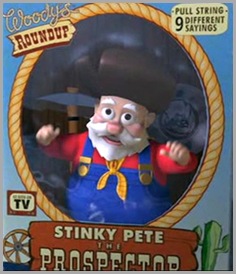
Stinky Pete as Existential Hero

by Henry Farrell on June 21, 2010

Haven’t seen the new one yet (it will be the four year old’s first movie in the theatre, so we are trying to figure out a family expedition, so that everyone can enjoy him enjoying it), but its arrival reminds me that I’ve been meaning for ages to post on how _Toy Story 2_ maps out the major themes of Ishiguro’s _Never Let Me Go._ They both are driven by the same basic idea – of highly intelligent, potentially autonomous creatures who define their happiness entirely in terms of the happiness of others. In _Never Let Me Go_, this makes the (liberal) reader quite queasy. In _Toy Story 2_, this is treated as an entirely happy and natural state of affairs. Perhaps it shouldn’t be – and that so many people take the social relations in _Toy Story 2_ for granted, suggests that NLMG‘s clones’ acceptance of (and even joy in) their status is less socially unrealistic than some of its critics think.

There’s an article to be written on this (perhaps taking Gene Wolfe’s chilly little short story, The War Beneath the Tree in along the way. In the meantime, from this perspective, Stinky Pete is perhaps the only character in _Toy Story 2_ who is genuinely free, even if he _is_ stuck in a box for most of the movie.

Update: Tom Houseman has similar thoughts.

Corrupt academia

by Henry Farrell on June 18, 2010

Via Trudy Lieberman at _Columbia Journalism Review,_ an excellent story on the dubious linkages between medical academia and drug companies.

bq. Richard Page thinks Multaq is an excellent new drug for treating atrial fibrillation, a type of irregular heartbeat that affects more than 2 million Americans. And Page, chairman of the department of medicine at the University of Wisconsin School of Medicine and Public Health, should know. He co-authored a large, international study that led to the drug’s approval by the Food and Drug Administration last year, a move that could mean hundreds of millions in sales for Sanofi-Aventis, the company that makes the drug. But in putting his name on the influential paper, Page allowed Sanofi-Aventis to dictate the terms. He vouched for the accuracy and completeness of the study despite not seeing the raw data. The company, which paid for the study, collected that information and performed the analysis without an external audit for accuracy or completeness. Page says it comes down to trusting the drug company. “These companies, if they were falsifying data, wouldn’t be kept in business if that were found out,” he said. “I was satisfied and remain satisfied that the study was conducted in an appropriate way.” … In the Multaq case, Page and all six co-authors had financial ties to Sanofi-Aventis at the time of the study. Two authors worked for the company and owned its stock. Page and the four other authors moonlighted as consultants or speakers.

Genteelly corrupt relationships are a really big problem for medical research. The Boston Review has an excellent forum on this broad topic up on their website, including a quite preposterous defense by Thomas P. Stossel of medical-industry research ties against _any_ suggestion that formal standards, requirements of transparency etc might be helpful.

McLemee on Veeser on Said

by Henry Farrell on June 18, 2010

Here

bq. And so, two or three generations of young radical intellectuals have now had the pleasure of discovering that they are ever so much more radical than Edward Said. It must be very pleasant for them, but none of them has yet amounted to a replacement. With H. Aram Veeser’s _Edward Said: The Charisma of Criticism,_ we have a different sort of Oedipal drama on display. The stakes are less political than personal. It is an insightful book, but also a strange one, charged with an ambivalence towards its subject that is perhaps as intense as Said’s toward the works he discussed in _Orientalism_ or _Culture and Imperialism._

Envisioning unreal utopias

by Henry Farrell on June 17, 2010

John Gray on the disappearance of utopian dreams of social reform in science fiction here. His taste in SF is excellent and he has several good lines.

bq. The role of science has been to gauge the limits of the species, with new technologies and extra-planetary environments being used as virtual laboratories for an ongoing thought experiment. If the mainstream novel employs the lens of the commonplace career – birth and education, marriage and divorce, ambition and failure – SF has pursued the inquiry by abducting the human animal and placing it in alien environments.

is particularly nice. It captures real (if not universal) differences without fetishizing the one as better than the other.

However, the main argument seems to me to say more about John Gray than it does about the genre he is writing about. [click to continue…]

Habermas and Europe

by Henry Farrell on June 14, 2010

According to Kenneth Anderson

bq. It is impossible within Habermas’ account — faithfully reflecting German and European history — to disentangle patriotism from nationalism, a fundamental difference of political experience that is one of the chief reasons why American intellectual elite attempts to ape their presumed European betters are so far-fetched, ill-suited, and ultimately ugly.

A very considerable part of Habermas’ intellectual project over the last few years has been _exactly_ to come up with a form of patriotism which is distinct from nationalism. Habermas dubs this “constitutional patriotism” – and while it is not intended to overcome existing forms of nationalism, it is intended to temper them, and to make them non-exclusive. As it happens, one of the sources that Habermas draws on for this is US constitutional politics (he is also interested in the Swiss model). I suspect Anderson hasn’t actually read much Habermas, or he wouldn’t be mischaracterizing Habermas’ work so badly in a failed effort to score a cheap debating point against ‘American intellectual elites.’ It is entirely possible that Habermas’ ideas won’t work – but it is emphatically clear that Habermas _does_ disentangle patriotism and nationalism from each other as intellectual concepts, and that this distinction is at the heart of the broader project on which this essay draws. You might expect someone making grand claims about European intellectuals and their slavish American sycophants to actually know this. You’d be wrong.

This said, I don’t actually agree with Habermas here. Partly this is because I am a pragmatist rather than an idealist. But also, in large part, because I’m pretty skeptical about the potential for deliberative exchange to produce wide-reaching political agreement. Habermas seems to be hankering for a political party (and associated deliberative process) that would lead people to reach a consensus that we are all Europeans now.

bq. Our lame political elites, who prefer to read the headlines in the tabloids, must not use as an excuse that the populations are the obstacle to a deeper European unification. For they know best that popular opinion established by opinion polls is not the same thing as the outcome of a public deliberative process leading to the formation of a democratic will. To date there has not been a single European election or referendum in any country that wasn’t ultimately about national issues and tickets. We are still waiting for a single political party to undertake a constructive campaign to inform public opinion, to say nothing of the blinkered nationalistic vision of the left (by which I do not just mean the German party The Left).

I just don’t think that this is how democratic politics works – or should work. Democracy is about contention rather than reaching a happy-clappy consensus. My best guess (which is to say that I _think_ this is right, but to make a plausible case I would have to make serious arguments rather than just wave my hands around) is that the moment when (if) an actual European polity will be created, will not be the moment when European publics, led by their elites, realize that they are actually Europeans. It will be the moment at which self-interested political parties, rather than arguing and picking petty squabbles about whether ‘we’ should all be Europeans or not, start arguing and picking petty squabbles about what _kind_ of Europeans ‘we’ should be. In other words, Europe is never going to work as a broad consensus underpinned by processes of debate leading to the construction of a ‘democratic will.’ But it might possibly work as a space for faction, conflict and infighting – just the way that national processes work. How you get to this point, I don’t know. But I don’t think deliberation will have much to do with it.

Update: Kenneth Anderson updates his post to respond. I’m happy to withdraw the suggestion that he hasn’t read much Habermas and to apologize for it. I read his text as saying that Habermas couldn’t make any distinction between patriotism rather than that Anderson found his distinction unsatisfactory – but I should have refrained from the snark. That said, I still don’t think that the comment does justice to Habermas here (and I write this as someone who doesn’t buy into the Habermasian project). There is a quite clear and intellectually sustainable difference between constitutional patriotism as Habermas conceives of it and nationalism. It may very likely be that constitutional patriotism is too weak a reed to build a thick political identity around. But that seems to me to be a different question to whether one can sustain a difference between nationalism and patriotism in Habermas’ thought at all.