by Henry Farrell on November 2, 2007
Brad DeLong on What to Do With the Republican Party.
I find myself much less optimistic about the future of the Republican Party than Mark Schmitt. … There are, in general, three ways to compete for the majority of the vote … 3. To convince a majority that they are threatened by vicious and deadly enemies–and that the other party is, at some level, in league with those enemies … Starting early in the twentieth century, however the Republican Party has been increasingly pursuing the third: excoriating immigrants, Catholics,” that communist Roosevelt,” Russian spies in the State Department, appeasers and other advocates of “better red than dead,” rootless cosmopolitans, advocates of “peaceful coexistence” and other graduates of Dean Acheson’s Cowardly College of Containment, uppity Negroes, Hollywood, liberal socialists who want to control your life, the nattering nabobs of negativism in the press, Mexicans, muslims, homosexuals, China, atheists. … Four generations of Republican political activists have now been trained in the art of busying giddy minds with foreign (and domestic) enemies. … It’s time to do to the Republican Party what the Republicans did to the whigs: raze the structure and start over.
There are two questions here. First, the pragmatic – might the US be ready in the near future (by which I mean the next 10-15 years or so) for another major realignment in its party system, that might replace a Republican party that is increasingly dominated by torture-porn-loving all-war-all-the-time lunatics with a new (and hopefully sane) right-of-center political party? Second, the speculative – if there were such a realignment, what would the new party look like? A party dominated by moderate north-easterners (perhaps drawing in some conservative Democrats)? Some American variant of Christian Democracy, mixing social conservatism with a commitment to some kind of welfare state (Michael Gerson has been touting internal reforms of the Republican coalition along these lines, but _contra_ Ross Douthat there are stark differences between European Christian Democracy and the Republican notion of faith based politics)? A party based on some kind of soft libertarianism? Or some (to me hard to imagine) synthesis between some of these strains? The floor is open (I’ll ask our lefty commenters in particular to try to refrain as much as they can from rude criticisms of the current crew, which we can take as stipulated, and to try to stick to the above questions as much as possible).
by Henry Farrell on November 1, 2007
We’ll be doing a seminar on Dani Rodrik’s new book _One Economics, Many Recipes_ in the nearish future. Originally, the seminar was going to go upshortly after the book’s launch, but the book got out into the stores earlier than originally planned. Those who have an interest in buying the book so as better to follow the discussion can do so at Powells or Amazon.
by Henry Farrell on November 1, 2007
This FT article from Eoin Callan on private equity and hedge fund managers’ efforts to fight off taxes on deferred interests has a weird undertone to it. First of all, this:
House Democrats are determined to move ahead with new taxes, so the industry has concentrated its efforts on blocking threatened legislation in the Senate, courting influential figures such as Harry Reid, majority leader. Mr Reid was toasted by industry lobbyists recently at a party held at the luxurious Bellagio Hotel in Las Vegas. The event was billed as a moneyraiser for his special fund to get more Democrats elected – with generous donations suggested – and ended with a serenade by singer Barry Manilow. After the event, Mr Reid’s office indicated that the Senate leader continued to think it unlikely a bill to increase tax on carried interest would be passed before the end of this session. Lobbyists were anxious not to appear too gleeful.
So far, so run of the mill Democrats-showing-that-they-too-can-ramp-up-the-sleaze-to-11. But this is where it gets strange:
But while winning new friends, the industry is also gaining a reputation for making enemies that might haunt them as the political fight drags on. “These guys are not playing it well. They have hired too many people too quickly,” a senior Democratic tax staffer said. An industry lobbyist said: “A lot of good people are being hired, but some bozos too. They are trying to throw too much weight around but it is going to backfire.
“It is getting nasty: below the belt stuff; delving into people’s personal lives; crossing lines,” added the lobbyist, who was critical of colleagues but reluctant to repeat publicly allegations being made privately about lawmakers and congressional staff. People close to industry lobby groups such as the Private Equity Council and the Managed Funds Association are adamant they are not to blame for any sharp elbows thrown on Capitol Hill. Privately they tend to blame each other for black eyes to the industry’s reputation.
I may be wrong here, but it seems to me that Callan (who is an excellent and careful journalist, as best as I can tell from his previous articles) is suggesting that hedge fund lobbyists are blackmailing politicians and their aides over their personal lives, or doing the next best thing to it. Is there another plausible explanation that I’m missing here?
by Henry Farrell on October 31, 2007
Brad DeLong has a review of James Scott’s _Seeing Like a State_ which I found pretty useful in clarifying some of my disagreements with him (Brad, not Scott). What he sees as a fundamental problem in Scott (that Scott is a Hayekian in denial, and that his denial of his intellectual heritage leads him erroneously to claim that markets are harmful to human freedom) I see as pointing to an important, but underplayed set of themes in Scott’s argument. Which is to say that I would have liked Scott to develop the reasons why he disagrees with Hayek more explicitly, but I think that they are clearly present in the book, and are in some respects at least, compelling. [click to continue…]
by Henry Farrell on October 30, 2007
The brouhaha over freedom of speech below reminds me that I never got around to blogging about Bruce Barry’s very interesting book _Speechless:The Erosion of Free Expression in the American Workplace_ (Powells, Amazon) which I read over the summer. I was sent it as a freebie because it has a chapter about blogging in the workplace, but found that I was grabbed by the general discussion of how few rights Americans have at the workplace. This is something that I had known in a general sort of way but hadn’t experienced personally (academics, at least tenure-track academics in good institutions, typically have it a lot better than most), and that was really brought home by Barry’s extended arguments and plethora of real-life illustrations. The book starts by discussing the experience of Lynne Gobbel, an Alabama factory worker.
Gobbel had a John Kerry bumper sticker. Her boss informed her that the owner of the factory, Phil Geddes, had demanded that she remove the sticker or be fired; he also told her “you could either work for him or John Kerry.” Geddes had on a previous occasion inserted a flyer in employee paycheck envelopes pointing out the positive effects that Bush’s policies as president were having on them. “It upset me and made me mad,” said Gobbel, “that he could put a letter in my check expressing his political opinion, but I can’t put something on my car expressing mine.”
[click to continue…]
by Henry Farrell on October 29, 2007
AMERICANS FLEE NATIONAL HEALTH CARE SYSTEM: The Daily Ezra Klein reports:
Record numbers of Americans are travelling abroad for medical treatment to escape the American healthcare system – with 100,000 patients expected to fly out this year _for cosmetic surgery alone_, more than the sum total of “Britons seeking any type of services in foreign lands.” And by the end of the decade 200,000 American “health tourists” will fly to one hospital in Thailand alone on current trends to avoid extortionate costs, according to a new report.
_und so weiter_.
For original, see here.
by Henry Farrell on October 27, 2007
Republican Internet consultant Patrick Ruffini points to this fascinating resource for figuring out the raw numbers of liberal, moderate and conservative Facebook users interested in a specific issue. Don’t try to create a flyer or whatever – just go to the “targetting” section, type the topic that you are interested in into the keywords section, and see how the numbers change whether you click Liberal, Moderate and Conservative (there’s further microtargeting of cities etc available too). For example, about 2,520 self-declared liberal Facebook users declare blogging as one of their interests, as opposed to 1,320 moderates and 1,100 conservatives. 5,180 liberals show the good taste to declare My Bloody Valentine as one of their favourite bands, as opposed to 1,120 moderates, and only 340 conservatives. Less obviously, the number of liberals (7,300) and conservatives (7,580) who like bluegrass music is about the same1. Obviously, treat these numbers with extreme caution; there is _no way_ that Facebook users are a random sample of the population 2, but still, this promises much idle entertainment.
1 It occurs to me on re-reading this post that I’ve phrased this in a misleading way – obviously, if you wanted to make a serious point about this, you’d weight the absolute numbers or provide the odds ratios or whatever.
2 For one, the liberal-conservative ratio is skewed to liberals among Facebook users as compared to the ratio in the general population – there are just over 2.8 million self-identified liberal Facebook users and 2.18 million conservatives. Most survey evidence that I am aware of suggests that there are considerably more self-identified conservative Americans than liberal Americans (although the numbers of self-identified conservatives is dropping).
by Henry Farrell on October 26, 2007
Andrew Gelman and his co-authors build on results from a recent paper to draw some fascinating maps of what the 2004 presidential elections would have looked like if only (1) poor, (2) middle income, or (3) rich people had been able to vote.

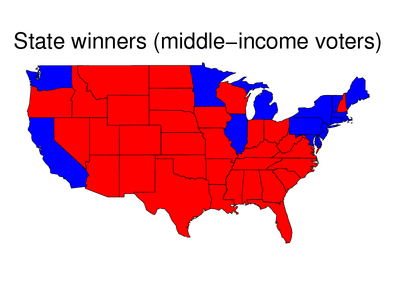
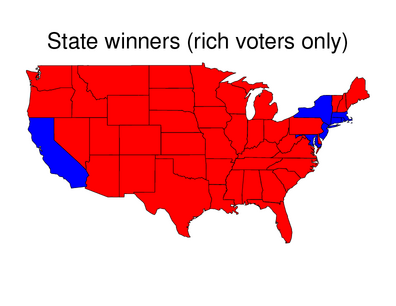
These maps show some obvious class differences (as well as illustrating the importance of poor voters to Democratic electoral prospects), but also suggest (as does the paper) some interesting relationships between how people at different income levels vote in rich and poor states.
For poor voters, there is no systematic difference between rich and poor states. But for middle-income and especially for rich voters, there is a very strong pattern of rich states supporting the Democrats and poor states supporting the Republicans.
In short, rich people and poor people who live in poor states have very different voting preferences from each other. Rich people and poor people who live in rich states have much more similar voting preferences. Gelman et al. don’t have any hard and fast explanation for this (they note that race explains about half of this disparity, but only half). However, their results do suggest that some of the conventional wisdom of American journalists on class, voting and geographic location stands in sore need of revisiting.
by Henry Farrell on October 26, 2007
Like Chris, I want to object to Andrew Sullivan’s post – but my objection is narrower. _What does he mean_ by insinuating that “at last” we’re “honest about the true agenda of the left”?? We let slip our hidden agenda of creating “a tyranny where Crooked Timber and the benign left will call the shots and enforce their orthodoxy” _years ago._ Not only that, but our nefarious plans have previously received widespread public attention. Andrew’s dire prognostications were _anticipated in their entirety_ in 2004 by “Mr. Nick Morgan Mr. Andy Duncan, commentator-at-large at catallarchy.net who not only pointed out that “What John Quiggin desires is Orwellian Newspeak, with Mr Quiggin and his friends at Crooked Timber being the Inner Party deciding the rules,” but sagaciously remarked that “Hell on Earth would be a World Government run by Crooked Timber.” You can’t say that you haven’t been warned. Repeatedly.
by Henry Farrell on October 25, 2007
China Mieville, a man who certainly knows his political pelagic communities, takes to the pages of _In These Times_ to fault floating libertarian utopias for _not being crazy enough_. Much unfair fun ensues,
However, one senses in even their supporters’ literature a dissatisfaction with these attempts that has nothing to do with their abject failure. It is also psycho-geographical: There is something about the atolls, mounts, reefs and miniature islets on which these pioneers have attempted to perch that insults their dignity. A parable from seasteading’s past goes some way in explaining. In 1971, millionaire property developer Michael Oliver attempted to establish the Republic of Minerva on a small South Pacific sand atoll. It was soon off-handedly annexed by Tonga, and, in a traumatic actualized metaphor, allowed to dissolve back into the sea. To defeat the predatory outreach of nations and tides, it is clearly not enough to be offshore: True freedom floats.
Via 3 Quarks Daily. Bonus points for anyone who figures out the obscure pun in the title of this post.
by Henry Farrell on October 23, 2007
I’ve been running my political science weblog for the last few months, and it seems to be doing quite well thank you in attracting some attention and readers to political science research. However, because there isn’t any single dominant repository for political science papers on the Internet, I have to look around a bit to find what people are doing – there are bits and pieces on SSRN, on various seminar websites etc etc. I’d be grateful for any suggestions from readers as to good places to find papers in political science, political theory and related disciplines (sociology, political economy). Weekly seminars at your university, working paper depositories, professors with lots of recent stuff on their homepages etc etc all qualify. Either email me, or submit it in comments below (if you do the latter, it has the advantage that other people can read it too). I’d also obviously be grateful for leads on interesting new papers that I haven’t come across but that are available in ungated form somewhere on the Internets. Suggestions for improvements to the site are also gratefully appreciated. It is probably going to be little more than a papers-plus-abstracts-blog until my tenure file is in next year, at which stage I should have a bit more time to develop it (I’ve gotten some suggestions as to how it may be put on a firmer institutional basis in the long run, but this will likely be up in the air for a while).
Finally and most generally, I would really encourage academics (esp. those on the market for the first time, or in the early stages of their career) to work on building a website which has access to their key papers. It’s straightforward to do, and massively increases your visibility to others (you are allowing people who are interested enough in you to look you up to economize on their search costs by downloading and reading papers that sound sort of interesting).
by Henry Farrell on October 22, 2007
by Henry Farrell on October 21, 2007
Andrew Sullivan links briefly to the post below on whether _g_ is a statistical myth, describing it as another expression of the “conventional left-liberal view,” and defending again his decision as editor of _The New Republic_ to publish extracts from _The Bell Curve._ I would have much preferred to have seen a substantive response to the essay by Cosma Shalizi that the post linked to and summarized. I don’t see anything in Cosma’s essay that requires subscription to left-liberal views, conventional or otherwise – instead, I see a (to me entirely convincing) methodological critique of the basis for statistical claims that _g_, the purported general factor for intelligence, exists. To quote Cosma again:
If, after looking at your watch, you say that it’s 12 o’clock, and I point out that your watch has stopped at 12, I am not saying that it’s not 12 o’clock, just that your watch doesn’t actually give you any evidence about the time. Similarly, pointing out that factor analysis and related techniques are unreliable guides to causal structure does not establish the non-existence of a one-dimensional latent variable driving the success of almost all human mental performance. It’s possible that there is such a thing. But the major supposed evidence for it is irrelevant, and it accords very badly with what we actually know about the functioning of the brain and the mind.
If Andrew would like to take issue with something, these are the claims that he needs to be taking issue with. And there’s nothing stopping him, if he has even a moderate grasp of statistical reasoning (Shalizi’s arguments are quite comprehensible to someone with a basic minimum of statistical training, as evidenced by the fact that a gawp like me can reasonably claim to understand them). What Cosma is saying is that the entire body of research on _g_ is demonstrably based on bad statistical reasoning. Nor is it only Cosma who says this. Nor is this a product of political druthers – it clearly flows from a set of methodological claims that are widely accepted among statisticians, and that have many applications outside this particular and highly heated debate. If Andrew wants to show how Cosma’s methodological critique is fundamentally flawed in some way because of left-liberal preconceptions, he really should do so. If not, then all of his claims about “conventional left-liberal view”s and “going to challenge many assumptions of right-thinking liberalism” are by-the-by – they don’t count for anything unless they are actually backed up by, like, methodologically sound science.
by Henry Farrell on October 19, 2007
Myself and the wife have been watching the second series of _Heroes_, which is finally beginning to pick up after a slow start (although the spunky cheerleader needs to lose the drippy boyfriend _immediately_ ). One of the subplots plays out, strangely enough, among the Cork criminal underclass, or at least the show producer’s idea of same. The accents of these purported Corkonian ne’er-do-wells are nothing short of atrocious. Perhaps it’s understandable that there’s nothing at all resembling an actual Cork accent to be found among them; that might be a bit much to inflict on unsuspecting American television viewers. But there’s not much in the way of _Irish_ accents, full stop. One fella who thinks that Irish people speak like Scotsmen with adenoids, another with standard mid-Atlantic intonations, and a British actress who at least seems to have heard Irish people talking once upon a time, even if her ability to imitate them slips in and out of focus. The nadir was reached when one of the actors pronounced “Slainte” as “slah-in-che” on this week’s show (all they needed to do to get this one right was to do a bloody Google search). This is all quite unnecessary – I can testify from a considerable personal acquaintance that unemployed Real Irish Actors with Real Irish Accents are not a commodity in short supply.
That said, the problem goes both ways. We also recently saw the first episode of _Spooks_ (MI5 on this side of the Atlantic), a BBC production, which has an abortion clinic bomber whose purported Southern US accent had to be heard to be believed. My wife didn’t even realize that it was meant to be an American accent until I told her (a later episode’s subplot concerning the vast amounts of WTO cash subsidizing the Russian economy did little to add to my estimate of the show’s commitment to verisimilitude). So anyway, I thought that there might be some entertainment value in a thread on Bad TV/movie Accents that you have heard (and good ones too, if you like; the best Hollywood Irish accent by far that I’ve heard was Brad Pitt in _Snatch_ – it approached a kind of incomprehensible Platonic ideal of dense Midlands guttural).
by Henry Farrell on October 19, 2007
The debate about IQ and race is rearing its ugly head again with James Watson’s charming interview statements about IQ and how while
there was a natural desire that all human beings should be equal …”people who have to deal with black employees find this not true”‘
Thus, this monster post by Cosma Shalizi (a sequel to his earlier piece on heritability), discussing why _g_, the purported general factor of intelligence, is a statistical myth, is well timed, even if (as Cosma notes elsewhere it’s not much more then yet another bloody iteration of the lessons that statisticians have been hammering home again and again for decades, but which don’t seem to have penetrated the public debate.
In primitive societies, or so Malinowski taught, myths serve as the legitimating charters of practices and institutions. Just so here: the myth of _g_ legitimates a vast enterprise of intelligence testing and theorizing. There should be no dispute that, when we lack specialized and valid instruments, general IQ tests can be better than nothing. Claims that they are anything more than such stop-gaps — that they are triumphs of psychological science, illuminating the workings of the mind; keys to the fates of individuals and peoples; sources of harsh truths which only a courageous few have the strength to bear; etc., etc., — such claims are at present entirely unjustified, though not, perhaps, unmotivated. They are supported only by the myth, and acceptance of the myth itself rests on what I can only call an astonishing methodological backwardness.
The bottom line is: The sooner we stop paying attention to _g,_ the sooner we can devote our energies to understanding the mind.
Health warning – a little statistics required to follow the argument, albeit no more then you’re likely to have gotten in your first grad school class on multiple regresssion in the social sciences (about which last Cosma also has some unkind words to impart in passing).
