I’m sure I’ve mentioned before that BBC7 could have been devised just for me; no news, no music, no sport, no ads, just a lower-middle-brow selection of comedy and drama from the radio archives. I tape the classic comedies for the kids (ISIRTA, The Goons, and, a bit worryingly, Steptoe and Son, are top of the pops in our house, on which more another time) and listen to the dramas myself. The best part of the station finding its feet has been hearing the announcers grow into their material. Initially only Jim Lee seemed to know and love the classic shows (I gather he is considered eccentric for being a Clitheroe Kid enthusiast; I can’t imagine why). My favourite announcer was openly bemused — even a little mocking — when she first started presenting the Paul Temple shows, and it has been a lot of fun hearing her come to love them, a love which is sweetly on display in this interview with Peter Coke (pronounced Cook) who played Temple in the 50’s and 60’s. At 92 Coke is stunningly energetic and on the ball — I caught him misnaming Coronation Scot, but he was otherwise enviously youthful, and obviously delighted to have such a young fan. Example of Coke’s amazing shellwork here (John Q might want to take note); a picture of the great man himself here if you scroll down the page a bit (he was born the same year as Ted Grant!).
BTW, I’ve probably listened to all but one of the extant Paul Temple adventures at least 3 times each, having been introduced to them not by the BBC but by KCRW in the late 1980s. I have only found a couple of the books, neither of which I could struggle through; Durbridge might have been one of our greatest radio writers but it doesn’t work on the page. The quality gap between the books and the radio show is comparable only with the gap between Colin Dexter’s novels and the Morse series.
Update: after some trawling I thought I’d throw in this link to prove that others are nerdier about Paul Temple than I am.
Any of you who wonder what we are going on about when we talk about the Eurovision Song Contest, can spend an hour learning about its complete history here (complete with an interview with the marvelous Dana).
I used to be homesick all the time. Now, it is only when I realise that I cannot watch the greatest living Irishman presenting Eurovision on TV.
by Chris Bertram on March 25, 2006
I had tickets to Welsh National Opera ‘s production of The Flying Dutchman last night (my second trip in a week, having seen Figaro on Wednesday). We Bristolians had been feeling slightly sore, since Bryn Terfel had sung the lead in Cardiff but had been replaced by Robert Hayward for later dates on the tour. Just before the was due to rise there was an announcement: Hayward was unwell and couldn’t sing. So now we get the third choice….? Not a bit of it! They had located Terfel on a golf course in North Wales that afternoon, put him in a car and rushed him down the M6/M5! Apparently it was touch and go whether he would make it in time. When the announcement was made the audience went wild (which made me feel extra sorry for poor Hayward). Terfel was, naturally, simply fantastic. A great singer with a tremendous presence. And a great guy … thanks for stepping in.
by John Holbo on March 9, 2006
Here’s a lovely little video that, near as I can tell, has not gone nearly so viral as it deserves. "Superman lay broken … La-da-da-da-Daa."
The naive beauty of it – part childcult, part cynicism about fight scenes – is what Daniel Clowes is getting at, I guess, in this interview.
As a kid, I was really attracted to superheroes, but I never read the comics. I’d buy every single comic, and I had some connection to it, but I didn’t like them, really. I remember talking to my other friends who read superhero comics, and they liked them on such a different level than I did. They were like, “Yeah, when Iron Man fights the guy, and punches him in the face, it’s so awesome!” But it had this pop-art iconographic quality to me that was really charming, and I just loved that aspect of it. I always gravitated towards that part of it, and I could never quite get past that, and that’s what I was going for. I wanted to create a story that lived up to the iconography, but also had something else going on.
If you don’t know who Clowes is, you should. (Go read wikipedia or something.)
[click to continue…]
by Harry on February 27, 2006
Kieran might have opened a Pandora’s Box here. I am, more or less, obssessed with old children’s TV shows, so my own kids get to watch a great variety. It is easy to watch a region 2 DVD in the US if you have a DVD-Rom and an S-video outlet from your laptop (there is, to my surprise, no PAL/NTSC problem), so I order DVDs from the UK, and they watch them on our TV (though, as my 9 year old points out, this is slightly ridiculous, since my laptop screen is as big as our TV screeen. I’ll devote a couple of future posts to the joys of nostalgic children’s tv, but first I have a question. Why is Champion, the Wonder Horse available only on region 2, PAL, DVD through Amazon.co.uk, but Larry The Lamb
 available only on region 1, NTSC, DVD through Amazon.com (you can get it through the UK site, but it ships from the US)?
by Eszter Hargittai on February 19, 2006

Let’s get those creative juices flowing. The Hayward Gallery is hosting Dan Flavin: A Retrospective (this seems to be the one that was at Chicago’s MCA recently) and has a fun interactive site to go along with it. You can create your own light installation dedications and add them to the pool. You can view other people’s here.
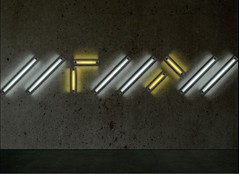
If you send yourself a copy of the image you create then you’ll have a URL to it like the one for the image above. Feel free to post a link to your creations in the comments.
by Chris Bertram on February 17, 2006
Following on from Kieran’s post about British and US TV the other day, I started thinking about the best TV miniseries/drama serial ever, by which I mean just the best drama series telling a story over a limited number of episodes. My list of five contains four British examples and one German. Maybe I’m just parochial, but maybe this is a format the British excel in and the Americans don’t. That’s my hunch. So here’s my list (with annotations). Post rival suggestions in comments.
1. Heimat . Does this count? It is long by miniseries standards, but Edgar Reitz’s story of the the Simon family and the village of Schabbach from the end of the First World War to the 1970s is simply the best thing I’ve ever seen on TV. The sequels, Heimat 2 and Heimat 3 are also pretty good, and some think Heimat 2 the best of the three. They’re wrong, but non-culpably so.
2. The Edge of Darkness . Mid 80s nuclear drama set in Britain as policeman Bob Peck goes after the killers of his daughter (Joanne Whalley) with help from rogue CIA man Joe Don Baker. Eric Clapton soundtrack with frequent playings of Willie Nelson’s “Time of the Preacher” thrown in (the daughter’s favourite record). Tense, paranoid, and secured Peck his role in Jurassic Park.
3. The Singing Detective . Who could watch the pathethic Hollywood remake after this? Michael Gambon, Joanne Whalley (again!) and a sense of growing incredulity that the plot can actually come together. Complete with Dennis Potter’s trademark use of music and song as the key to the unconscious. His best work.
4. Our Friends in the North . Currently being shown again in the UK. From 1960s idealism, through local government and police corruption, vice, and the miner’s strike. Christopher Ecclestone and Gina McKee both superb.
5. Traffik . Why did they ever make the crummy Hollywood version with Douglas and Zeta-Jones? Lindsay Duncan gives an ice-cold performance as the wife as the various threads come together in the UK, Germany and Pakistan. Shostakovich’s 8th String Quartet as the backing music.
I note the dates for these are 1984, 1985, 1986, 1996 and 1989, suggesting the 1980s as a golden age for the format. I might have included Bleasdale’s Boys from the Blackstuff (1982) or GBH (1991) on a different day.
by Harry on February 13, 2006
by John Holbo on February 12, 2006
Couple days ago I posted some fine metaphysical poetry and extremely witty self-criticism by Conrad Aiken at the Valve. I like Aiken very much. (One of our commenters mentioned that Eliot praised him as "il miglior fabbro", but someone else noted he also called Pound that. So maybe he just carried around a whole tray of that one at parties.) There’s also a family friendship on Belle’s side. Warings and Aikens have been friends for generations, apparently.
Anyway, I’ve been reading poems from Aiken’s second book, Turns and Movies (1916), long out of print. One couplet – and that’s pretty much it – from "All Lovely Things" sometimes gets quoted, from the end of this stanza.
All lovely things will have an ending,
All lovely things will fade and die,
And youth, that’s now so bravely spending,
Will beg a penny by and by.
Since the book’s public domain, I’m tempted to make a nice CC edition. Be a bit of work. But here’s a start: the title poem, which you won’t find intact elsewhere on the web, although you will find bits. It’s got a certain something. "In Turns and Movies he willfully sacrificed his ability to write in smooth involute curves for a dubious gain in matter-of-fact forcefulness." Of the title poem in particular: "although immature and uneven … at least a crude vitality." So writes Conrad Aiken. I agree the metaphysical stuff he wrote later is better. But if Art Spiegelman decided he wanted to illustrate something like The Wild Party again, he could do worse that this. (You could really do a Batman and Robin-inspired number on part xii, "Aerial Dodds".)
[click to continue…]
by Chris Bertram on January 12, 2006
Birgit Nilsson , the Swedish soprano famous, among other things, for her Brünnhilde in Solti’s pathbreaking Decca Ring cycle and her Isolde on Boehm’s Tristan, is dead at the age of 87. Her recordings speak for themselves, but there are also plenty of nice anectotes in the obits. From the New York Times :
bq. After a disagreement with the Australian soprano Joan Sutherland, Ms. Nilsson was asked if she thought Ms. Sutherland’s famous bouffant hairdo was real. She answered: “I don’t know. I haven’t pulled it yet.” After the tenor Franco Corelli was said to have bitten her neck in an onstage quarrel over held notes, Ms. Nilsson canceled performances complaining that she had rabies.
The NYT obit has some MP3s (including one of the Liebestod from Tristan). See also the Times and the Washington Post .
by Harry on January 6, 2006
I’m deeply disappointed in Daniel, Tom and Chris (especially Daniel, our house monitor of GG’s career) because this is the kind of news I expect to hear from them, not to have to provide by myself. Aren’t you all devotees?
BTW, do all the really unlikely contestants have the initials GG? Gary Glitter next, no doubt.
by Chris Bertram on December 10, 2005
I went to see a production of Robert Bolt’s A Man for All Seasons in Bath last night. Martin Shaw was marvellous as More. I was surprised that I already knew much of the dialogue (certainly from the Fred Zinnemann film ). And there are many great moments such as the confrontation between More and Roper in Act 1 concerning the conflict between conscience, God’s law and the laws of England. I wondered, watching the play, whether anything had been mucked about with to make the performance more “topical”, and I was sure it must have been when the “Common Man” declaimed at the start of Act 2:
bq. Only an unhappy few were found to set themselves against the current of their times, and in so doing to court disaster. For we are dealing with an age less fastidious than our own. Imprisonment without trial, and even examination under torture, were common practice.
But no. Those lines are there in Bolt’s original.
by Harry on December 9, 2005
The BBC is obsessed with the anniversary of Lennon’s death. For my own part I have four memories — the shock of Radio 4 (the Today Programme) announcing the death in the morning; the amazing sense of loss at school, mitigated only by the bizarre spectacle of Lennon-look-alike Nick P crying his eyes out all day long; somebody on Question Time saying that everyone would remember where they were when they heard about Lennon’s death, and finally, watching Not the Nine O Clock News that week (Thursday?) and wondering all the way through the show how they would respond to his death — and being first touched, and then shocked, by the way they did it (am I the only person who remembers this?)
Anyway, I’m deliberately posting this the day after the anniversary in order to alert you to 2 wonderful shows full of cover versions:
Mike Harding’s show, with numerous folkies covering songs from Rubber Soul (released 40 years ago this week? Amazing)
and
Lennon Live with numerous non-folkies covering Lennon songs, with varying degrees of success (My favourite: Teddy Thompson, whom I’d never heard before, and is eerie)
Other Lennon-related radio shows include a portrait narrated by Mark Ratcliffe and a play based on Ray Connolly’s reflections on his death.
Oh, and you can hear Libby Purves reminisce about him, too, but its a bit odd.
by Chris Bertram on December 8, 2005
Via a page devoted to Swedish dance bands of the 1970s, I happened upon Eurobad 74 “an exhibition of Europe’s worst interiors of 1974”. I have no idea what the horse is doing in #4, nor why the child is lifting the woman’s mini-skirt in #11, but it is indeed hard to imagine interiors much worse than these, even in 1974.
by Kieran Healy on November 10, 2005
Via Jamie Zawinski comes C'était un Rendezvous. A short and very fast film:
On an August morning in 1978, French filmmaker Claude Lelouch mounted a gyro-stabilized camera to the bumper of a Ferrari 275 GTB and had a friend, a professional Formula 1 racer, drive at breakneck speed through the heart of Paris. The film was limited for technical reasons to 10 minutes; the course was from Porte Dauphine, through the Louvre, to the Basilica of Sacre Coeur. No streets were closed, for Lelouch was unable to obtain a permit. The driver completed the course in about 9 minutes, reaching nearly 140 MPH in some stretches. The footage reveals him running real red lights, nearly hitting real pedestrians, and driving the wrong way up real one-way streets.
The film has been remastered and released on DVD. You can watch the whole thing here. (Big download: about 34MB.) Bump it up to full screen mode or twice the normal size to get the full effect. The middle third of the film, when he’s right in the middle of Paris, is just unbelievable, as he runs six or seven red lights, screams around garbage trucks and narrowly misses several pedestrians as he flies down narrow, cobbled streets. Apparently there are all kinds of stories about the film, including whether the director did the driving himself in his own car. Having just watched it, I’d happily insinuate I could drive like that, too.