by John Holbo on May 13, 2016
I just added an item to my collection of graphical curiosities: a 1948 pamphlet, published by The International Book Store in San Francisco, “The Communist Manifesto In Pictures”.
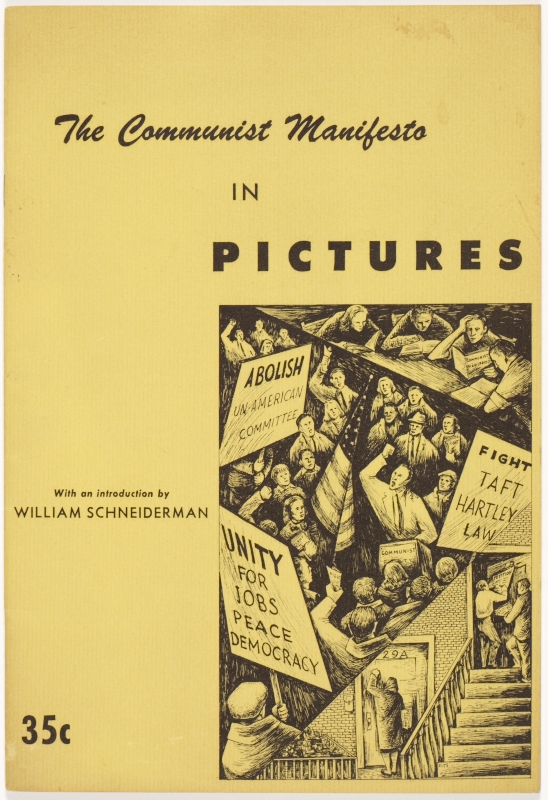
You can get the PDF version for free. I’m interested in it mostly as a data point in the history of American graphic design. The International Book Store seems to have had some graphical flair:

I don’t own that one. I don’t imagine the contents – apparently republished from Soviet Russia Today – are as fun as the cover.
by John Holbo on March 18, 2016
I forgot St. Patrick’s day. But I remembered all-Trump, all-the-time is dull. And some people like my pen-and-ink posts. So let’s celebrate a pair of illustrators named ‘Neill’, or nearly. [click to continue…]
by John Holbo on March 7, 2016
Cory Doctorow links to a nifty graphic design project: crowdsourced covers for public domain classics. If you know anyone teaching a relevant art class at the high school level, or above, I think this might make a fine class project. Everyone pick a title and go for it!
Cory: “I can’t figure out what license the new covers are under and whether anyone can use them as covers in their own collections of public domain books, or whether permission must be sought for each design.” I wondered about that as well. The info page doesn’t cover rights. I signed up to see what one would have to agree to. Answer: a CC license. (Cory will be gratified to hear it!) [click to continue…]
by John Holbo on March 3, 2016
First things first: thanks to everyone who dug deep (or shallow) to purchase (or just freely download) a copy of Reason and Persuasion, allowing us to enjoy evanescent ecstasies of semi-upward-mobility into the 5-digit sales range on Amazon for a period of some days now. Now please keep that Amazon aspidistra flying for the next several years running and we’ll have ourselves a standard textbook! (Sigh. I know. No hope. If I want sales like that, I have to update Facebook more than once every 4 years. And be on Twitter. Shudder.)
As I was saying: it is also fun to watch the (no doubt CT-fueled) evolution of the ‘customers who viewed this item also viewed’ Amazon scrollbar, associating our Plato book with all manner of comics and science fiction. I hope the present post shall further enrich that eclectic mix.
Back in December I posted about how I would like a history of semi-popular philosophy of mind, to complement the history of science fiction. Many people left genuinely useful, interesting comments, for which I am sincerely grateful. Today I would like to strike out along a semi-parallel line. Science fiction film, with its special effects, has a strong phenotypic and genotypic relation to stage magic. Georges Méliès was a stage magician. But sf is older than film; stage magic, too. We might enhance our sense of the modern origins of the former by coordinating with the modern history of the latter. I just read a good little book, Conjuring Science: A History of Scientific Entertainment and Stage Magic in Modern France, by Sofia Lachappelle, that doesn’t make the sf connection, but makes it easy to make. (It’s an overpriced good little book, I’m sorry to say. Oh, academic publishing. But perhaps you, like me, enjoy library privileges somewhere.)
It contains some nice sentences, certainly. For example: “While Robertson was presenting his phantasmagoria in an abandoned convent and professors of amusing physics were performing their wonders, scientific and technological innovations were impacting the world of the theater at large.” (118)
As I was saying: history of modern stage magic. I’ll quote passages, and comment, and supplement with relevant images. [click to continue…]
by John Holbo on February 24, 2016
Following up my Franklin Booth post, how about I do a series of comics and art posts this week?
I made a fine recent purchase on Comixology: Sergio Toppi’s The Collector. If you don’t know Toppi, a Google image search will give the flavor. The comic is pretty ok. The Collector is a cool-looking, mysterious dude who collects precious antiquities. He always gets what he wants. He’s like an amoral Indiana Jones. There are supernatural elements. Mostly you read it for the art: [click to continue…]
by John Holbo on November 28, 2015
I’m not going to feed all that Black Friday madness, but X-Mas is a time for giving nice illustrated books. One that just came out, which I’m looking forward to getting my hands on, is Shaun Tan‘s The Singing Bones. It consists of photographs of sculptures, and some text, originally just illustrating Grimm’s Fairy Tales, but I gather he branches out from there. Like this. At this point I think you can only get it from the publisher. Anyway, looks great. And if you didn’t catch his award-winning animated short, few years back, here it is. Or watch a lo-quality version on YouTube. Of course, The Arrival is his best book. I assume you’ve read it already.
by John Holbo on November 26, 2015
The older daughter has a Holiday TV Special thought: “Isn’t it ironic that Bill Watterson wouldn’t commercialize his stuff, but Calvin would have loved to have his face plastered on everything. Charles Schulz licensed everything about “Peanuts” to go on everything, and Charlie Brown would have hated that.”
Happy Thanksgiving, everyone!
by John Holbo on November 16, 2015
by Henry Farrell on September 29, 2015
So the MacArthur ‘genius’ awards were announced today; I’ve always thought of them as tottering on a Bourdieuian knife-edge between two different kinds of legitimation. On the one hand, they are supposed to have consequences, to publicly recognize people who would otherwise be less well known, and giving them financial and symbolic support that they can then go on to use to do good and wonderful things. This means that it would be weird to give one e.g. to someone like Paul Krugman, who already is doing very nicely in terms of public recognition. On the other, they are supposed to go to people who are creative and brilliant – but in socially legitimated ways so as to maintain the status of the award. This means that they are unlikely to go to genuinely unsung geniuses, not simply because the selection process can’t find brilliance if it isn’t publicly well known, but because the legitimacy of the awards partly depends on their social validation by a variety of elite networks.
Hence, for example, we get today’s decision to give an award to Ta-Nehisi Coates. In one sense this is unquestionably awesome – Coates is fantastic. However, it would be unquestionably much more awesomer if they had given an award to Coates five years before, or gave it today to someone where Coates was five years ago. But the sociology of the process doesn’t seem to be set up to do that – like most institutions, it gravitates towards safe choices. A more risky symbolic venture capital approach – say giving grants to people earlier in their career in the expectation that 80% of them will flame out, 10% will do well, and 10% will be just wonderful would probably not be sustainable over the longer term (or at the least, it would make the prizes very different in status and connotation). Hence the current set up, which I suspect is mostly aimed to support safe bets – people who are either famous or very well regarded in their specific discipline – with perhaps a couple of riskier ones thrown in here and there, where they really strike fire with one of the selectors.
So if we were giving out awards rather than the actual selection committee, who would we give them to? It’s not likely, but it is possible that actual real people involved in the selection process will read this (Crooked Timber doesn’t have Vox-level readership, but it does have its own odd forms of cultural capital; stranger things have happened). So it’s possible that this thread could have consequences. Comments are open. My own two nominees (I can think of other very deserving candidates, but they’re personal friends; I’m also sure I’ll kick myself about all the people I should have mentioned as soon as I’ve posted this) would be Astra Taylor and Tom Slee. Both are writers in the hinterlands between technology and culture, neither is so high profile as to be a likely candidate at the moment. But both are just fantastic – brilliant writers (and in Taylor’s case, documentary maker and musician too) who could do wonderful things with MacArthur level exposure. Who else?
by Belle Waring on September 9, 2015
It’s hard to believe, but there was a time in area woman Belle Waring’s life when she thought she didn’t like Stevie Wonder. Yeah, I know. In graduate school (!) I learned just how wrong I was. I was wronger than like 30 goddamn Dick Cheneys. I remember my conversion experience quite distinctly: I was in the back seat of an acquaintance’s car, driving from Berkeley to Da Club (I mean, da club in general, not a club called “Da Club”) in San Francisco, not even near the Bay bridge yet. We had just gotten off the surface streets. I was sitting alone in the back seat while this random…Linguistics?…no, English Literature grad student and my boyfriend talked–it is a peculiarity of highway driving that although you can hear the people conversing in the front seats fine, they can’t hear you for shit. Then, “Maybe Your Baby” came on his car stereo and I was like “hold up, hold up, who is this?” When I got told it was Stevie Wonder I made some shocked comment like, “but…Ebony and Ivory though.” Then he turned around from the front seat and shot a withering glance at me that said “think for ten seconds and recall, at least, the existence of ‘Uptight‘ or ‘Signed, Sealed Delivered!'” He was right! Also, the withering was more my reaction than a real thing that he did.
[click to continue…]
by John Holbo on July 29, 2015
Do you like colors? Do you like art? If you answered ‘yes’ to both questions, you might find this site interesting.
by John Holbo on July 20, 2015
I’m still preparing to teach Nietzsche. Today I was rereading “The Convalescent”, in Zarathustra – the key chapter in which the animals clue Z. in that his job shall be to teach Eternal Recurrence. A minor linguistic detail auf Deutsch: he is moping in the depths of his most abysmal thought and they – the animals – sing to him about how everything that goes around, comes around, and he calls them ‘barrel organs’ [Drehorgeln] and accuses them of bothering him with a mere Leier-Lied. Which seems like it should just be translated ‘lyre-song’, which it has been. But the Del Caro translation is ‘hurdy-gurdy song’. Which seems a bit unnecessarily far from the original. Curious, I put ‘Leier-Lied’ in Google translate and got ‘lyre-lay’. But then I tried ‘Leierlied’ – no hyphen – and got ‘gurdy song’. Is that a thing? (Obviously I have too much time on my hands.) ‘Hurdy-gurdy’ in German is Drehleier. Leierkasten, by contrast, is a synonym for barrel-organ, so it makes sense that the translator would make a connection. Both barrel-organs and hurdy-gurdys operate by means of cranked cylinders, which makes sense: Zarathustra is complaining that the animals’ philosophy is just cylindrical crankiness. Round and round and round. Very lowbrow stuff. The animals set Zarathustra straight and tell him he needs to make himself a new Leier, so he can sing this song himself, because this is totally his jam. At this point there is no question of translating it as ‘hurdy-gurdy’. Dude is in the middle of nowhere and those things are very complicated engineering feats. He’ll be lucky to string a few strings on a frame, to sing to the sheep, thank you very much. [click to continue…]
by John Holbo on June 14, 2015
Continuing my ‘great art books I bought this year’ series, it turns out that, secretly, Dr. Seuss liked to draw cats and architecture, in a Seussian style. You can buy the book . Or just browse the gallery. Mostly it turns out the secret is: he liked color. (That’s a reason to buy the book. Nice printing.) Also, a bit more sex.
Maurice Sendak wrote the introduction, just as he did for my other new Seuss book.
Ted and I met years ago and liked each other immediately. I gave him reason to laugh mightily on more than one occasion when I launched into one of my “wacky” (his word) subtext theories relating to my favorite Seuss books. I was a product of fifties psycho-analysis, and he forgave me that and my terrible earnestness.
Oh, to be a fly on the wall as an earnest young Maurice Sendak expounded his theory of Green Eggs and Ham. “I would not, could not, in the dark.” Hey, sometimes a tunnel is only a tunnel.
by Henry Farrell on June 13, 2015
Today’s the 150th anniversary of the birth of William Butler Yeats. From what I’ve heard (including a couple of first hand accounts), he wasn’t a particularly nice man. But he was a great poet. So, if you want to quote favorite bits in the comments, quote away. One of mine (not one of his great and famous poems, but some nice lines all the same), Two Songs from a Play:
I SAW a staring virgin stand
Where holy Dionysus died,
And tear the heart out of his side.
And lay the heart upon her hand
And bear that beating heart away;
Of Magnus Annus at the spring,
As though God’s death were but a play.
Another Troy must rise and set,
Another lineage feed the crow,
Another Argo’s painted prow
Drive to a flashier bauble yet.
The Roman Empire stood appalled:
It dropped the reins of peace and war
When that fierce virgin and her Star
Out of the fabulous darkness called.
II
In pity for man’s darkening thought
He walked that room and issued thence
In Galilean turbulence;
The Babylonian starlight brought
A fabulous, formless darkness in;
Odour of blood when Christ was slain
Made all platonic tolerance vain
And vain all Doric discipline.
Everything that man esteems
Endures a moment or a day.
Love’s pleasure drives his love away,
The painter’s brush consumes his dreams;
The herald’s cry, the soldier’s tread
Exhaust his glory and his might:
Whatever flames upon the night
Man’s own resinous heart has fed.
by John Holbo on June 6, 2015
 . Which is sold out everywhere by now. Sucks to be you.