From the category archives:

Science

The case of the disappearing teaspoons

by Kieran Healy on May 23, 2010

Morning and Afternoon Tea are the twin social hubs of Australian academia, so it’s only natural that a disturbing tearoom phenomenon would be noticed, investigated and subsequently published in the British Medical Journal: The case of the disappearing teaspoons: longitudinal cohort study of the displacement of teaspoons in an Australian research institute.

Objectives To determine the overall rate of loss of workplace teaspoons and whether attrition and displacement are correlated with the relative value of the teaspoons or type of tearoom. Design Longitudinal cohort study. Setting Research institute employing about 140 people. Subjects 70 discreetly numbered teaspoons placed in tearooms around the institute and observed weekly over five months. Main outcome measures Incidence of teaspoon loss per 100 teaspoon years and teaspoon half life.

Results 56 (80%) of the 70 teaspoons disappeared during the study. The half life of the teaspoons was 81 days. The half life of teaspoons in communal tearooms (42 days) was significantly shorter than for those in rooms associated with particular research groups (77 days). The rate of loss was not influenced by the teaspoons’ value. The incidence of teaspoon loss over the period of observation was 360.62 per 100 teaspoon years. At this rate, an estimated 250 teaspoons would need to be purchased annually to maintain a practical institute-wide population of 70 teaspoons.

Conclusions The loss of workplace teaspoons was rapid, showing that their availability, and hence office culture in general, is constantly threatened.

Follow the link and scroll down for the long correspondence that followed. Notable contributions include “Teabags and forks are confounding factors“, “Communism and Biros“, “Global Implications, Impending Catastrophe“, and “Could teaspoons be the larvae of some unrecognised adult?

Minds, Magnets and Morals

by Jon Mandle on March 30, 2010

MIT researchers have shown that people’s moral judgments change when the functioning of a certain part of the brain is suppressed using magnetic stimulation. Here’s the abstract:

When we judge an action as morally right or wrong, we rely on our capacity to infer the actor’s mental states (e.g., beliefs, intentions). Here, we test the hypothesis that the right temporoparietal junction (RTPJ), an area involved in mental state reasoning, is necessary for making moral judgments. In two experiments, we used transcranial magnetic stimulation (TMS) to disrupt neural activity in the RTPJ transiently before moral judgment (experiment 1, offline stimulation) and during moral judgment (experiment 2, online stimulation). In both experiments, TMS to the RTPJ led participants to rely less on the actor’s mental states. A particularly striking effect occurred for attempted harms (e.g., actors who intended but failed to do harm): Relative to TMS to a control site, TMS to the RTPJ caused participants to judge attempted harms as less morally forbidden and more morally permissible. Thus, interfering with activity in the RTPJ disrupts the capacity to use mental states in moral judgment, especially in the case of attempted harms.

So basically, they have identified a part of the brain that is important in attributing mental states to others. And the moral judgments of normal adults depend on attributing mental states – intentions, specifically – to others. When they suppress the functioning of this part of the brain, moral judgments alter.

“We judge people not just for what they do, but what they’re thinking at the time of their action, what they’re intending,” [Liane] Young says. But, she says, a brief magnetic pulse was able to change that.
…
[The resulting judgments are] the sort of moral judgment you often see in kids who are 3 or 4 years old, Young says.

Interesting. The researchers themselves seem to be fairly careful in stating their results, but Joshua Greene – psychology professor at Harvard, Ph.D. in philosophy from Princeton – swings for the fences (although note that this is mostly a reporter’s paraphrase):

The fact that scientists can adjust morality with a magnet may be disconcerting to people who view morality as a lofty and immutable human trait, says Joshua Greene, psychologist at Harvard University. But that view isn’t accurate, he says.
…
[According to Greene,] The scientists are trying to take concepts such as morality, which philosophers once attributed to the human soul, and “break it down in mechanical terms.”

If something as complex as morality has a mechanical explanation, Green says, it will be hard to argue that people have, or need, a soul.

But of course the scientists are not adjusting morality with a magnet, they’re affecting people’s moral judgments. I don’t think anyone ever doubted that manipulating the brain in various ways can lead people to alter their judgments – moral and otherwise. This is obvious to anyone who has observed the results of alcohol, for example, or – much more indirectly – framing effects.

The experiment really doesn’t have much to say one way or the other about souls, meta-ethics, or the justification of any ground-level moral judgments. (Actually, it might suggest that you shouldn’t rely on your interpersonal judgments when the neural activity in your right temporoparietal junction is being disrupted by transcranial magnetic stimulation, or perhaps just when you’ve volunteered as a subject in an MIT lab.) Rather, it highlights the importance of attribution of intention in the moral judgment of normal adults, shows how localized in the brain this function is, and demonstrates how easily it can be suppressed in isolation from other functions. A plausible next step:

Sarah-Jayne Blakemore, a brain expert at University College London, said the findings were insightful.
“The study suggests that this region – the RTPJ – is necessary for moral reasoning.
“What is interesting is that this is a region that is very late developing – into adolescence and beyond right into the 20s.
“The next step would be to look at how or whether moral development changes through childhood into adulthood.”

Carroll on Colbert

by Kieran Healy on March 11, 2010

Cosmic Variance‘s Sean Carroll doing a very good job indeed on The Colbert Report. That shit is hard. Along the way he makes deft use of a Dara O’Briain line (“Of course science doesn’t know everything — if science knew everything, it would stop”) that I believe I introduced him to, so therefore I take full credit for all the laughs he got and expect to receive a check for any royalties accruing from Colbert-related sales.

Sally Mann, uncertainty and the collodion process

by Chris Bertram on January 21, 2010

A bit of mindless surfing had me looking at the execrable Instapundit for the first time in ages … but there was actually something interesting there: a link to Sally Mann, talking about memory, uncertainty and the collodion process. Those 19th-century photographers who managed to produce near-flawless images using the process were really something.

I’m still working on the follow-up to my Descartes post, to which comments have been good and useful. I’ll plug the gap with a passage from the Dan Garber book I mentioned before, Descartes Embodied (good book.) I’ve never read much Francis Bacon (I don’t teach him); and in particular I haven’t read New Atlantis, which I know is his science fiction utopia (you’d think I would have gotten around to reading such a thing). Garber summarizes the organizational structure for the House of Saloman, which is apparently New Atlantis’ League of Extraordinarily Scientific Gentlemen. The job titles are pretty much turned all the way up to Awesome.

At the bottom of the organization are those who form the tables of natural history, a total of twenty-four investigators. Twelve “Merchants of Light” “sail into foreign countries under the names of other nations … [and] bring us the books and abstracts, and patterns of experiments of all other parts.” Three “Depredators” collect experiments from books three “Mystery-men” collect experiments from mechanical arts and liberal sciences, and three “Pioneers or Miners” try new experiments of their own devising. They are joined by three “Compilers,” who arrange these observations and experiments into proper tables. Twelve workers are employed at the next stage of the enterprise. Three “dowry-men or Benefactors” examine the initial tables compiled by the Compilers and draw out both technological applications and the first theoretical conclusions that can be drawn from the tables, presumably what Bacon calls the first vintage in the Novum organum. Three “Lamps” as he calls them, then draw new experiments out of the work of the Compilers and Benefactors, which experiments are them performed by three “Inoculators.” And finally, “we have three that raise the form discoveries by experiments into greater observations, axioms, and aphorisms. These we call Interpreters of Nature.”

I think someone really ought to write an SF thriller in which the science heroes of New Atlantis have to race against time to compile the proper Baconian tables that will allow them to understand and technologically defeat the invading Martians. Or something.

Perhaps Adam Roberts will consent to show up in comments and tell us whether New Atlantis is actually as fun to read as it sounds.

Artificial Meat

by Jon Mandle on November 30, 2009

I don’t know how I missed the breakthrough in fish stick technology mentioned so casually in this article from the Sunday Times:

SCIENTISTS have grown meat in the laboratory for the first time. Experts in Holland used cells from a live pig to replicate growth in a petri dish.
The advent of so-called “in-vitro” or cultured meat could reduce the billions of tons of greenhouse gases emitted each year by farm animals — if people are willing to eat it.
So far the scientists have not tasted it, but they believe the breakthrough could lead to sausages and other processed products being made from laboratory meat in as little as five years’ time.
They initially extracted cells from the muscle of a live pig. Called myoblasts, these cells are programmed to grow into muscle and repair damage in animals.
The cells were then incubated in a solution containing nutrients to encourage them to multiply indefinitely. This nutritious “broth” is derived from the blood products of animal foetuses, although the intention is to come up with a synthetic solution.

The Dutch experiments follow the creation of “fish fillets” derived from goldfish muscle cells in New York and pave the way for laboratory-grown chicken, beef and lamb.

The Vegetarian Society reacted cautiously yesterday, saying: “The big question is how could you guarantee you were eating artificial flesh rather than flesh from an animal that had been slaughtered. It would be very difficult to label and identify in a way that people would trust.” Peta, the animal rights group, said: “As far as we’re concerned, if meat is no longer a piece of a dead animal there’s no ethical objection.”

That’s the “big question”? I’m guessing that Dr. Kass will find this even more repugnant than the public licking of an ice cream cone.

Chicken Little

by Henry Farrell on November 10, 2009

Paul Krugman links to an excellent take-down by Elizabeth Kolbert of the notorious climate change chapter in _Superfreakonomics._

what’s most troubling about “SuperFreakonomics” isn’t the authors’ many blunders; it’s the whole spirit of the enterprise. Though climate change is a grave problem, Levitt and Dubner treat it mainly as an opportunity to show how clever they are. Leaving aside the question of whether geoengineering, as it is known in scientific circles, is even possible—have you ever tried sending an eighteen-mile-long hose into the stratosphere?—their analysis is terrifyingly cavalier. A world whose atmosphere is loaded with carbon dioxide, on the one hand, and sulfur dioxide, on the other, would be a fundamentally different place from the earth as we know it. Among the many likely consequences of shooting SO2 above the clouds would be new regional weather patterns (after major volcanic eruptions, Asia and Africa have a nasty tendency to experience drought), ozone depletion, and increased acid rain.

Kolbert’s closing words are, however, a little unfair.

To be skeptical of climate models and credulous about things like carbon-eating trees and cloudmaking machinery and hoses that shoot sulfur into the sky is to replace a faith in science with a belief in science fiction. This is the turn that “SuperFreakonomics” takes, even as its authors repeatedly extoll their hard-headedness. All of which goes to show that, while some forms of horseshit are no longer a problem, others will always be with us.

Not unfair to Levitt and Dubner, mind you, but to science fiction. After all, two science fiction authors, Frederik Pohl and Cyril Kornbluth, had their number down way back in 1953 with _The Space Merchants_ (Pohl, amazingly, is still alive and active).

The Conservationists were fair game, those wild eyed zealots who pretended modern civilization was in some way “plundering” our planet. Preposterous stuff. Science is _always_ a step ahead of the failure of natural resources. After all, when real meat got scarce, we had soyaburgers ready. When oil ran low, technology developed the pedicab.

I missed out on the book title contest a while back, so here’s my entry. As regards earnestness, i’m riffing off Andrew Gelman, via Kieran, who observes “”pissing off conservatives” is boring and earnest?”

The main point, though, is that the fuss over the global cooling chapter in Levitt and Dubner’s new book is the first occasion, I think, where the refutation of specific errors has taken a back seat (partly because, in this case, it’s so easy) to an attack on contrarianism, as such. The general point is that contrarianism is a cheap way of allowing ideological hacks to think of themselves as fearless, independent thinkers, while never challenging (in fact reinforcing) the status quo. Here’s Krugman and Joe Romm, for example

[click to continue…]

Looking at Data

by Kieran Healy on October 13, 2009

Jeremy Freese is doing some analysis:

So, the General Social Survey reinterviewed a large subset of 2006 respondents in 2008. They have released the data that combines into one file the respondents interviewed for the first time in 2008 and the 2008 reinterviews of the respondents originally interviewed in 2006. In a separate file, of course, you can get the original 2006 interviews for the latter people.

What has not yet been released, however, is the variable that would identify what row in the first file corresponds to what row in the second file. In other words, you know that person #438 in the reinterview data is somebody originally interviewed in 2006, but you don’t know what person in the 2006 data there are.

Well, especially because the last thing I need to be doing right now is procrastinating, that sounded like a challenge. Just as I have learned that just because there are no microwave instructions for a frozen dinner doesn’t mean you can’t microwave it, just because there isn’t a merge variable doesn’t mean you can’t merge the data. At least if no secure data agreement is involved.

All I have to say is: holy crap. You’d think knowing somebody’s sex, survey ballot (which was kept the same both times), zodiac sign, year of birth, self-identified race, region where they lived where they were 16, whether they lived with their parents when they were 16, whether they lived in the same place they did growing up, who they said they voted for in 2004, their marital status, their education, what they say they did for a living, how many years their mother went to school, inter alia, would allow you to pretty easily pinpoint who is who. I am here to tell you this is not the case.

I was able to devise some convoluted scheme and check how well it was doing thanks to a pretty big clue that I’ll refrain from posting, but even then there ended up being 50 cases that out of 1500 that I wasn’t sure who they were. In general the experience affirmed a fundamental suspicion I’ve had about analyzing survey data: the data seem so much less real once you ask the same person the same question twice.

The real distinction between qualitative and quantitative is not widely appreciated. People think it has something to do with counting versus not counting, but this is a mistake. If the interpretive work necessary to make sense of things is immediately obvious to everyone, it’s qualitative data. If the interpretative work you need to do is immediately obvious only to experts, it’s quantitative data.

Reality Thursday

by John Holbo on October 1, 2009

I don’t see why only Theory and Monday should have all the fun. Still, one comment from Michael’s thread caught my eye. Hidari:

I might also add that the ‘anti-relativist’ or (as I would prefer to put it) ‘anti-contextualist’ position is generally hopelessly confused in that they tend to use Positivist arguments to support Realist positions. But you can’t do that. The positivists were instrumentalists, as befitted their anti-metaphysical, pro-empiricist assumptions. Realism is a metaphysical position.

The rest of the comment suggests this is supposed to express a Nancy Cartwright-style view, which I don’t think is really quite properly described as anti-realist. (It is anti-Realist, for certain values of the self-important capital-R. But that is another kettle of fish. Or, possibly, Fish. I mention this out of scrupulosity because it just isn’t clear to me the positions Hidari is objecting to in the thread are Realist, as opposed to realist.) Anyway, the point is this. I’ve been watching the new They Might Be Giants Here Comes Science DVD with my girls [amazon]. It’s great! Can’t decide yet whether I like it better than the earlier TMBG kid’s discs, but it does measure up so far.
In the opening number, one of the Johns does exactly the thing that bothers Hidari (and Cartwright is indeed someone who scourges this particular move): offering positivist arguments on behalf of realism.

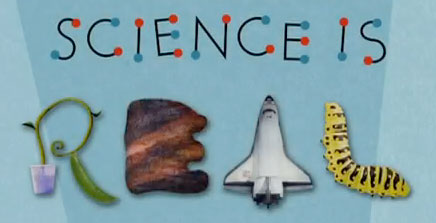
As I was saying, one of the Johns quotes Rudolf Carnap, “science is a system of statements based on direct experience and controlled by experimental verification.” And the other John then says: “Or as we say, Science Is Real!” And the song starts. But these two statements are hardly equivalent. Indeed, even the graphic for the song title is eloquently anti-Carnapian:

sciencereal

This clearly implies that science does not consist of sentences. It is a thing that itself contains the things that sentences about science are about. Or as we say: things! Reality! (Call it what you will. Place is thick with the stuff.)

Here’s a YouTube link to the video for TMBG “Science is Real”, complete with Carnapian intro. (You can also watch it as an Amazon preview, but they cut the Carnap bit! That was the best part!)

So your job, this Reality Thursday, is to write a song – or poem – expressing as clearly as you can, with extra style points for keeping it intelligible to an 8-year old – your favored philosophy of science. Does it consist of sentences, or does it consist of reality? You decide! The only thing I can think of that rhymes with ‘paradigm’ is ‘spare a dime’. As to the rest: I’m recovering from the flu myself and have 100+ papers to grade, so don’t ask me to dance you a little jig. I don’t have the time or energy.

You can also comment in prose.

What global warming looks like

by Chris Bertram on September 25, 2009

Some amazing time lapse sequences of glacier retreat and a spectacular ice-shelf collapse:

Is this the same Steven Pinker?

by John Q on August 5, 2009

Over at my blog a couple of days ago, we were discussing Steven Pinker’s The Blank Slate, a book which I thought, when I reviewed it in 2002, was much below the standard of his earlier work, though no worse than the average book about the ‘nature-nurture’ controversy. In particular, I thought his discussion of war and violence was hopelessly confused, putting forward a Hobbesian view of violence as the product of rational self interest as if it was consistent with the genetic determinism that was the central theme of the rest of the book.

Now, via John Horgan at Slate, I’ve happened across this broadcast by Pinker at TED (which, by the way I’ve just discovered and is excellent). The broadcast has a transcript which is great for those of us who prefer reading to listening.

In this piece, Pinker appears to me to change sides almsot completely, from pessimist to optimist and from genetic determinist to social improver. Not only does he present evidence that war and violence are declining in relative importance, his explanation for this seems to be entirely consistent with the Standard Social Science Model he caricatured and debunked in The Blank Slate. He’s still got a sort of rational self-interest model in there, but now Hobbes is invoked, not for his ‘nasty, brutish and short’ state of nature, but for his argument that the Leviathan of social order will suppress violence to the benefit of all.

But even more striking is this:

[Co-operation] may also be powered by cosmopolitanism: by histories and journalism and memoirs and realistic fiction and travel and literacy, which allows you to project yourself into the lives of other people that formerly you may have treated as sub-human, and also to realize the accidental contingency of your own station in life; the sense that “there but for fortune go I.”

I agree entirely, but we seem to have come a long way from the African savannah here.

Meanwhile, in the libel courts…

by Harry on June 4, 2009

…Simon Singh is appealing the finding that he libeled the British Chiropractor Association by denying that chiropracticionariness is evidence-based medicine. (More details here). (Beware, Daniel — you’ll have the scientists suing you if you’re not careful). Fortunately, he has the greatest living Englishman on his side, so there is some hope that justice will be done.

The news that NICE has put acupuncture and chiropractic on the list of approved therapies for non-specific lower back pain has led to about the reactions you’d expect – back-slapping and high-fiving from the crystals and “life force” crowd, agonised complaining from the professional skeptics. But it’s actually a sign of something that ought to make us worry, not much but at least a little bit, about the way in which we’re doing medical science in this country.
[click to continue…]

Biology and Breeding

by John Holbo on May 30, 2009

Hey, you know those psychedelic bio text images I posted about? Well, someone took an interest in the post and the images and went and did a bit of research on the textbook itself: [click to continue…]