Hey, you know those psychedelic bio text images I posted about? Well, someone took an interest in the post and the images and went and did a bit of research on the textbook itself: [click to continue…]
From the category archives:
Science
Via P.Z. (but put under the fold so as to protect the delicate sensibilities of CT’s readership).
[click to continue…]
So I clicked over to Pharyngula to see whether PZ had blown his top about the Fish thing (see previous post). Yes! In a manner of speaking.
I feel the need to cheer poor PZ up. So: the coolest thing on Flickr is this set of scans from a 1972 biology textbook that so desperately wanted to be a prog rock concept album. You should also read the tart commentary by the guy who posted it.
I thought about posting a few of the images here but I think, for full effect, you just need to view the whole set. (Just like you can’t really explain to someone why a particular Yes album is great by playing only 10 seconds of it.)
Julian Sanchez on climate change debates.
Sometimes, of course, the arguments are such that the specialists can develop and summarize them to the point that an intelligent layman can evaluate them. But often—and I feel pretty sure here—that’s just not the case. Give me a topic I know fairly intimately, and I can often make a convincing case for absolute horseshit. Convincing, at any rate, to an ordinary educated person with only passing acquaintance with the topic. A specialist would surely see through it, but in an argument between us, the lay observer wouldn’t necessarily be able to tell which of us really had the better case on the basis of the arguments alone—at least not without putting in the time to become something of a specialist himself. Actually, I have a plausible advantage here as a peddler of horseshit: I need only worry about what sounds plausible. If my opponent is trying to explain what’s true, he may be constrained to introduce concepts that take a while to explain and are hard to follow, trying the patience (and perhaps wounding the ego) of the audience.
Come to think of it, there’s a certain class of rhetoric I’m going to call the “one way hash” argument. Most modern cryptographic systems in wide use are based on a certain mathematical asymmetry: You can multiply a couple of large prime numbers much (much, much, much, much) more quickly than you can factor the product back into primes. Certain bad arguments work the same way—skim online debates between biologists and earnest ID afficionados armed with talking points if you want a few examples: The talking point on one side is just complex enough that it’s both intelligible—even somewhat intuitive—to the layman and sounds as though it might qualify as some kind of insight. (If it seems too obvious, perhaps paradoxically, we’ll tend to assume everyone on the other side thought of it themselves and had some good reason to reject it.) The rebuttal, by contrast, may require explaining a whole series of preliminary concepts before it’s really possible to explain why the talking point is wrong. So the setup is “snappy, intuitively appealing argument without obvious problems” vs. “rebuttal I probably don’t have time to read, let alone analyze closely.”
This is both true and smart (as is Julian’s work more generally; in my opinion, he is by far the most consistently interesting and intelligent of the young sort-of-libertarian opinion journalist set).
Rev. of Sean Carroll, <i>From Eternity to Here: The Origin of the Universe and the Arrow of Time</i>. Forthcoming from Dutton (Penguin), 2009.
Time just isn’t what it used to be. And space has gotten to be a bit of a problem, as well. When I was a lad, physicists told me that they had these things pretty well figured out: they had discovered material evidence of the Big Bang, they had adjusted their conception of the age and evolution of the universe accordingly, and, having recalculated the universe’s rate of expansion (after Hubble’s disastrous miscalculations threw the field into disarray), they were working on the problem of trying to figure out whether the whole thing would keep expanding forever or would eventually slow down and snap back in a Big Crunch. The key, they said, lay in finding all the “missing mass” that would enable a Big Crunch to occur, because at the time it looked as if we only had two or three percent of the stuff it would take to bring it all back home. When I asked them why a Big Crunch, and a cyclical universe, should be preferable to a universe that just keeps going and going, they told me that the idea of a cyclical eternity was more pleasing and comfortable than the idea of a one-off event; and when I asked them what came before the Big Bang, they patted my head and told me that because the Big Bang initiated all space and time, there was no such thing as “before the Big Bang.”
From an otherwise serious article about the effects of pollution on males of all species:
bq. … a study at Rotterdam’s Erasmus University showed that boys whose mothers had been exposed to PCBs grew up wanting to play with dolls and tea sets rather than with traditionally male toys.
Michael Reiss has been forced to resign as Director of Education of the Royal Society . Absolutely shocking, in my view. Several of those calling for his head, such as Sir Richard Roberts, made much of the fact that he is an ordained minister. But since at least two FRSs — John Polkinghorne and Bernard Silverman — are also priests, that’s hardly a reason for the Society not to employ him. The RS statement says:
bq. “Some of Professor Michael Reiss’s recent comments, on the issue of creationism in schools, while speaking as the Royal Society’s director of education, were open to misinterpretation. While it was not his intention, this has led to damage to the society’s reputation. As a result, Professor Reiss and the Royal Society have agreed that, in the best interests of the society, he will step down immediately as director of education.”
Well, no, they weren’t “open to misinterpretation”, they were wilfully misinterpreted by those who were always going to be determined to do so, and it shows real spinelessness on the part of the RS that they didn’t back him. As I blogged a few days ago , Reiss didn’t call for creationism to be part of the science curriculum, he said (absolutely clearly, _in his original statement_ of his view) that teachers should, as a matter of good pedagogical practice, be willing to engage with students they encounter who come to the class with creationist views. That seems to me to be a perfectly legitimate position for someone concerned with science pedagogy to take. Others may disagree with the substance of his view. That’s fair enough. But to push him out for saying it? Dreadful.
(A list of issues where partisans are only willing to tolerate a simple straightforward and unequivocal expression of the party line (on either side) and will seek to punish deviants: anything touching on religion and education (including this issue); Israel/Palestine; abortion/right to life, ….etc. )
Update: see also James Wimberley here .
There’s much anger circulating around the blogosphere about the comments of Michael Reiss, Director of Education at the Royal Society about how to deal with creationism and ID in school science classes. In fact, the whole thing could stand as an example of how on some issues (of which this is one) people only want to hear an unequivocal assertion of a party line and get unreasonably annoyed (and purport not to understand what they understand perfectly well) when someone says something nuanced or pragmatic.
Here’s the question Reiss asked:
bq. What should science teachers do when faced with students who are creationists?
To which he gave the answer that simply ignoring them is wrong and counterproductive. Rather, in his view, it is better pedagogical practice to engage with their doubts about evolution. He also adds that teachers have a duty to explain the scientific position but that they should not expect the doing so will displace creationist beliefs in students. His thought there is that explaining that evolutionary theory provides the best _scientific_ explanation is not necessarily going to cut ice with people who don’t accept the scientific way of looking at the world.
All reasonable enough, or so it seems to me. But then you get headlines like Leading scientist urges teaching of creationism in schools Of course, strictly speaking that’s true, since he advocated that teachers be open to the discussion of creationism with their students. But it gives the impression that he wanted creationism (and its ID variant) to be given house-room in the curriculum as “valid” alternative explanations of life. And that he didn’t say.
Incidentally, the Times also devoted a leader to the controversy , comparing _inter alia_ Reiss to Sarah Palin:
bq. Sarah Palin, the Republican vice-presidential nominee, while not a creationist, has courted the support of those who want to teach biblical creationism alongside evolution in science classes by saying that schools should “let kids debate both sides”. Both Governor Palin’s populism and Professor Reiss’s well-meaning intervention are based on the same mistake – that it is acceptable to teach faith as if it were science.
Since Reiss’s clearly expressed view is that creationism is no part of the scientific world view, that is a gross distortion by their leader-writer who is clearly neither a careful nor a charitable reader.
Oh how times change! I rather doubt that a piece of 1958 research on how children behave when locked in fridges would make it past a modern university ethics committee!
bq. Using a specially designed enclosure, 201 children 2 to 5 years of age took part in tests in which six devices were used, including two developed in the course of this experiment as the result of observation of behavior. Success in escaping was dependent on the device, a child’s age and size and his behavior. It was also influenced by the educational level of the parents, a higher rate of success being associated with fewer years of education attained by mother and father combined. Three major types of behavior were observed: (1) inaction, with no effort or only slight effort to get out (24%); (2) purposeful effort to escape (39%); (3) violent action both directed toward escape and undirected (37%). Some of the children made no outcry (6% of the 2-year-olds and 50% of the 5-year-olds). Not all children pushed. When tested with devices where pushing was appropriate, 61% used this technique. Some children had curious twisting and twining movements of the fingers or clenching of the hands. When presented with a gadget that could be grasped, some (18%) pulled, a few (9%) pushed, but 40% tried to turn it like a doorknob. Time of confinement in the enclosure was short for most children. Three-fourths released themselves or were released in less than 3 minutes; one-fourth in less than 10 seconds. Of those who let themselves out, one-half did so in less than 10 seconds. One-third of the children emerged unruffled, about half were upset but could be comforted easily, and a small group (11%) required some help to become calm.
I’ll bet they did.
H/t Zoe D.
I keep referring to this cartoon in conversations and people keep telling me they have no idea what I’m talking about so I’m just going to put it here with the hope that it spreads to more and more folks. (I know some of you have already seen it, Vivian linked to it in her comment here. Nonetheless, it deserves its own post.)
It’s amazing how well it tells so much. It reminds me of specific experiences throughout my life from high school through graduate school (although the latter not in my department, to be fair). Plus one encounters this type of attitude online all the time.
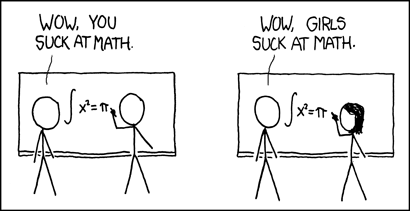
Thanks to xkcd. I’d buy this one on a T-shirt, but it’s not in the store. The college-style XKCD is tempting.
Steve Fuller gets a good kicking from the excellent Steven Poole:
bq. … Fuller happily adopts ID’s rhetorical tactics: speaking of biologists’ “faith”; forgetting to mention (or merely being ignorant of) the wealth of evidence for evolution in modern biology that wasn’t available to Darwin himself; and even muttering about the “vicissitudes” of fossil-dating, thus generously holding the door open for young-Earth creationists, too. The book is an epoch-hopping parade of straw men, incompetent reasoning and outright gibberish, as when evolution is argued to share with astrology a commitment to “action at a distance”, except that the distance is in time rather than space. It’s intellectual quackery like this that gives philosophy of science a bad name.
(Hat tip: SO)
The Prospect article defending Rachel Carson I wrote with Tim Lambert kicked off a lengthy round of blast and counterblast in the blogosphere. Some of the response did little more than illustrate the continuing gullibility of the RWDB segment of the blogosphere, notably including Glenn Reynolds (start here). The more serious discussion began with links from Andrew Leonard at Salon and Brad Plumer at TNR, and a reply from Roger Bate, claiming that we had greatly overstated his links with the tobacco industry (Tim Lambert responded here and Andrew Leonard here and here, with plenty more evidence on this point). A further piece makes the claim (which I have no reason to dispute) that British American Tobacco has now switched sides and is arguing against DDT use in Uganda.
Through all this sound and fury, some progress was made. No one even attempted to defend the claim that the use of DDT against malaria had been banned, or the outrageous lies of Steven Milloy (still employed by Fox News and CEI, despite his exposure as a tobacco industry shill) who blames Rachel Carson for every malaria death since 1972. It even turned out that the much-denounced decision of South Africa to abandon DDT use (reversed when malaria cases increased because of resistance to the pyrethroids used as alternatives) was not primarily due to environmentalist pressure. As Bate noted in his reply, the main factor behind the decision was the unpleasant look and small of DDT sprayed on hut walls, which often led to repainting or replastering. A minor, but still striking point, is that DDT continued to be used for public health purposes in the US (against plague-bearing fleas) even after the 1972 ban on general use of the chemical, and is still available for these purposes if needed.
Update:Absolutely the last word Via Ed Darrell a quiet victory for friends of Rachel Carson with the abandonment by Senator Tom Coburn of a block on the naming, in her honor, of the post office in her birthplace. It appears that the campaign of denigration against Carson (and, by implication, the environmental movement as a whole) has become untenable.
In a classic discussion of scientists sampling the ground in the Amazon rainforest, Bruno Latour details the process through which physical bits of soil are turned into recorded measurements and data points for comparison and analysis. He remarks,
Stage by stage, we lost locality, particularity, materiality, multiplicity, and continuity, such that, in the end, there was scarcely anything left but a few leaves of paper. … But at each stage we have not only reduced, we have also gained or regained, since, with the same work of representation, we have been able to obtain much greater compatibility, standardization, text, calculation, circulation, and relative universality, such that by the end, inside the field report, we hold not only all of Boa Vista (to which we can return), but also the explanation of its dynamic.
Now, via Andrew Gelman, a fascinating story from Quirin Schiermeier at Nature about the social production of data.

Kevin Drum points to this piece by Michael Gerson, denying the existence of a Republican War on Science. As Drum points out, Gerson doesn’t even mention the major battlegrounds like global warming denialism, creationism and intelligent design, and the Gingrich-era shutdown of the Office of Technology Assessment, focusing on a much narrower set of issues including stem cell research and abortion.
Moreover far from refuting the claim of a war between Republicanism and science, Gerson spends most of the article fighting on the Republican side. Most obviously the obligatory, and in this case, lengthy discussion of eugenics, tied in Jonah Goldberg fashion to contemporary liberalism.
There’s an even more fundamental problem here. Gerson is so focused on the political/cultural/ethical war he is fighting that he doesn’t even consider the question of whether there are any scientific facts that might be relevant to the question.
One of the big problems with talking about what Chris Mooney has called The Republican War on Science is that, on the Republican side, the case against science is rarely laid out explicitly. On a whole range of issues (evolution, passive smoking, climate change, the breast-cancer abortion link, CFCs and the ozone layer and so on) Republicans attack scientists, reject the conclusions of mainstream science and promote political talking points over peer-reviewed research. But they rarely present a coherent critique that would explain why, on so many different issues, they feel its appropriate to rely on their own politically-based judgements and reject those of mainstream science. And of course many of them are unwilling to admit that they are at war with science, preferring to set up their own alternative set of scientific institutions and experts, journals and so on.
So it’s good to see a clear statement of the Republican critique of science from John Tierney in this NY Times blog piece promoting global warming “skepticism”. The core quote is
climate is so complicated, and cuts across so many scientific disciplines, that it’s impossible to know which discrepancies or which variables are really important.Considering how many false alarms have been raised previously by scientists (the “population crisis,” the “energy crisis,” the “cancer epidemic” from synthetic chemicals), I wouldn’t be surprised if the predictions of global warming turn out to be wrong or greatly exaggerated. Scientists are prone to herd thinking — informational cascades– and this danger is particularly acute when they have to rely on so many people outside their field to assess a topic as large as climate change.
Both this quote and the rest of Tierney’s article are notable for the way in which he treats science as inseparable from politics, and makes no distinction between scientific research and the kind of newspaper polemic he produces. Like most Republicans, Tierney takes a triumphalist view of the experience of the last thirty years or so, as showing that he and other Republicans have been proved right, and their opponents, including scientists, have been proved wrong (illustrated by his blithe dismissal of complicated problems like population and energy as “false alarms”). Hence, he argues, he is entitled to prefer his own political judgements to the judgements (inevitably equally political) of scientists.