by Harry on December 2, 2015
Here’s the terrorist-sympathising MP John Baron:
Any successful strategy to destroy Isis hinges on there being a component of ground troops. Here the government makes the assumption that there are 70,000 Syrian moderates willing to take the fight to the organisation. While on our visit [Baron was part of a fact-finding mission to Middle-East capitals last month], we were reminded that, after nearly five years of conflict, there are precious few “moderates” in Syria. They do not form a coherent group; and, as the Americans found to their cost, they tend to be as liable to fight each other as they are to fight the extremists. The government has forgotten the lessons of Libya, where the anti-Gaddafi forces splintered into a thousand militias the moment the common enemy was defeated. A fresh civil war has been a result. Syria would be similar, but on a grand scale.
In any case, a feature of the Syrian civil war has been the speed at which new groups and organisations can spring from the shadows and stake their claim to support, legitimacy and territory. It is a bold assumption that the government’s strategy would prevent this, and the risks should be obvious that military intervention would merely clear the field for the next wave of extremists. We are all encouraged by the Vienna talks, but we are a long way off any lasting political solution.
The prime minister’s strategy is also notable for being heavy on emotion. We all sympathise with the French after the terrible attacks in Paris, and are mindful that such outrages could easily happen here, but we serve no purpose by allowing our thinking to be cloyed. When emotions run high, people tend to make mistakes. If parliament votes to intervene in Syria, it should not be in “solidarity” with our French partners – they know our sympathies are with them in any case.
Read the whole thing.
Similar tired old lefty stuff from old Trot Matthew Parris, sounding smug at the Times:
‘If not now, when?” asked the prime minister this week: a question that has surely preceded some of the silliest decisions in history. It could have been asked before Iraq. It could have been asked before Afghanistan or Libya, or Suez. It was probably asked before the Charge of the Light Brigade. There is no right time for an unwise decision.
To a hushed House of Commons David Cameron brought the news that he had consulted his conscience. Politicians love interviewing their consciences; they reliably receive a supportive response. Tony Blair and his conscience got on famously: one of the longest-running romances of modern times. Let us have a little less about conscience and a little more about judgment.
Now must come a sentence I never expected to compose. Jeremy Corbyn is right.
[click to continue…]
by John Q on October 27, 2015
I don’t have much to say about this, but I couldn’t resist the multiple absurdities embodied in the title. For those who haven’t heard anything about this, two appointed members of the House of Lords (Warner and Grabiner) have announced that they will no longer follow the direction of the Labour Party on how to vote, and a third (Mandelson) has made noises suggesting he may go the same way. This is a result of the party’s leadership election, in which the members a (nominally, at least) democratic socialist party chose a (nominally at least) democratic socialist leader.
For those who are a little closer to the action, this is your chance to comment or speculate on the implications.
by Chris Bertram on September 15, 2015
Over at the Monkey Cage, our very own Henry Farrell [sets out how Peter Mair’s brilliant *Ruling the Void*](http://www.washingtonpost.com/blogs/monkey-cage/wp/2015/09/14/this-book-explains-why-jeremy-corbyn-now-leads-labour-its-author-died-in-2011/) helps explain Corbyn’s recent triumph. A shout-out too for my friend [Martin O’Neill’s treatment of Corbyn’s victory at Al Jazeera](http://america.aljazeera.com/opinions/2015/9/the-unexpected-rise-of-jeremy-corbyn.html).
by Chris Bertram on September 13, 2015
Driving though France to catch a cross-channel ferry is an odd situation in which to try to follow the UK news. Back in 1997 we tuned into British radio and heard outraged callers demanding to know why the BBC had been insensitive enough to run a documentary on the land-speed record after Diana died in a car crash. That was weird, but not so weird as being on a ship where we seemed to be the only people not worshipping in front of enormous TV screens installed for the funeral. We were coming back to a country that was a bit different to the one we had left three weeks before. Eighteen years later we managed to pick up decent reception for radio 5 just before the Labour leadership result was announced, but every bridge and power-line we passed under resulted in a whoosh of deep-bass interference, so that key bits of information were lost and we had to infer them from later commentary. And then the only programme on the ferry was rolling BBC News, a succession of talking heads and policy wonks on College Green, telling the public what to think about events which had revealed just what an important section of the public thinks about people like them.
BBC journalists, newspaper columnists and professional politicians all seemed to be carrying on with zombie incantations of what they take to be the the eternal truth of British politics, as decreed by the prophet Tony: tack to the centre. This hardly seems adequate to what has happened. Jeremy Corbyn, the most awkward of the awkward squad, previously barely a household name in his own house, has thrashed the professional elite of one of Britain’s two main political parties, gaining nearly 60 per cent of the vote against candidates with ministerial experience and considerable public reputations. The estimable Flying Rodent [deployed the following well-judged sporting analogy](http://flyingrodent.blogspot.co.uk/2015/09/just-any-kind-of-sign.html):
> In football terms, this is like East Fife beating Celtic 13-0 at Parkhead – one of those things that should just never, ever happen.
> To stretch the analogy, I can tell you now that if a bottom-tier team dealt out that kind of drubbing to the richest club in the country, nobody would put it down to East Fife’s sudden samba football. The headlines wouldn’t read “Fifers Fantastic”.
> They’d say – “Woeful Celtic hammered”, “Shambolic Celts stuffed” and, most importantly, “Fans demand immediate resignation and suicide of everyone associated with this mortifying catastrophe”.
But the media friends of the androids who Corbyn defeated thought the important thing to say was that the he had no future, rather than querying the performance of their preferred candidates.
[click to continue…]
by Harry on August 11, 2015
It looks like I’m going to be out 100 quid — when the first poll came out I bet my dad (a Labour Party member of much less long standing than lots of people assume, but, still, long enough that it would be entirely decent for him to vote in the election) that Corbyn would not win — that, once faced with the actual decision, people who say they would vote for him, would pull back. The latest yougov poll shows Corbyn winning on the first round, and Peter Kellner says “I would personally be astonished if Mr Corbyn does not end up Labour’s leader.”
Personally, I have found the newspaper reporting and media commentary about the leadership election entirely unenlightening. The frequent comparisons with the 1980s are idiotic: Corbyn does not represent, as Benn (who never stood for the leadership) did, a massive socialist movement within and outside the party that had been building for 2 decades. He also lacks any, let alone extensive, leadership experience in government or opposition: many of the people who will, apparently, vote for him, did not know who he was 3 months ago. Only 5 years ago the (more impressive than Corbyn) leftwing candidate was eliminated almost immediately in what was, effectively, a two-horse race between two candidates who shared a last name and were — in terms of the political views (though certainly not their political or leadership experience or abilities) — almost identically right of the center of where the party has traditionally been. I agree with the frequently made point that it is hard to see a Labour Party led by Corbyn winning a general election outright (though it might have a chance of increasing the number of seats, by eating into the SNP bloc in Scotland): but whereas in the 1980s plenty of people believed that if only it were left wing enough Labour could win the next general election, I don’t think anyone believes that this time. Brian Eno can plausibly say that “unelectability” is not an issue in this leadership race because, absent developments over which the Labour Party has no control (eg (an unlikely) further surge of UKIP support splitting the right-wing vote enough to deprive Tories of massive numbers of seats) it is so difficult to see any of the candidates (or, frankly, almost anyone in the Parliamentary party) leading Labour to outright victory, and not difficult to see at least two of the candidates being worse.
So. I’m not telling you who I would vote for (its many years since I was, briefly, a member of the party, and although the distinctly odd voting system seems to allow anyone in the world to vote, I’m not going to), and I’m certainly not telling you who my dad and step-mum will be voting for: but I am curious what it looks like on the ground, why people are voting for Corbyn, what people think will happen in the next 2 to 3 years, etc. Please be polite to one another in this forum — I don’t mind how rude you are to each other in party meetings, because I don’t believe for a second you will be as rude as people were in the 80’s).
BY the way: without gooogling, can you name the last time the the candidate who was unambiguously the most left-wing became leader? Its been a very rare event.
by Chris Bertram on August 6, 2015
Back in May, to squeals from some commenters, I observed that “within less than a week of coming to power, the new British government has made financial threats or legislative proposals with the following effects:
* [to intimidate independent journalism](http://www.telegraph.co.uk/culture/tvandradio/bbc/11598450/Tories-go-to-war-with-the-BBC.html)
* [to make legal strike action impossible](http://www.bbc.co.uk/news/business-32702585)
* [to criminalize dissent](http://www.bbc.co.uk/news/uk-politics-32714802)
* [to increase state surveillance of citizens](http://www.theguardian.com/politics/2015/may/09/theresa-may-revive-snoopers-charter-lib-dem-brakes-off-privacy-election)
* [to block access to legal remedies against the abuse of state power](http://www.theguardian.com/politics/2015/may/10/michael-gove-to-proceed-with-tories-plans-to-scrap-human-rights-act) .”
To this list we can now add
* [to deprive its principal electoral opponents of their finances](http://www.theguardian.com/politics/2015/may/27/labour-funding-hit-change-political-levy-bill)
* [to cripple public-sector union finances](http://www.theguardian.com/politics/2015/aug/06/public-sector-workers-stopped-automatically-union-subscriptions-pay-cheques)
* [to strip the electoral roll of non-Tory voters and to ensure boundary changes that under-represent economically deprived areas](http://www.theguardian.com/politics/2015/aug/05/the-gaping-hole-in-the-voter-registration-changes)
In short, the British government is acting so as to make it as hard as possible for opponents of its intended changes to the state to oppose them by voice, by collective action, by exercising legal rights and in the political arena. Taken together, the systematic and comprehensive attention the Conservatives are giving to closing off avenues of opposition leaves the UK drifting in the direction of those states that are nominally democratic, but where the political system strongly favours the incumbent, states such as Russia, Hungary, Turkey. Hyperbole?
In 1898, the Skibbereen Eagle, the weekly paper of the landed and merchant classes of West Cork, published a thundering editorial against Nicholas II, Tsar of Russia. The Eagle had taken note of the Tsar’s tendency to trample the self-determinative rights of various Central Asian nations and took it upon itself to say to the world; ‘down with that sort of thing’. And so it was that the last of the Romanovs’ hand surely trembled as he clutched his own copy of the Eagle and timidly read its promise to “keep its eye on the Emperor of Russia and all such despotic enemies – whether at home or abroad – of human progression and man’s natural rights which undoubtedly include a nation’s right to self-government. ‘Truth’, ‘Liberty’, ‘Justice’ and the ‘Land for the People’ are the solid foundations on which the Eagle’s policy is based.”
And so it is, that a week after the Conservatives took power in Westminster and announced their insistence on ramming through their first round coalition negotiation document manifesto, the question of what it means for Ireland must be asked, and fulminating admonitions bellowed from across the Irish Sea. Or, in my case, south London. [click to continue…]
by Chris Bertram on May 13, 2015
Within less than a week of coming to power, the new British government has made financial threats or legislative proposals with the following effects:
* [to intimidate independent journalism](http://www.telegraph.co.uk/culture/tvandradio/bbc/11598450/Tories-go-to-war-with-the-BBC.html)
* [to make legal strike action impossible](http://www.bbc.co.uk/news/business-32702585)
* [to criminalize dissent](http://www.bbc.co.uk/news/uk-politics-32714802)
* [to increase state surveillance of citizens](http://www.theguardian.com/politics/2015/may/09/theresa-may-revive-snoopers-charter-lib-dem-brakes-off-privacy-election)
* [to block access to legal remedies against the abuse of state power](http://www.theguardian.com/politics/2015/may/10/michael-gove-to-proceed-with-tories-plans-to-scrap-human-rights-act)
In a rather chilling turn of phrase, the Prime Minister [tells us](http://www.theguardian.com/uk-news/2015/may/13/counter-terrorism-bill-extremism-disruption-orders-david-cameron) (by way of explanation):
>”For too long, we have been a passively tolerant society, saying to our citizens: as long as you obey the law, we will leave you alone.”
By my rough estimate, the party making these proposals has the positive support of around 22% of the adults subject to coercive state power who are resident on the territory. This was the party that used to go on about the perils of [“elective dictatorship”](http://news.bbc.co.uk/1/hi/uk_politics/319002.stm). So it goes.
Kieran’s posts below, and the various discussions I’ve seen in the papers, and heard on the radio, have got my wondering: isn’t it rational for the Labour Party to split, now, before it saddles itself with a new leader?
Why should it do so? Well as many people have said, it is too right wing to defeat the SNP, given the SNP’s savvy (and in my view largely cynical) adoption of left-social democratic political positions that appeal to the Scottish electorate. But to have any chance of restoring its hold Scotland in the short term, it needs to become more obviously left wing than it dares to be, for fear of losing antsy English voters. Two, quite separate, parties (preferably with identifiably different names) might have a better chance of becoming a governing coalition. As it is, all three of the major English parties refrain from fielding candidates in one part of the Union — Northern Ireland. An amicable divorce might help, not hurt, the Labour Party’s prospects. And, simultaneously, help save the Union by giving Scots a prospect for an actual voice and real influence in government (eventually).
by Kieran Healy on May 10, 2015
I’m still playing around with the [UK Election data](http://kieranhealy.org/blog/archives/2015/05/09/who-came-second-in-the-uk-election/) I mapped yesterday, which ended up at the Monkey Cage blog over at the [Washington Post](http://www.washingtonpost.com/blogs/monkey-cage/wp/2015/05/10/what-the-runners-up-tell-us-about-britains-election/). On Twitter, Vaughn Roderick posted a [nice comparison](https://twitter.com/VaughanRoderick/status/596967966647971840) showing the proximity of many Labour seats to coalfields. That got me thinking about how much the landscape of England is embedded in its political life. In particular, what do the names of places tell you about their political leanings? I looked at English constituencies only, and searched constituency names for some common toponyms like “-ham”, “-shire”, “-wood” and -field”. Then I looked to see what proportion of seats with these features in their names were won by the Conservatives and Labour. For simplicity of presentation, I omitted the Liberal Democrats and UKIP who won a very small percentage of some of these seats. Here’s the result.
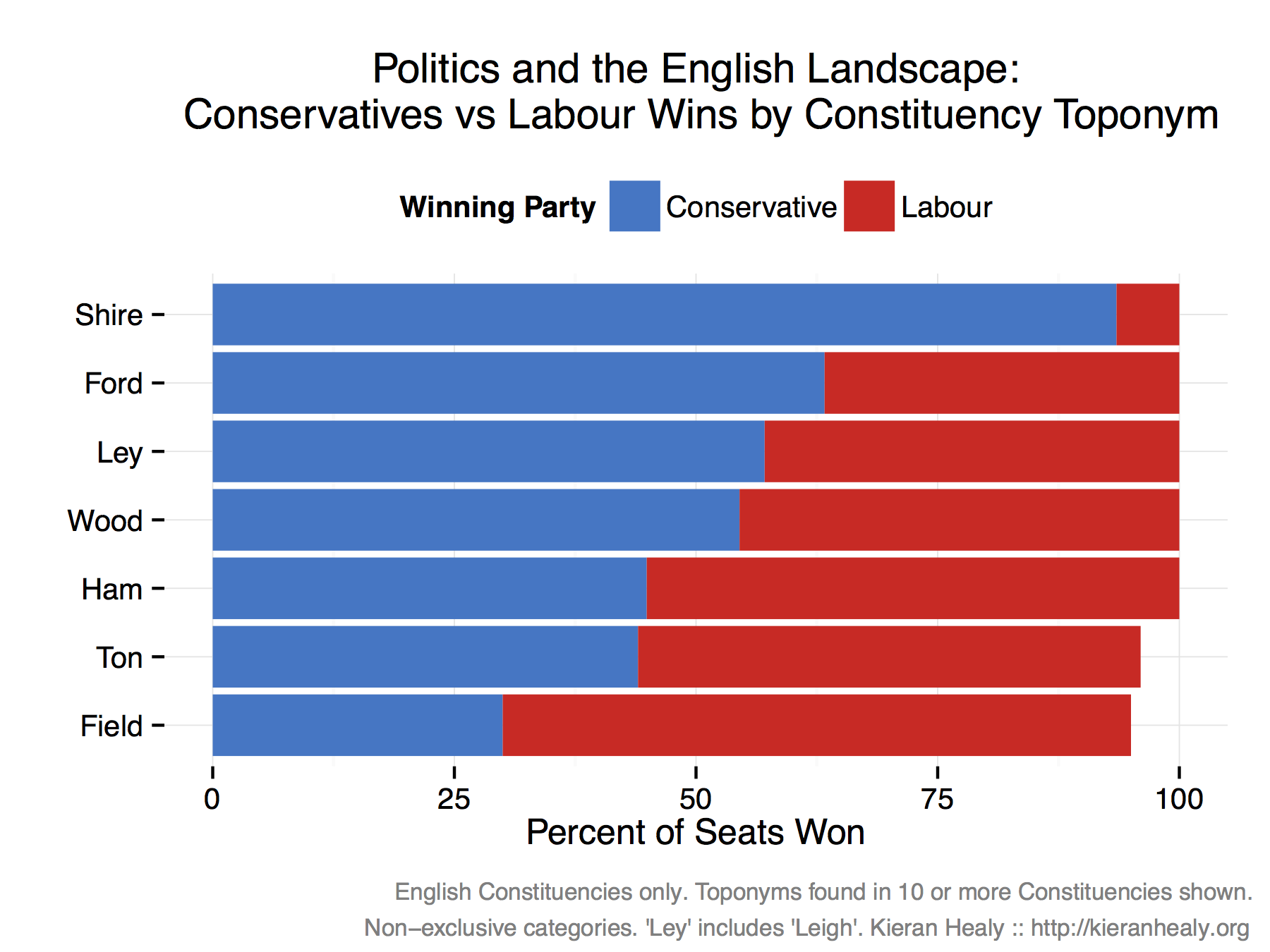
I think that’s rather nice. The Tories are the party of shires and fords, and to a slightly lesser extent of woodland clearings (-ley, -leigh) and woods. Labour meanwhile are the party of -hams (as in, a farm or homestead), of -tons (or towns), and of fields.
Note that some double-counting occurs, because the naming categories are not necessarily exclusive. I did focus on suffixes, so for example “Northampton” would be counted as a -ton but not a -ham, and constituencies with ‘ton’ in their name but not at the end of a word would not be counted in that category.
by Kieran Healy on May 9, 2015
The UK’s election results are being digested by the chattering classes. So, yesterday afternoon I thought I’d see if I could grab the election data to make some pictures. Because the BBC has sane HTML structure, this proved a lot more straightforward than I feared—thanks in no small part to [Hadley Wickham](http://had.co.nz)’s `rvest` scraping library together with `ggplot` and `dplyr` and all the other tools he’s contributed to the R-using public.
So I grabbed the data and made two maps. The first is a version of the one you’ve seen showing the winning party in every constituency in Great Britain (sic: excluding Northern Ireland). The other shows who came in second.
[click to continue…]
3 seats in, all Labour in the northeast. Exit polls indicate meltdown for the LDs, but the Tories doing much better than they expected. Also that UKIP will be the third party in England and Wales in terms of votes. Speculate/Enjoy/Analyze away.
I have been following the UK election as much as I can given an unusually heavy workload for the time of year. Fortunately the campaign seems to have been pretty dull, so I haven’t missed much — and all the fun will be watching the results come in and finding out what nobody seems to know about the outcome. Most of my following of news is either reading or listening – I don’t watch much. So I miss certain nuances and tend to give politicians the benefit of the doubt when I hear them say things that either seem stupid or are mystifying. So, to get to the point, when I have heard Ed Miliband say that he will not go into coalition or do a deal with the SNP, I have tended to think — well, of course he is saying that to try and scare Scots into voting Labour, but he doesn’t really mean it and, when the time comes, he’ll do what he has to do to become Prime Minister.
But I just watched him on Question Time, and when I see him say it, he really seems to mean it . My first question is: does he really mean it?
One possible outcome is that Labour has the by some distance the most seats of any party, but falls well short of a majority, and can govern successfully in (some sort of) partnership with the SNP. On some possible versions of that, the Tories could not form a majority coalition even with the UUP, the DUP and either the LibDems or UKIP. Second question: Even if Miliband really does mean, now, that he wouldn’t do a deal with the SNP, would he renege on that in such a scenario? Third: What would the political consequences for him be if he did renege?
Please will our UK resident contributors and commenters try to enlighten me?
by Chris Bertram on April 12, 2015
Yesterday morning there was a protest near my house in Bristol against a letting agent who has been pushing for rent increases, the story made the national press. Here’s my photo:
by Chris Bertram on March 13, 2015
Well, almost. The British government has just produced [the guidance for its “Prevent” scheme for education](http://blog.sghmartineau.com/archive/2015/03/13/final-version-of-prevent-guidance-published.aspx), which aims to stop young people from being drawn into “extremism”. The elite at Oxford and Cambridge have been granted a specific exemption, allowing them to hear dangerous ideas that might corrupt the ordinary youth, and universities haven’t been given specific guidance on what they may teach. Colleges of further education, on the other hand, have been told that “All relevant curriculum areas will need to be engaged, with a single contact point for delivery of Prevent-related activity.” This so that students are not exposed to arguments that involve
> “active opposition to fundamental British values, including democracy, the rule of law, individual liberty and the mutual tolerance of different faiths and beliefs.”
I suppose it will be news to some that these are “British” values, particularly if they are Irish or live in the former colonies. But leaving that aside, it looks like Plato is off the menu and to make sure:
> “Compliance with the duty will be monitored centrally via the Home Office and through appropriate inspection regimes in each sector.”
Well, that’s freedom for you.