by Henry Farrell on April 18, 2014
As long time readers may recall, I am not a big fan of Elsevier and was a public advocate of the position that no-one should submit to Elsevier journals at a time when it was neither profitable or popular. However, reading this article about Elsevier’s new policy of issuing take-down notices against authors who publish their work on university websites has made me change my mind. Now, I think that everyone should submit as much of their work to Elsevier as they possibly can. Any article that has even a modest chance of success. People should bear through the revise and resubmit process as many times as it takes. Once the piece has finally been accepted, then, and only then, should they withdraw the article from consideration, and then publish it on their university or personal website with an “accepted by Elsevier Journal x and then withdrawn in protest,” together with a copy of the acceptance email (containing the editor’s email address etc).
I do foresee a couple of possible wrinkles in this plan. Perhaps disgruntled elder colleagues might frown upon this (although in some fields at least, disgruntled elder colleagues seem entirely on board with pushing against Elsevier). Non-tenured faculty might want to think a little about the benefits and disadvantages before deciding they wanted to do this. This said, I could imagine senior faculty or tenure letter writers who would find this kind of thing wholly admirable, and to be congratulated, not punished (I know that I would). If this campaign actually took off, Elsevier would doubtless try to disrupt it, by e.g. obliging prospective authors to sign a contract agreeing to publish in the journal if accepted. However, I could also see any such efforts backfiring – most journals would be damaged by such a policy, since many academics (especially prominent and well published ones), would see forced contracts as presumptuous and insulting. Doubtless, there are other flaws that readers can point out.
However, I can’t imagine that the journal’s peer reviewers would have much ground for complaint. Their job is to help improve academic work that is eventually publicly circulated (in other words their loyalty should be to the field, rather than to the journal). Journal editors would probably be unhappy, but really, at this point, no-one should want to be the editor of an Elsevier journal. I’m perfectly OK with academic publishers who don’t try to extract monopoly rents, just as I’m OK with various forms of open publishing (I happily do both). But Elsevier relies both on the willingness of scholars to submit work and their willingness to review it, to make extortionate profits by effectively selling academics’ labor back to the academy. Current proposals to target Elsevier seek to withdraw this labor in one or the other way. Another possibility (which is the one I’m suggesting, albeit without a great deal of serious thought) is to subvert the current system and make it unsustainable in other ways, by extracting the kudos that acceptance in some Elsevier journals can bring out from the obligatory signing away of rights that goes together with agreeing to let the journal actually publish your piece. In a world where ever fewer academics discover articles by actually picking up the journals, this kind of strategy is at least thinkable.
by Belle Waring on April 18, 2014
Congratulations to Harry on his new US citizenship! Perhaps English people rock the whole YOLO thing a little more like this:
by Harry on April 18, 2014
by Corey Robin on April 18, 2014
1. The first time Clarence Thomas went to DC, it was to protest the Vietnam War.
2. Clarence Thomas grew up a stone’s throw from the Moon River that Audrey Hepburn sang about in Breakfast at Tiffany’s.
3. In the 1970s, Clarence Thomas kept a Confederate flag on his desk. [Correction: It was the Georgia State flag, which features quite prominently the Confederate stars and bars. It was a large flag, apparently, and he hung it over his desk.]
4. There’s a law review article about Clarence Thomas called “Clarence X?: The Black Nationalist Behind Justice Thomas’s Constitutionalism.”
5. Clarence Thomas attended antiwar rallies in Boston where he called for the release of Angela Davis and Erica Huggins.
6. Clarence Thomas told Juan Williams that “there is nothing you can do to get past black skin. I don’t care how educated you are, how good you are—you’ll never have the same contacts or opportunities, you’ll never be seen as equal to whites.”
7. Clarence Thomas is the only Supreme Court justice to have cited Frederick Douglass and W.E.B. DuBois in his opinions.
8. In college, Clarence Thomas hung posters of Malcolm X on his wall, memorized his speeches, and studied his writings. “I’ve been very partial to Malcolm X,” he told Reason in 1987. “There is a lot of good in what he says.”
9. Clarence Thomas does not believe in color-blindness: “I don’t think this society has ever been color-blind. I grew up in Savannah, Georgia under segregation. It wasn’t color-blind and America is not color-blind today…Code words like ‘color-blind’ aren’t all that useful.”
10. Yale Law scholar Akhil Reed Amar has compared Clarence Thomas to Hugo Black:
Both were Southerners who came to the Court young and with very little judicial experience. Early in their careers, they were often in dissent, sometimes by themselves, but they were content to go their own way. But once Earl Warren became Chief Justice the Court started to come to Black. It’s the same with Thomas and the Roberts Court. Thomas’s views are now being followed by a majority of the Court in case after case.
11. Clarence Thomas resents the fact that as a black man he is not supposed to listen to Carole King.
by Belle Waring on April 16, 2014
OK, my mom texted me earlier that it was snowing in D.C. That is wrecked-up sideways, people. LAND’S SAKES IT IS THE MIDDLE OF APRIL?! In a way I should really post the Weezer song “My Name is Jonas,” because, do you know what else? Guess what I received in a text today–words of deep concern from my little brother. Building’s not going as he planned. The vortex means digging is banned. The dozer will not clear a path; the driver swears he learned his math! The workers are going home–I reckon, because the dirt’s frozen! How’s the man meant to get a cellar dug for his cool 1950s-plan cabin on the lower meadow of his proppity up in West Virginia if it starts snowing and the workers are going home? Now I imagine it’s all going to melt in a trice but this really has been retarding his plans, for real, and not just in a Weezer song (which is an excellent song, but not as good as “Say it Ain’t So,” The Best Weezer Song. Um. OK, no, I’m changing my plea to guilty claim to “The World Has Turned And Left Me Here“). Yep, they have had the stones and the timber and all that, sufficient to build a cabin, and all taken from the woods itself, but they haven’t been able to break ground till last week because they couldn’t break into the damn ground!
And now it’s snowing on all they poor heads, even that of Fatso, the chihuahua-pomeranian mix, who isn’t fat, and was chosen for his mighty endurance and ability to withstand the harsh winters by sitting in a dog bed made of a damn knitting basket or something right up next to the wood stove. I am told that despite being a pom-chi-chi (no, psych, it’s cause he’s 1/4 pom and the rest chi), Fatso has the soul of a black lab, and that I will love him and not think he is a wretched yappy creature whom humans brought into the world only in order to illuminate the First Noble Truth. We’ll see. E’erbody says so, though. Hmmm. OK Fatso, win my heart. He’ll get a chance this summer when I meet him for the first time.
Anyway, for the rest of y’all, here’s DJ Earworm’s Summermash 2013, with the “hey where’s all my ‘Get Lucky’ and ‘Blurred Lines'” you were wondering about I was complaining about with regard to the 2013 mashup (which has grown on me). Watch, listen, and imagine. Summer is coming, sure as anything. If she is delayed in some way I feel certain that small felt and metal figures whose manipulable fingers become dark with smuts over the course of the film will be animated in stop-motion and narrated over by an avuncular zombie Burl Ives in such wise as to overcome any difficulties as may be posed by the Snow Miser or Jim DeMint or whoever.
by Maria on April 16, 2014
E and I are acquiring a hairy baby this weekend. We can’t agree on a name. He is against human names, except for when he isn’t. I tend towards cute ones that will be embarrassing to call out in a south London park. We’re not allowed to get pretentious ones after writers and such. Suggestions?

[click to continue…]
by Henry Farrell on April 15, 2014
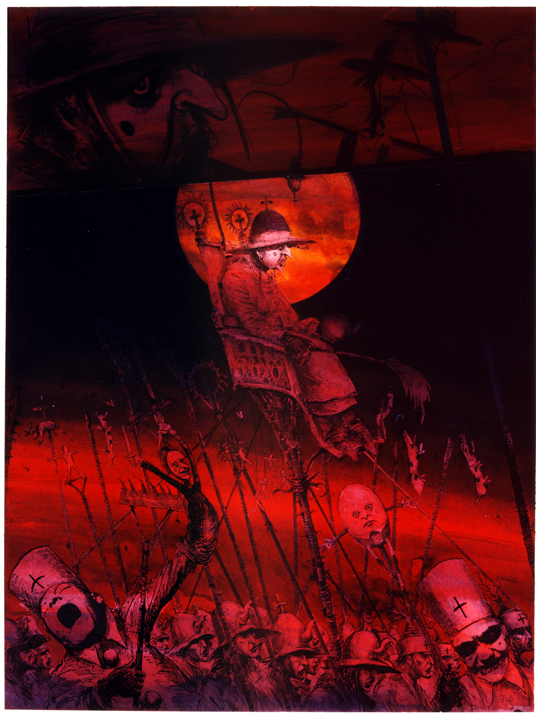
A new collection of Ian Miller‘s art is out today. When I was in my early twenties, I was mildly obsessed by Miller’s graphic novel collaboration with M. John Harrison, The Luck in the Head, to the point that a few years ago, when I could finally afford to, I bought a couple of the originals, including the ‘Procession of the Mammy’ shown above (reproduction isn’t wonderful; it’s far sharper and not nearly as drenched with red in real life).
I thought about this graphic novel, and the Harrison short story it built on a lot last year, when Margaret Thatcher died. Neil Gaiman describes in his introduction to Harrison’s work how:
For me, the first experience of reading Viriconium Nights and In Viriconium was a revelation. I was a young man when I first encountered them, half a lifetime ago, and I remember the first experience of Harrison’s prose, as clear as mountain-water and as cold. The stories tangle in my head with the time that I first read them – the Thatcher Years in England seem already to be retreating into myth. They were larger-than-life times when we were living them, and there’s more than a tang of the London I remember informing the city in these tales, and something of the decaying brassiness of Thatcher herself in the rotting malevolence of Mammy Vooley (indeed, when Harrison retold the story of “The Luck in the Head” in graphic novel form, illustrated by Ian Miller, Mammy Vooley was explicitly drawn as an avatar of Margaret Thatcher).
He doesn’t mention (but then it’s an aside) how Harrison and Miller’s collaboration captures the contrast between Thatcher’s role as emblem and her frailty as a human being. In the picture, she’s already become a kind of ritual object, carted around to no particular purpose beyond display. Like the teapots that are the helmets of her supporters, she’s been superannuated and put to new uses that are both ludicrous and sinister. Another panel shows her after the procession, without her wig, shaven-headed, exhausted and empty, pushed along in a bath-chair by a lackey wearing a fish-head mask (a reference both to Miller’s art – he likes to draw fish – and to an incident in Harrison’s short novel _In Viriconium_). Miller and Harrison depict Thatcherism not as the revolution it believed itself to be, but as an aftermath where the symbols have been emptied of all meaning. Put another way, the senescent Thatcher depicted by Miller and Harrison’s Mammy Vooley represents less a foretelling of Thatcher’s own decline, than the decay of the movement that she represented (a decay which was already present in its moment of full flowering).
by John Holbo on April 15, 2014
That’s the title of this really good (in my opinion) Jonathan Chait cover article in New York Magazine. At this point it would be customary for me to extract a nut graph but, you know, that results in a lot of squirrels fighting it out in comments about just the nut. I think the whole article deserves considerate discussion. So do that instead. (I will be Chait’s defender! Although, of course, if someone picks on one of the places where his foot slips … well, I can’t defend that.)
UPDATE: Sorry, original link was to a subsection not the whole article. And original post title was a subsection title, not the actual article title. Not that it really matters.
by Belle Waring on April 14, 2014
It’s cool that Chris and Ingrid were meeting up recently; Maria came here to have roti prata with me and John in Singapore just the other day. Maybe someday in the future perfect subjunctive all the CT authors could have met one another. Maybe someday we could all meet up at once and have a killer party! I would like it to be…on Ortygia in Syracuse, I think (the one in Sicily). It would be OK if it were in a different city too. HK would be cool. Mataram isn’t exactly a city, but it still might be nice to meet on Lombok somewhere. I took this photo on Lombok week before last, looking East off the Southwest coast. If it were clear and you looked to the left you could see Bali across the Lombok strait, three mountains one behind the other, about as big as the knuckle line of your fist held out at arm’s length. This is also the Wallace line, which divides Eurasian flora and fauna from Austronesian. Storms marching towards us across the marsh and then the river, and up the bluff, and then whiting out the screened porch with rain and then hammering the tin roof with a thousand pebbles taught me as a child that clouds get really full and black and then water up and falls out the bottom. It’s just science.

by Chris Bertram on April 13, 2014
I met up with Ingrid recently and she reminded me that we had plans to run a regular photoblogging series at Crooked Timber, indeed, we actually started one. So here’s a re-start. This is the staircase at the Musée des Beaux Arts at Nancy, France, taken last summer. Here’s hoping that other CTers will join in.
by John Holbo on April 12, 2014
I have resisted writing about the Brendan Eich Mozilla affair. Literally. The ‘resisted’ bit is literal, I mean. Every day, for more than a week, I have expended non-trivial willpower to post nothing. It’s the moral equivalent of a giant bag of snacks in the kitchen of my mind. Unopened. That I am so distracted by the knowledge that someone, right now, is writing something wrong on the internet about Brendan Eich, is a sign I am a glutton for empty calories of falsehood.
Thus, my new policy. I am allowed to eat as many stale snacks of falsehood as I want. I’m opening the Brendan Eich bag. Now. By commencing to write this post I have opened the bag. The temptation is increasing! But I’m … just going to let it sit, getting good and stale. It’s already sort of stale. I did manage to wait more than a week. If, after staleness really sets in, I still want to partake, I may do so. At which point I just may manage to do so moderately, in proportion to such true nutritional content as I may add.
Going forward, let it be so! Fresh truths and stale falsehoods served! [click to continue…]
by Corey Robin on April 12, 2014
The first night of Passover is on Monday, and I’ve been thinking about and preparing for the Seder. I had a mini-victory this morning, when I was shopping for fish in Crown Heights. The guy at the fish store told me that thanks to the Polar Vortex, 90% of Lake Huron is frozen. Which means no whitefish. Which means no gefilte fish. So I put on my best impression of Charlotte in Sex and the City —”I said lean!”—and managed, through a combination of moxie and charm, to get him to give me the last three pounds of whitefish and pike in Crown Heights. Plus a pound of carp. Which means…gefilte fish!
Food is the easy part of the seder. The hard part is making it all mean something. [click to continue…]
by Harry on April 11, 2014
Sue Townsend is also dead. Guardian obit here. I have a small supply of Adrian Mole books, which I give to students (even if, sometimes, I don’t know them well) who have prolonged illnesses — or sometimes just to cheer them up. I have no idea whether it works for them, but it pretty much always works for me.
.
by Harry on April 11, 2014
Richard Hoggart is dead, at 95. BBC obit here; Guardian obit here. His first book, The Uses of Literacy  is still in print after 58 years. I was struck by this para from the Guardian obit:
Late in life he wondered if his readiness to serve on committees was a byproduct of a childhood that had left him “unusually glad to find myself wanted”. Yet he was sceptical about the idea that these compulsions had stopped him from producing another Uses of Literacy. “Did you really expect that I would?” he asked an interviewer. “I didn’t. That’s the sort of book that – if you’re lucky – you can write once in a lifetime.”
by Chris Bertram on April 10, 2014
We’re hoping to have a proper book event on Thomas Piketty’s _Capital in the Twenty-First Century_ in due course. That’s hard for those of us who have read it, because the book is so stimulating, so bursting with surprising facts and ideas, that there’s a lot to talk about. Still, I think I’ll permit myself to share a few thoughts that I had about the way in which reading Piketty might impact on teaching political philosophy, and, specifically, teaching Rawls and the difference principle.
_A Theory of Justice_ came out in 1971 and was composed during the period the French call the _trente glorieuses_ . During that period it was easy to believe that the power of inherited wealth had melted away and that we were living in a new era of more equal opportunity, with careers open to talents and income inequalities largely explained by the differences in talent and ability that the parties in the original position were denied knowledge of. To be sure, 1960s America (like 1960s Europe) hadn’t accomplished that social-democratic meritocratic ideal, but it was kind of visible in embryo, waiting to be born. Rawls’s book took us way beyond that, challenging the glib assumptions about desert that the winners flattered themselves with, but in its toleration of some inequality for the greater good (and particularly for the benefit of the least advantaged), Rawls’s view was recognizably connected to a then-emerging social reality.
[click to continue…]