Third and last part of an article discussing Imperia, the large concrete statue of a semi-fictional medieval sex worker. Part 1 is here and Part 2 is here.
A Clandestine Erection
Imperia went up in April 1993, and I won’t even try to explain the insane backstory.
Short version: some people in Constance wanted a cool statue to add luster to the waterfront. Most of them were thinking of something like a Statue of Liberty. A minority, however, had a more subversive idea. And those guys picked Peter Lenk, a sculptor with a reputation. But when the City Council of this fairly conservative small German city saw the plans… you can probably guess how that went over. There was, let us say, some pushback.
But Lenk and his allies went ahead and put up Imperia anyway. The statue was prefabricated and shipped to the harbor in pieces. Most of the construction happened in a single night, between midnight and dawn.
So Constance woke up to Imperia, and… honestly, it wasn’t love at first sight. “Bemusement” was one common reaction. “Disgust” and “outrage” were up there too.
Part of it was, of course, that she’s a gigantic sex worker. Another part is that she was satirizing something that happened almost six hundred years previous, which even in Germany is not exactly front page news. And of course, there were her let’s say attributes,
[there are a lot of photos of her from this angle for some reason]
plus the fact that she was holding a naked Pope in one hand. Constance is a pretty Catholic town, and the whole “naked Pope” thing didn’t really go over well.
[click to continue…]
From the category archives:
Humanities
Some Americans have been talking about our shared European culture lately! As CT’s resident American-in-Europe, I feel I must respond. So, here’s a European culture story. (This is Part 2, You can find Part 1 here.)
Okay, so Imperia! Big concrete statue on the shore of Lake Constance. Medieval sex worker. 9 meters tall, weighs 18 tons, rotates once every four minutes. Here she is again:
Let’s look at some details.
[click to continue…]
Just north of the Alps, on the border between Germany and Switzerland, lies beautiful Lake Constance. And on the northwest shore of the lake is the lovely small city of Constance, Germany.
Constance is well worth a visit. A lot of German cities have rather bland or unattractive centers, thanks to the American and British air forces. But Constance escaped these attentions entirely, because the Allies didn’t want to risk any bombs landing in neutral Switzerland. So Constance has an unusually intact Old Town with lots of interesting old buildings, some going right back to medieval times.
Constance also has this::quality(80)/images.vogel.de/vogelonline/bdb/1272600/1272674/original.jpg)
A nine meter tall, 18 ton statue of a medieval sex worker. She’s down at the harbor, on the lake. She rotates once every four minutes. Her name is Imperia.
You may reasonably ask, what? And part of the answer is, she’s memorializing the Council of Constance, the great political-religious council that happened here 600-some years ago, from 1414 to 1417. And you may ask again, what?
I’ll try to explain.
[click to continue…]
Now this Seth… did leave children behind him who imitated his virtues…. They also were the inventors of that peculiar sort of wisdom which is concerned with the heavenly bodies, and their order.
And that their inventions might not be lost before they were sufficiently known, upon Adam’s prediction that the world was to be destroyed at one time by the force of fire, and at another time by the violence and quantity of water, they made two pillars; the one of brick, the other of stone: they inscribed their discoveries on them both, that in case the pillar of brick should be destroyed by the flood, the pillar of stone might remain, and exhibit those discoveries to mankind; and also inform them that there was another pillar of brick erected by them. Now this remains in the land of Siriad to this day.
— Antiquities of the Jews, Flavius Josephus, Book 1, Chapter 2, 68-71
So first, a brief digression on Flavius Josephus.
The Turncoat
Ah, Flavius Josephus. Born Joseph ben Matthias, a Jew in Judea, he was a general during the Jewish Revolt against the Romans. But then he switched sides and joined the Romans. He then caught the attention of the Roman general with a flattering prophecy that the general would one day become Emperor. (Which eventually happened. Emperor Vespasian, 69-79 AD.) 
[this guy]
So Josephus became part of the Imperial staff. He changed his name — “Flavius” was the family name of the new Emperor — and led efforts to get other Jews to switch sides. (Mostly unsuccessful efforts. Like, when he approached the walls of besieged Jerusalem, his attempts at persuasion were met with “howls of execration or derision, and sometimes showers of stones.”) After the war was over, with several hundred thousand dead and Judea in ruins, Josephus ditched his Jewish wife and children, followed the new Emperor back to Rome, and wrote a best-selling history. His Jewish War lays great emphasis on the wisdom, strategic brilliance, and noble character of the new Emperor; the invincible might, glory, and greatness of Rome; and Josephus’ own cleverness and correct choices(1). While Judea was crushed under the Roman yoke, Josephus became wealthy and influential, picked up a trophy wife and a villa, and eventually retired to a life of ease.
(1) To be fair, he may have solved the first Josephus Problem. It’s a rare case where mathematical insight was actually life-saving! Well, life-saving for Josephus anyway.
It might be possible to view Josephus as a pragmatic survivor who just joined the winning side. But if you actually read his memoirs, Josephus’ character comes across pretty clearly, and he’s just so immensely pleased with himself.
Anyway:
[click to continue…]
“I am especially to speak to you of the character and mission of the United States, with special reference to the question whether we are the better or the worse for being composed of different races of men.”
— Frederick Douglass, Composite Nation, 1869
Today is Thanksgiving Day in the USA. So, here’s a Thanksgiving cartoon from 1869, by the great American cartoonist Thomas Nast.
You may have seen it before. But it’s an interesting piece of work, and rewards close attention.
[click to continue…]
As universities worldwide face major cuts, especially to the humanities, this meme has been doing the rounds. So I thought I’d share my story about Indiana Jones’ last day of work, drawn in part from Indiana Jones and the Dial of Destiny.

Image: Pic of Indy punching a nazi with text: I came here to study the humanities and punch nazis. And they just cut funding for the humanities.
Indiana Jones, whose front row students once wrote “I love you” on their eyelids, now faced a half empty lecture theatre of students who hadn’t done the reading. OK, he says, let me tell you what was in the reading and then we will do the lecture. But shorter. Of course, Indy knew that the students hadn’t done the reading because they were all forced, under cost of living pressures, to work 12 hour days as disability support workers, supermarket shelf-stackers and Starbucks baristas.
Then Indy went to a Faculty meeting where management explained that “research showed” (cos if anyone cares passionately about painstaking, expensive high quality research, as we know, it is university management) that student consultation, individual feedback or indeed anything else that helps each student become the historian or archaeologist that only they can be, is useless and therefore not included in his workload.
A little dispirited, Indy returns to his desk. Sure, he has to find the desk under a large pile of carefully labelled artefacts that he insisted belongs in a museum. They are on his desk, however, because Indy can’t for the life of him find a museum that will take them. Funding cuts they all say, we can’t possible store, preserve or display anything else. We just don’t have the staff or equipment for proper conservation. Or the space! Who has space, anymore? Plus museum visitors these days really prefer to see Lego models of ancient artefacts. We have to go where the money is. Money is, after all, what museums are for.
Locating his 1991 Apple Portable, which is the most recent computer that Indy’s Arts Faculty can afford, Indy endured the extremely slow campus wifi to check his email. While he waits for the emails to load, he stares out the window. Across the brand new paved corridor through campus, which management claims will soon be lined with groovy shops and cafes, the 24-storey administrative building named after the last Vice-Chancellor glimmers conspicuously in the sunlight. I bet they have newer computers over there, Indy reflects.
The emails load, finally. Indy has several very long emails explaining how he has to manually copy and paste last year’s learning outcomes into a new template even though nothing has changed, just in case one year they want to change one of the regulations no one reads. It is a legal thing.
Ping! Another meeting. This time by zoom. Naturally Indy’s internet connection is too slow, so he keeps his camera off. Actually, the camera doesn’t work at all, but Indy doesn’t realise that until the end of the meeting.
Leading the meeting is a former academic, a colleague of Indy’s, now a low level manager because her teaching load was deemed unnecessary (she only taught historical and archaeological ethics, no one needs that) and she never had a research workload anyway. Having valiantly taken what amounted to (so she was assured) a promotion, she informs the team that archaeological field work needs to be cut, because the latest educational research shows that archaeologists learn best by self directed quizzes and ten minute videos.
Indy can’t get his microphone to work and is unable to object.
Under Any Other Business, the scholar-turned-manager makes the gentle suggestion that team meetings should be ‘camera on’. Someone turns on their camera to remind the manager that cameras off can be important for neurodivergent people. Indy is unable to explain that his camera isn’t working because the manager, fearing staff dissent over the cutting of field work, selectively disabled chat. Actually, she just blocked Indy.
After enduring this ‘teamwork’, Indy crosses the paved thoroughfare to the new shiny building named after the last Vice-Chancellor to attend a consultation workshop. Seated in a plush meeting room with its own deluxe coffee machine, Indy is given an opportunity to ’ask questions’ as part of the staff centred consultation on authentic assessment and real work simulation in archaeological teaching. Shaken by the loss of fieldwork, Indy can’t quite imagine what questions he should ask, which the educational developer in charge of rolling out the expensive and completely unnecessary new eLearning tool (it was a friend’s pet project – they’d poured their third university redundancy payout into the start-up and definitely deserved support from well-placed friends across the sector) takes as enthusiastic support.
When he goes outside again, Indy has to fight Nazis who want him to acknowledge that he’s a secret agent for leftist woke thinking and has Soros sponsorship. It is Thursday, after all.
Finally, just when Indy is thinking about heading home, he’s confronted with urgent questions from his head of discipline, about whether a formula privileging real world application or field defining thinking is most important in deciding who gets the best classroom next year.
So Indy shakes his head and steps into the Room of Retirement, where he is predictably handed a clock as thanks for his – ahem – time teaching and fighting Nazis. Indy looks across to the brand new building named after the last Vice-Chancellor and thinks of all his colleagues whose redundancies went entirely unacknowledged, even by managers with whom they worked closely. He feels almost grateful.
A little woozy from the day’s dizzying lack of actual research or teaching, Indy steps outside. Handing the clock to a homeless person, he heads off purposefully. The Nazis still need fighting, after all.
Geopolitics of knowledge is a fact. Only few (conservative) colleagues would contend otherwise. Ingrid Robeyns wrote an entry for this blog dealing with this problem. There, Ingrid dealt mostly with the absence of non-Anglophone colleagues in political philosophy books and journals from the Anglophone centre. I want to stress that this is not a problem of language, for there are other centres from which we, philosophers from the “Global South” working in the “Global South”, are excluded. In political philosophy, the centre is composed of the Anglophone world and three European countries: Italy, France, and Germany. From my own experience, the rest of us do not qualify as political philosophers, for we are, it seems, unable to speak in universal terms. We are, at best, providers of particular cases and data for Europeans and Anglophones to study and produce their own philosophical and universal theories. I think most of you who are reading are already familiar with the concept of epistemic extractivism, of which this phenomenon is a case. (If not, you should; in case you don’t read Spanish, there is this).
Critical political philosophy is one of the fields where the unequal distribution of epistemic authority is more striking. I say “striking” because it would seem, prima facie, that political philosophers with a critical inclination (Marxists, feminists, anti-imperialists, etc.) are people more prone to recognising injustice than people from other disciplines and tendencies. But no one lives outside a system of injustice and no one is a priori completely exempt from reproducing patterns of silencing. Not even ourselves, living and working in the “Global Southern” places of the world. Many political philosophers working and living in Latin America don’t even bother to read and cite their own colleagues. This is, to be sure, a shame, but there is a rationale behind this self-destructive practice. Latin American scholars know that their papers have even lesser chances of being sent to a reviewing process (we are usually desk-rejected) if they cite “too many” pieces in Spanish and by authors working outside of the academic centre. [click to continue…]
The decades long decline of the Humanities – the academic study of texts and/or the academic practice of criticism* – is often blamed on the latest fad in it, or its faddishness, when such diagnosis is not altogether ground in ideological, political, or theoretical culture-war score-settling (with structuralism, deconstruction, queer theory, critical race theory, etc.) To be sure, in North America and Europe, the decline is very real when measured along a whole range of intrinsic and extrinsic measures: relative undergraduate enrollments, the hiring of freshly minted PhDs, starting salaries of its college graduates, and cultural prestige.
By contrast, I suggest that the decline of the Humanities indicates a more general shift away from the cultural significance of texts in our societies. And put like that allows the real underlying culprit of the decline of the Humanities to come into view: it is fundamentally due to the declining significance of the Bible and of getting its meaning right among those that seek out higher education and social forces that are willing to sponsor the academy. The unfolding death of God — understood (with John 1:1) as the Word — is the source of the decline of the Humanities.
One of the things I really like about my job, is that I have been appointed on a chair with the explicit expectation to advance interdisciplinary collaborations between ethics and political philosophy on the one hand, and the social sciences (broadly defined) on the other. I’ve been co-teaching with historians, taught some courses that were open to students from the entire university, have been giving guest lectures to students in many other programs including economics, pharmacology, education, and geosciences; and I co-supervised a PhD-student in social work. I’ve written an interdisciplinary book on the capability approach, and have co-authored papers with scholars from various disciplines. So interdisciplinarity is deeply engrained in much of what I do professionally.
But while I love it enormously, interdisciplinary teaching and research is also often quite hard. One of the challanges I’ve encountered in practice, is that students as well as professors/researchers are not always able to recognise the many different kind of questions that we can ask about society, its rules, policies, social norms and structures, and other forms of institutions (broadly defined). This then leads to misunderstandings, frustrations, and much time that is lost trying to solve these. I think it would help us if we would better understand the many different types of research that scholars working on all those aspects of society are engaged in. [click to continue…]
Today, for the first time for over thirty years, I don’t have an employer. This is because I decided to retire rather than to face the unwelcome choice between online teaching and exposing myself to COVID in the classroom. I think, in fact, that I didn’t have enough “points” to get an exemption from face-to-face, despite being nearly 62 and having high blood pressure. Oh well, the issue is now moot. I shall miss being around students, chatting to them, helping them and getting the buzz that you get from a good classroom discussion. I won’t miss reading and marking student essays and exams though. Not one bit. I hope I’ve done a good job over the years, even though I feel I only learnt to teach well in the past decade (thanks to the direct and indirect influence of Harry).
There’s another reason to stop now though, which gives me a slight sense of vertigo, to be honest, and it involves “owning your own bullshit”. I’ll have a lot less income but I’ll have a lot more time. I’ve long believed that we, as a society (swap in your own society if you too live in a wealthy one) consume too much, engage in too much burdensome toil, and have too little leisure time to enjoy and indeed work on freely chosen goals. Capitalism has a built-in tendency to promote burdensome toil in the pursuit of consumption, but now I have a choice. Can I live with it? And will I make the most of it without the external discipline provided by the expectations of employers, colleagues and students? That’s a big test. But I hope to continue writing and publishing on many of the same topics I worked on up to now, and chiefly on migration and justice. I’m also happy to stand up on my hind-legs and talk to people about political philosophy and related matters, most of the time for nothing (invitations welcome!).
One thing I haven’t made my mind up on though: mode of publishing. People read books and people read blogs, so if you want to communicate your ideas then both are good formats (among others). But is there any point in continuing to send papers to academic journals? On the plus side, the peer review process induces a kind of discipline and quality control. On the other hand, many of the things that reviewers insist upon are pointless and detract from what you’re trying to say. And then there’s the small matter of the fact that nobody reads such papers. It is a source of lasting frustration that political philosophy as practised in academic journals is an activity that is almost entirely disconnected from the social and political life of the societies that surround it. I don’t mean that we ought to be getting down and dirty with Donald Trump or Brexit, but that we need to find ways of making the things we write about (should foreigners, or expatriates, have voting rights?, for example) cut through to public discourse. Making that argument in the pages of Philosophy and Public Affairs may not make enough of a difference, however good it is for an academic’s promotion prospects. But then, cutting through was one of the hopes I always had for Crooked Timber.
Just finished Johny Pitts’s Afropean: Notes from a Black Europe (Penguin). It is a remarkable and highly readable book which I strongly recommend. Pitts, a journalist and photographer from Sheffield in England, embarks on a journey across Europe to discover the continent’s African communities, from Sheffield itself, through Paris, the Netherlands, Berlin, Sweden, Russia, Rome, Marseille and Lisbon. Pitts, the son of an African-American soul singer and a working-class Englishwoman, is a curious insider-outsider narrator of the book which ambles from meditations on black history and (often American) literary forbears to chance encounters with black and brown Europeans in hostels, trains, stations, cafés and universities.
Is there a unity in all this? Hard to say, since as Pitts observes, these different populations, linked by an experience of marginalisation, come to be where they are via very diverse personal and collective histories. Some have come in their best clothes from former colonies to nations they were taught about as the motherland, only to find they had to make their lives in a place that was disappointing or hostile and where the white population — British, French, or Dutch — remain ill-disposed to see their new compatriots as being part of themselves. Others have fled war, persecution and trauma in Sudan or South Africa, only to find themselves exiled on the periphery of Scandiavian social democracy. And then there are the residual African students in a Russia transformed in thirty years from somewhere professing — occastionally sincerely — the unity and equality of all humankind, into a place where it is dangerous for black people to venture out at night for fear of violent attack or worse.
 So, folks, here it is, my book on the capability approach that has been in the works for a very long time. I’m very happy that it is finally published, I am happy that you can download the PDF for free at the publisher’s website, and that the paperback version is also about half the price of what a book with a university press would cost (and a fraction of the price it would cost if published by one of the supercommercial academic presses whose names shall not be mentioned here).
I am not going to sell you my book – in a literal sense there is no need to sell you anything since you can download the book (as a PDF) for free from Open Books Publishers’ website (and I have no material interest in selling you hardcopies since I will not receive any royalties). And in a non-literal sense I should not sell this book either, since it is not up to me to judge the quality of the book. So I’ll only make three meta-comments. [click to continue…]
There’s nothing like a few unexpected days at home to allow you to discover new things, and the great find of the past few days — thanks to a tweet from Fernando Sdrigotti @f_sd — has been to watch (via Youtube, start [here](https://www.youtube.com/watch?v=vpijOSSlZCI) five programmes in all) some BBC documentaries about Albert Kahn and his Archives of the Planet, now preserved at the [Musée Albert Kahn](http://albert-kahn.hauts-de-seine.fr/) outside Paris. Born in Alsace, Kahn was displaced by the Prussian seizure of the territory in 1871 and became immensely rich though banking and investing in diamonds. But he was also an idealist, convinced that if the various tribes of humanity only knew one another better they would empathize more and would be less likely to go to war. In pursuit of this hope, and taking advantage of the Lumière Brothers’ [Autochrome](https://en.wikipedia.org/wiki/Autochrome_Lumi%C3%A8re) colour process, he sent teams of photographers to all parts of the globe and, before the First World War, caught many forms of life on the edge of being swept away by globalisation, war and revolution. (There’s quite a good selection [here](http://www.afar.com/magazine/a-trip-through-time) but google away.) Pictures taken around the Balkans, for example, depict the immense variety of different cultures living side-by-side at the time and then later we see the sad stream of refugees from the second Balkan War as they head from Salonika towards Turkey. Kahn’s operative document rural life in Galway, harsh penal regimes in Mongolia, elite life in Japan and a tranquil Rio de Janeiro with little traffic and few people.
Kahn’s hope for a peaceful world was lost in 1914, but we owe to his project many images of wartime France, particularly the life of ordinary people behind the lines. Postwar, Kahn was a great supporter of the League of Nations and, again, his operatives were on hand to document many of the upheavals of the inter-war years, such as the burning of Smyrna in 1922 (as Izmir, the city is once again crowded with refugees today) and the abortive attempt to found the Rhenish Republic in 1923. Many of the photographs are included in a book by David Okuefuna, *The Wonderful World of Albert Kahn: Colour Photographs from a Lost Age* (BBC Books, 2008). Sadly, Kahn was ruined by the Great Depression and died in Paris shorly after the Germans invaded in 1940. He seems little-known today, but there’s a lot of material out there that’s worth your time.
We’ve already had Janice Rogers Brown on Samuel Beckett as feel-good self-help guru. Now (from a bit of Molloy I was reading last night), here’s Beckett on the quantified self movement, half a century before it was a movement.
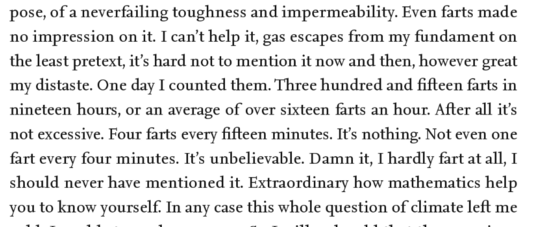
Update: I hadn’t realized that today was the 100th anniversary of Beckett’s birth.
I finished Elena Ferrante’s Neapolitan quartet yesterday. I know there’s been a lot of hype about these novels, but it is entirely justified. Actually, I write “these novels” but this is actually just one long novel, distributed across four printed volumes. For those who don’t know, it concerns the relationship between two women, Elena (or Lenu or Lenuccia) – the narrator – and Lila (or Lina) from childhood to early old age, and their mutual relationship to “the neighbourhood”, a working-class district of Naples and the many other families who live there. It is a difficult friendship, infected with rivalry, jealousy and resentment from the start. Lila is both intelligent and impulsive, spiky and demanding, capable of both extraordinary determination and of self-neglect and remains forever tied to the district; Lenu eventually enjoys worldly success and social evelation, but, in her own mind, is forever in the shadow of her “brilliant friend”.
[click to continue…]