Mr Magpie has always been a bold friend. He sits at the table with us when we are outside. In the warmer months when we often leave the back door open he walks inside the house, sometimes looking for a snack, but often enough walks all the way through the house, apparently just to say hello.
Mrs Magpie and Magpie Jr are friendly, but less bold. They come and sit near us on the ground, not at the table. And they join Mr Magpie in eating nearby, but they don’t eat with us as he does – insists upon, even.
When there is food the three magpies sing a special song. It starts with one low warble, then the other two join in. The pitch of the warble gets higher and it ends with a long note, in three parts, pleasantly discordant. The song feels like gratitude or celebration to me, but who knows.
Being in relationship with Magpies is just great.
For the past few months we’d been noticing Magpie Jr is looking pretty adult. How long with they live with Magpie parents, we wondered? Turns, out, not much longer.
For a bit, Mrs Magpie and Magpie Jr hadn’t been around much. Then on a pleasantly warm day that turned out to be a False Spring (it was beautiful – but now we are kinda expecting snow tonight), Mr Magpie walked up to us while we were having lunch in the outdoor kitchen. Seeming kinda coy, but bolder than she had been for months, along came Mrs Magpie AND ALSO A NEW BABY.
Soft downy grey feathers along its little neck, I am totally anthropomorphising, but Mr and Mrs M seemed so proud. We felt so lucky that they wanted us to meet the new baby.
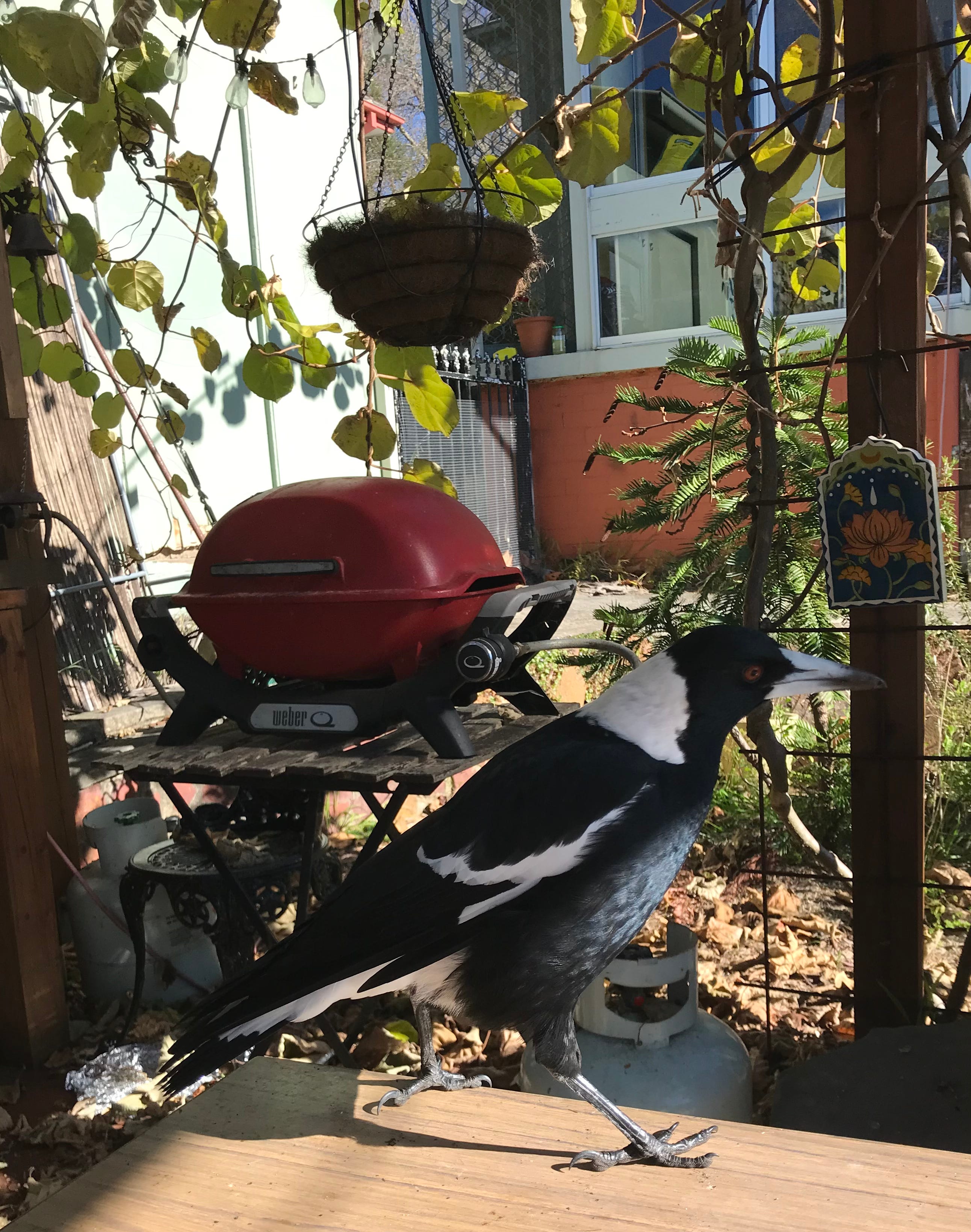
But what happened to the old baby? Obviously I googled. Apparently the young magpies go and join a young magpie gang. The youth gang roams around without a territory and then maybe one day our former Magpie Jr will settle with their own mate and take ownership of a new territory.
That process of roaming, mating and then claiming territory is fundamentally unstable. Each magpie carries with them the potential to maintain control over territory that they don’t yet have. It is messy, power hungry and a bit violent.
As spring looms the violence brews; magpies swoop magpies, in groups and alone. From now until summer is a pretty uncertain season as birds – magpies and their mortal enemies, the sulfur-crested white cockatoos – battle for territorial rights.
Is this a bit like what is happening to us, now?
Globalisation is over, Globalisation is Back on
I’m no expert on tariffs but their intention is surely towards deglobalisation. The Economist magazine, which as I understand it has supported free trade for 182 years, has been all doom and gloom about this whole tariff thing. I’m not saying they are wrong, but rather that 182 years of such a position also constitutes a politics.
Those economists (like at The Economist) who declare tariffs to be universally, ahistorically bad may be correct from certain angles, but we also gotta say that the latest phase of anti-tariff globalisation since the 1970s/8-s has not been that great, based as it is/was on enforcing governmental austerity (from some quarters, a deliberate attempt to override democracy’s tendency to redistribute the booty of capitalism to make things slightly fairer), so that goods, human labour and contracts flow like water to where profit can be extracted at the lowest cost.
Well, really the lowest price for the costs were and are enormous. The environmental cost alone might one day kill us all, while in the meantime we live with unspeakable levels of inequality that may well spill over to Magpies-in-spring level violence, but by humans who have nuclear weapons.
Carbon-spewing globalisation has been terrible for the actual (not just metaphorical) magpies, too, whose trees burned to an existential degree in the 2019 Black Summer bushfires. We were in green, damp England, but my wonderful local friend Naomi Parry Duncan says that many birds moved into town and began to build closer relationships with humans.
When I came home (due to Covid return-home directives) I shed tears as I walked in silent, burned forests with no birdsong – and not even the scuttling of tiny lizards beneath the leaves. The silence, it seemed to me, of mass extinction.
See the entangled nature of our living, and of historical capitalism. Even our present friendship with the Magpie family and their new baby may well be a result of globalisation.
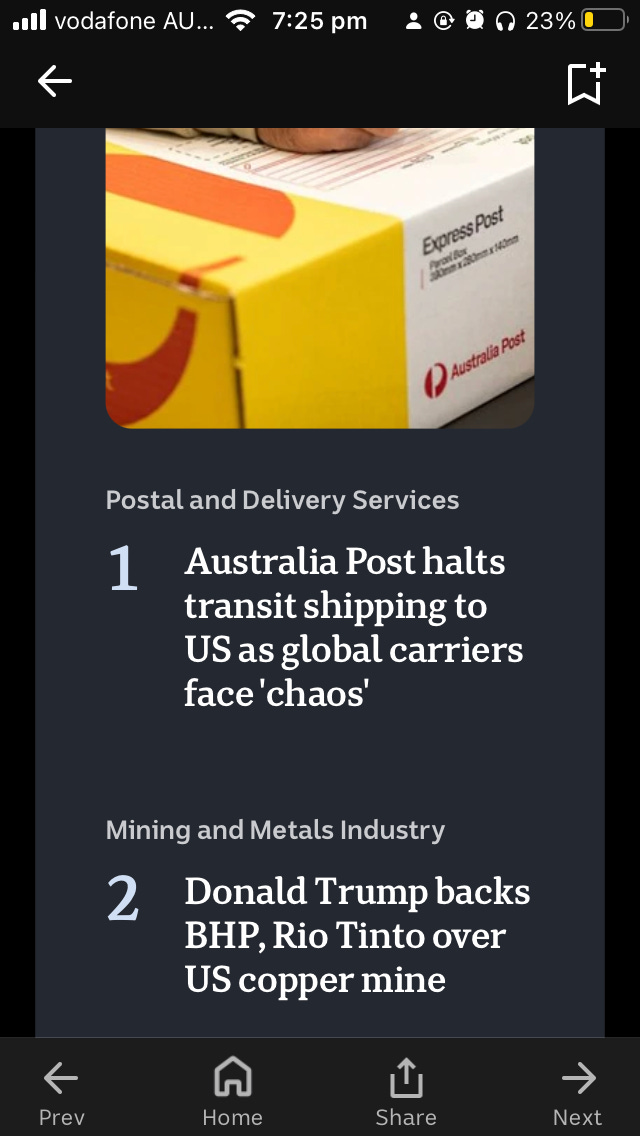
The next story on the ABC news website contradicted the first. Mr “America First” was now choosing our Australian mining giants over red blooded American corporations to mine copper in Arizona.
Well, the end of globalisation didn’t even last as long as the End of History. Before I even scrolled down, globalisation was already back on.
I wonder if that is because deglobalisation is just not what is happening, but instead a kind of geoeconomic fragmentation, forging new complex, networked and multiple trading and relationship blocs.
I find this thought tantalising. But although Google Ngram shows ‘geoeconomic fragmentation’ growing since 2016 (wonder what happened then?), it still thinks ‘deglobalisation’ dominates – if frequency of mentions is a measure of anything (and it probably is).
Finding Capital Down the Back of the Sofa
In fact, under geoeconomic fragmentation, nations may instead be anxious not to lose critical goods, resources and human capital – and definitely, definitely not capital capital, which surely needs to be invested at home, especially to build more homes, flats and high-rise apartments, since somehow everyone seems to now have a housing crisis.
As a result, nations may have more difficulty accessing markets, components, materials, iron ore, and those dangerous-to-get but essential rare earths – and may need to look for them closer to home. So that one might also ask local capital to hang around, please. That really does sound like deglobalisation, doesn’t it, actually?
A related problem is that the workforce is getting older on average and the global workforce is shrinking, due to declining birthrates (except perhaps in Oz where we have high migration).
What it looks like, at least to my inexpert eyes, is that, no longer able to trust in the flow of global capital and a workforce ever-expanding by adding women, migrants and just more people being born, everyone instead is coerced into hunting for the scraps of capital in every dusty corner, under each piece of furniture and between the couch cushions.
Capitalists have long colonised ‘empty’ (not empty) worlds and accumulated their resources. They have exhausted forests (but are still bulldozing the last of them), have tapped the water sources (and are pouring their last dregs into AI) and are scraping the bottom of the very large coal and gas barrel provided by the carboniferous period (and are determined to exploit the last of it, even to the end of the world).
In recent decades the system has gathered women into the workforce (though boosting childcare might grab the scraps of the gendered commodity frontier).
What is left? Maybe the speed of investment, producing faster reinvestment?
Because now, a new deregulation (not-actually-deregulation, really) movement seeks to loosen selected regulations (in a flexible, targeted way) so that capital can be deployed more quickly (but without the perverse, deadly results of deregulation). Less friction, more profit from even small scraps of capital, right?
Similarly, encouraging labour mobility, at least within domestic borders, so that skills that are under-utilised in one area can be exploited by a sector that really needs them.
Augmenting labour with AI and other forms of automation waves the metal detector over the old mine.
And then, combining multiple, previously-marginal, sources of energy will ensure there is enough power to make the AI run.
Somewhere under those couch cushions is some loose capital which, added up, amounts to something that is not austerity and we might as well call abundance – though it does not look, at least to me, like abundant life.
Can the Magpie Unionise?
And in an anti-colonial, turning-power-systems-upside-down sense, we also, surely, want to attribute agency to the Magpies – and maybe even those dickhead suflur-crested cockatoos who snip the heads of hyacinths, lettuces and even the solar-powered outdoor lights in the outdoor kitchen. Rather than extract value from a perceived passive ‘nature’, we include it as agents that make our world, history and economy.
In our history of capitalism reading group last week we (re)read Timothy Mitchell’s classic book chapter ‘Can the Mosquito Speak?’.
A wondrous, meandering discussion about agency and relationships between non-human things (birds, coal, mosquitos, pens, AI) and humans in the history of capitalism a clever postdoc at the beleaguered UTS, Matt Ryan, pointed out that the question of agency in the history of capitalism may not be so much about whether the mosquito can speak as whether the mosquito can unionise.
When I went out to the outdoor kitchen to find snipped light bulbs, I gotta say that felt like anti-colonial, collective direct action on the part of the cockatoos – against me.*
So, maybe.
I’m not certain about much. But things are changing. Power relations. Geopolitics. The global economy. And the logics and intellectual frameworks in which we try to think, do and make policy. Even if we are Magpies.
*Since I drafted this the sulfur crested cockatoos also destroyed a bed of garlic, another of spring onions and DUG UP (not just snipped) the jonquils.
{ 23 comments }
Cheez Whiz 09.09.25 at 11:18 pm
The Trump economic plan is a pastiche of 19th c. economics, empire tribute extraction, and what appears to be a very deliberate downshift of the us economy. The administration is completely sincere in its desire to deport 10M or more immigrants, defining “illegal” on the fly as needs be. The parallel Wellness agenda of RFK at HHS and the gutting of Medicaid, will result in up to millions of unnessary deaths. It looks like a concerted effort to decrease the size of the US population, to what end may be buried in Project 2025 or the 7 Mountains project. The various economic deals being struck are agreements to make a deal, with vague and unenforceable investment numbers thrown around. Most likely this all constitutes a plan by accident at best. How the rest of the world reacts and adapts will be the real plan, not anything the US does.
John Q 09.10.25 at 1:51 am
Unfortunately magpies routinely mistake humans, particularly cyclists, for cockatoos or maybe goannas (monitor lizards that like to eat birds eggs,name is a corruption of the unrelated iguana). First attacks are occurring right on time in September.
It’s striking that magpies, which are quite intelligent birds, haven’t worked out that humans can’t fly and almost never climb trees. Even in the absence of retaliation, time spent attacking humans is time when the nest is unguarded against real threats.
Ken_L 09.10.25 at 4:08 am
The magpies in my little village know all the local residents. We never get swooped. Not so the brain-dead plovers, who spend every day in a state of panic because people are approaching.
The cockies are definitely organising against us. They delight in biting unripe fruit off our fruit trees, tilting their heads in joy to watch it fall to the ground.
It’s probably nothing but the disillusionment of old age, but it does seem to me that lots of Americans are rapidly regressing into resentful violent adolescence, inspired by infantile billionaires, and an increasing number of people in the rest of what was once called “the free world” are thinking “That looks like fun!”, and doing the same.
Gareth Wilson 09.10.25 at 4:13 am
“we live with unspeakable levels of inequality that may well spill over to Magpies-in-spring level violence, but by humans who have nuclear weapons.”
I believe that among the particular people with control over nuclear weapons, inequality isn’t too bad.
Laban 09.10.25 at 9:33 am
Aussie magpies are such lovely singers, unlike the UK magpie. We stopped in a layby on the Great Ocean Road to admire the view (I think of Torquay) and one alighted on a post maybe six feet away and warbled beautifully. It didn’t mind a camera pointed at it either. Probably that bird’s on dozens of tourist videos, if not hundreds.
engels 09.10.25 at 9:59 am
In recent decades the system has gathered women into the workforce… What is left?
Florida debates lifting some child labor laws to fill jobs vacated by undocumented immigrants
https://edition.cnn.com/2025/03/25/business/florida-child-labor-laws
engels 09.10.25 at 10:22 am
Also: forcing sick and disabled people to work (harder), raising the retirement age to infinity and gradually replacing everyone’s “leisure” with various joyless but economically productive compulsions.
Maybe not as sexy as asteroid mining but it’s a lot more lucrative.
Doug Muir 09.10.25 at 2:17 pm
“It’s striking that magpies, which are quite intelligent birds, haven’t worked out that humans can’t fly and almost never climb trees. Even in the absence of retaliation, time spent attacking humans is time when the nest is unguarded against real threats.”
— This may be happening because they’re intelligent birds. Magpies are bright enough to send and receive threats, and they probably have some concept of deterrence. So, demonstrating truculence — “look everyone, I’m SO aggressive that I’m even attacking this harmless thing!” — could easily be adaptive.
Competition for nesting sites and territory is, unfortunately, a zero-sum game. If a magpie wants to pass on its genes, it needs a sufficiently large territory. That territory has to be defended against all potential rivals — and there are always lots of potential rivals. So, ostentatious displays of aggression may be selected for.
It’s basically Mad Bomber Theory, bird style. You want to look too crazy to mess with! It may be expensive — but not as expensive as getting in a no-kidding fight that may end in injury, death, or defeat.
It’s depressingly possible that the chill, calm magpies that don’t attack cyclists are more likely to be perceived as weak, and thus are targeted by rivals or the hungry landless.
Doug M.
Kindred Winecoff 09.10.25 at 4:30 pm
This is very good, Hannah.
“I wonder if that is because deglobalisation is just not what is happening, but instead a kind of geoeconomic fragmentation, forging new complex, networked and multiple trading and relationship blocs.”
That is my bat-signal.
Yes this is happening, but not “fragmentation” into blocs… “fractionalization” into communities. The difference is technical but important. If we don’t get this right then the timelines that open up are very bleak indeed: https://www.pnas.org/doi/10.1073/pnas.1509423112
So what is important (IMO) is to rapidly pursue direct ties where there used to be indirect ones. For decades, many economies were indirectly connected to each other through the US, with the US taking a service fee for providing the connection.. I.e., Asia recycles export surpluses through Wall St which are then invested in the EU and Latin America.
Now the US is closing off that “brokerage” aspect of connectivity (Henry would refer to “chokepoints”).
So there are two choices: allow fractionalization to proceed on the US’s terms, or form new ties — very rapidly — in order to create more direct connectivity on alternate paths that do not run through the US.
Allowing fractionalization to proceed on the US’s terms is submission to imperialism. Forming direct connections around the US requires facing the reality of the global economy, taking responsibility for it rather than expecting someone else to do so. That is the magpies problem.
The good news is that creating pathways around the US’s chokepoints could be more democratic and egalitarian than the previous system. The bad news is getting to that point will require forms of coordination that the world is poor at, and in particular it will require actors and institutions that are uncomfortable expressing power to get comfortable with it.
NOW.
dk 09.10.25 at 11:59 pm
It never surprises me that magpies attack humans. We’re the greatest threat to the survival of most species barring rare exceptions, and we have extensive form in causing extinctions and destroying habitat. Lucky for humans that the natural world doesn’t engage in collective action, or every animal on the planet would be doing their level best to kill us in self-defense.
John Q 09.12.25 at 7:57 pm
“The bad news is getting to that point will require forms of coordination that the world is poor at, and in particular it will require actors and institutions that are uncomfortable expressing power to get comfortable with it.”
Most obviously, Europe which has very good reasons for being uncomfortable with the expression of power, and has built co-ordination mechanisms internally on consensus and externally on US leadership.
Tm 09.12.25 at 8:05 pm
Did my Comment get lost?
There’s one about quantum computing that’s been posted. Nothing in moderation- JQ
Black Bird 09.14.25 at 8:13 am
I love birds, in general, but I must confess, I particularly love magpies.
Still, I do have a question: how can one tell the gender of a magpie?
Incidentally, last year I was witness to a bit of a golden-crested cockatoo versus currawong confrontation. If the thing had reached the physical stage, my guess is that the currawongs wold have been no match for the cockies: bigger, heavier, stronger and with some very respectable beaks.
So, I intervened, scaring both gangs.
That goes to show that cockies are not just cocky, but maybe even a bit bully?
AndrewMcK 09.14.25 at 9:04 am
Black Bird,
Adult males have a clear white back.
Juveniles and adult females have a black/grey/white back
Kindred Winecoff 09.15.25 at 6:02 pm
JQ, sorry for the slow reply, things got loud in the US over the weekend.
Yes, Europe, but not just Europe, that’s too reductionist. The Commonwealth too. Emerging non-China Asia too. Latam too (big opportunity there). ASEAN too.
All of these places/communities have been effectively able to eschew responsibility for decades, other than providing mostly-reliable support for hegemonic projects (which included some public goods provision but also some extraction). All of these places have grown enormously from their positions within this structure, and are now much stronger than they seem to realize, understandable given their long histories in subordinate roles.
Now that structure is going away, and more people/groups/states are going to have exert themselves in ways they are not used to doing in order to prevent system collapse and secure the gains they’ve made. There is no hegemonic project to support anymore, so those efforts need to be re-directed towards direct integration efforts. The plus side is that there are tangible (and symbolic) gains out there to be seized for those who act with initiative, and there are new mechanisms for resolving domestic political squabbles by taking them into the international domain.
It seems that every democracy is suffering from versions of the same problem — policy statis in a context of socioeconomic and demographic change — and transnationalizing those problems can be the way out.
This has been the US’s secret sauce for decades: they transnationalize their problems and make ROW bear some/most of the cost of adjustment, which has helped the US manage domestic political problems through the distribution of globally-earned rents, basically.
That’s now the prize for system-builders: you can get your slice of the exorbitant privilege if you work quickly to secure your interests through building paths, and if you do it now you lock in your slice of the privilege indefinitely.
This, I think, is what Mark Carney understands very well: he cannot solve his domestic political problems domestically. And neither can anyone else.
If you wait for someone else to move first then you might not like the next hegemonic project so much. So there is a strong incentive to act NOW: replace the ties being severed even in advance of them being severed, so there is a supportive structure in place to prevent freefall.
LFC 09.16.25 at 4:30 am
Re “expression of power”: France and Germany, and sometimes the UK also, have shown a willingness to break from the U.S. on certain foreign policy issues (e.g., France and Germany opposed the 2003 Iraq war, and all three countries are about to recognize a Palestinian state, admittedly a symbolic move but one that breaks w/ the U.S.). Lula’s govt in Brazil is properly upset about Trump’s tantrums re Bolsonaro, who was just convicted. Maybe these and other political divergences from U.S. can (somehow) be translated into closer economic co-operation, encompassing EU, at least parts of S. America, and bringing in e.g. sub-Saharan Africa as well which shdnt be overlooked.
Kindred Winecoff 09.16.25 at 3:56 pm
LFC, what I am describing must go far beyond mere disagreement, and is going far beyond that already. We need PROACTIVITY. Everywhere.
Think of it this way: world politics was “ordered” — contestable concept, but whatever — via large multinational IGOs backed by US hegemony. That is gone. Not going; gone. Everyone needs to update quickly, that world is over and we are now in a scramble to build another one. On one side are the “move fast / break stuff / ask questions later” tech fascists who are constructuring platform power in order to “lock in” their dominance. They’ve been winning: global democracy levels have been in decline for a quarter-century already.
If the other side does nothing but critique these efforts, then that side will win. What we need is countervailing infrastructure, and what I hope people realize is that that exists in sufficient supply to push back the efforts of the platformers already, if it is linked and a few gaps are closed (see below on triads).
You are correct that Lula is a key actor here, and what is important is that EU-Mercosur are poised to pass an FTA that would — once already-existing FTAs are brought into consideration — link Europe (inc UK), Latam, and Pacific Asia via overlapping trade institutions that also include the Commonwealth. Japan-Mercosur is also being negotiated.
A very useful concept for those who recognize the need to “dispense with the US” (as JQ puts it) is “triadic closure”. Imagine a world of 3 units: USA, Europe, Pacific Asia. Prior to now there have been strong ties b/t USA and Europe and USA and Pacific Asia, but the ties b/t Europe and Pacific Asia have been indirect, largely mediated by the US.
The job now is to “close the triangles”: form direct ties to reduce dependency — remember when the left used to talk about dependency?? — on the US that comes from structural positioning, so when the US tries to leverage (“weaponize”) their mediating role everyone can walk away. The US can severe its ties, but then it only isolates itself… the rest of the structure holds, while the US falls through its own trapdoor.
I know Starmer bores the left, but the UK signs a defense-cooperation agreement with Europe and another one with Japan and thus Europe Japan are institutionally connected without having to go through the US. That is leading to things like a joint stealth fighter program built as a Japan-UK-Italy joint industrial project. Reducing reliance on US security provision is far more important for carving out space for progressive politics than anything Corbyn accomplished in 10 years as Labour leader.
When we think of triadic closure as the project then we see opportunities everywhere already, b/c the stagnation of the WTO / Bretton Woods architecture over the past quarter-century (since GWOT began post 9/11) has already encouraged infrastructure building. A very dense web of individually-smaller-but-systemically-larger agreements that produce network communities. Some IR scholars call this the “regime complex”, it is a multifaceted system of polycentricity which can be activated to govern cross-broder relations without a new form of centralization.
We need to close the gaps faster that are emerging faster than the 47 admin can attack the existing connections and thus isolate (and exploit) the communities. Right now 47 has to keep backing down (TACOman) because he’s not strong enough, but if he isolates the communities then he will be.
Ernesto Talvi understands how the pieces can fit together: https://euobserver.com/eu-and-the-world/ara4c61699
LFC 09.17.25 at 2:59 am
@ Kindred W.
Thanks; I hadn’t heard the phrase “triadic closure” before. (When I get a chance I perhaps will email you some thoughts.) Would point out that the UK this past June bought some dual-capable (i.e. conventional/nuclear) F-35s from the U.S. Fwiw, I don’t think that makes a lot of strategic sense — Putin is going to be deterred by strong conventional forces esp. in the front-line NATO states, not by F-35s that can drop B61 nuclear bombs — and, more relevantly here, it tends to cut against some of what you’re mentioning. Still, I’m glad to learn that Starmer has signed defense coop agreements w Europe and Japan that bypass the U.S. (And yes, I remember the dependency theorists very well, for reasons that are mostly way too autobiographical to go into here.)
Buster Keaton 09.17.25 at 7:09 pm
LFC, UK is playing a mixed strategy, which they have to do for now. In fact most countries have to do it in the short run, that is the cost of dependency.
It is also the reward of investing in infrastructure to reduce dependency. The NIEO did not do that, they tried to “weaponize” commodity power through the UN. That made them targets, and there was not enough solidarity to overcome that once the oil shocks hit. (I know you know this, just writing it out for others and to establish how now is different, structurally.)
It’s not the 1970s, this is a much broader range of countries with a much more diverse/complex economic base than 50 years ago. And, crucially, the world is far more interdependent now. Which means that concepts such as triadic closure are increasingly useful. And not just triadic… k-adic (where ‘k’ can be any number of countries greater than 2).
So think about the F35s this way: does that make the UK a more attractive security partner for Japan/EU?
If so, then the purchasing might be about improving the UK’s structural position in international negotiations with peer states who are suddenly in a position of burden-sharing that they did not ask for and are having difficulties navigating. E.g., Japan cannot buy F-35s, b/c they are not a nuclear power and do not have a forward-deploying security force; the EU cannot buy F-35s, b/c they are stuck in bureaucratic procurement processes with tons of veto players who prefer EU-based supply chains (not unreasonably).
But the UK can buy them, and then engage in diplomacy to share the benefits of a nuclear deterrent with like-minded states who can bring other things (e.g., tech R&D) to the party. In the network analysis we would say that the “fitness” — as in evolutionary fitness — of the UK was enhanced with that investment, which allows it to attack new ties with other nodes in the network, thus closing structural holes and reducing dependency on American security provision for the network (not just the UK individually).
So the UK buys equipment, shares access to that equipment with the EU and Japan, and within a few months there is a new security connection from Europe to Asia through the Commonwealth. This, at minimum, buys time for more durable arrangements to be created.
This is one way in which bridges can be built to the post-American future without completely destroying global structures as a prerequisite (as in the 1930s). Yes it is ad hoc, but that is probably for the best right now.
Tm 09.18.25 at 7:18 am
Buster 19: “Japan cannot buy F-35s, b/c they are not a nuclear power and do not have a forward-deploying security force”
Why then can Switzerland buy F-35s? Not that it’s a good choice to buy them but they did make that purchase decision (the vast majority of the people are opposed to it).
I’m confused by your statements about the F-35s. The thing with buying these expensive bombers is that the purchaser is buying into a huge dependency from the US, which now means dependency from a pro-Russian fascist regime. They cannot just use the F-35s as they wish let alone share them with other countries. Everybody now seems to agree that the F-35 is a bad idea.
Buster Keaton 09.18.25 at 3:36 pm
It is correct that there are often multiple competing factors at play, and multiple time scales too. I did not bring up F-35s, and I don’t think it’s worth trying to force binaries onto a system in which many things happening at once. We’re not in a situation where states can easily choose all of one thing and none of another; hence TACOman.
(Japan is constitutionally restricted in many ways that other countries are not. Japan is also militarily occupied by a foreign power in ways that other countries are not.)
Within NATO and its appendages there is huge dependency on the US already. This is the present situation. There are also immediate/intermediate threats that require cooperation with the US in various ways, even while pursuing off-ramps from indefinite US dependency.
There’s is a “buying time” component to this, because we are in a transactional moment. The point is that time, once bought, should be used constructively to build infrastructure to reduce structural dependence. Countries cannot develop and build fighter jets over night. They can develop and enact resource-sharing agreements, tech-sharing agreements, trade agreements, investment agreements, etc. Out of those, defense projects and products can be created too.
Today the only path is: buy the F-35s. We need to construct alternate paths precisely to avoid that form of dependency.
LFC 09.18.25 at 7:19 pm
As I understand it, the only formal control the US maintains w.r.t. the F-35s that Britain bought has to do w/ the B61 nuclear bombs themselves. When flying the planes in their conventional (i.e., non-nuclear) mode, the Royal Air Force can do pretty much what it wants w/ them. Some other European countries prob. have F-35s, but I doubt they’re the dual-capable (conventional/nuclear) model that Britain bought, which has different weapons bays that can carry the B61. I would think Switzerland, for instance, has the conventional-only (non-nuclear) model. (The F-35, btw, is not a bomber; it’s a very expensive fighter jet whose weapons bays in the so-called dual-capable model, as already mentioned, are configured to accommodate modernized nuclear “gravity” bombs. In the conventional model, it can carry only non-nuclear weapons.)
Japan is in a different position b/c its basic laws, although maybe recently amended (?) in this respect, still place some limits, I believe, on the size of its military and the types of weapons it can acquire. (Not researching this, but that’s my impression.)
As for B.K.’s point that Britain’s purchase makes it “a more attractive security partner” for others (i.e., other than the U.S.) — perhaps. I think one wd need to wait and see. However, “triadic closure” can proceed in other ways, as B.K. suggests.
Tm 09.22.25 at 7:27 am
LFC, even without formal control over the operation of fighter jets, if you buy them from the Trump regime, you are gonna have a degree of dependence on the Trump regime because you need constant maintenance, you need spare parts and software updates and the likes.
“Without access to American-controlled maintenance and logistics chains, as well as computer networks, any F-35 fleet would quickly start to become unusable and any jets that remain flying for a truncated period of time would only be able to do so with massively degraded capabilities.”
https://www.twz.com/air/you-dont-need-a-kill-switch-to-hobble-exported-f-35s
It is also usually forbidden by contract to share advanced weapons systems like the F-35 with other countries without US permission.
Comments on this entry are closed.