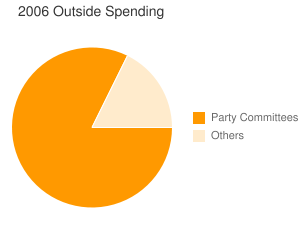
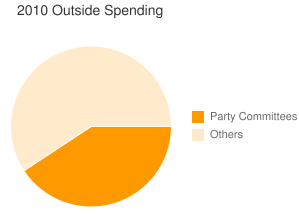
A lot of US-based bloggers are speculating about who is going to win or lose in the Congressional mid-terms. Myself, I’ve nothing much to add to that discussion. What’s more interesting to me is the potential transformation happening within the Republican Party. Parties – like most other organizations in advanced industrial democracies – depend on money. And it’s pretty clear that the sources of fundraising are changing. Take a look at this Sunlight Foundation post on the balance between spending by traditional party committees and by outside groups. Or just look at the key graphs.
Felix Gilman’s new book, _The Half-Made World_ is out (Powells, Amazon). I liked it very much indeed (but then, I’ve liked everything that Gilman has written since stumbling across Thunderer ). It’s a steampunk-inflected Western, with a fair dollop of HP Lovecraft thrown in (the malignant ‘Engines,’ whose physical appearance is mostly left undescribed, are genuinely unsettling). The writing is lovely, and the main character a genuinely complex and interesting woman.
bq. Amazon is rolling out a separate section of its Kindle store meant for shorter content—meatier than long-form journalism, but shorter than a typical book. Called “Kindle Singles,” the content will be distributed like other Kindle books but will likely fall between 10,000 and 30,000 words, or the equivalent of a few chapters from a novel. The company believes that some of the best ideas don’t need to be stretched to more than 50,000 words in order to get in front of readers, nor do they need to be chopped down to the length of a magazine article. “Ideas and the words to deliver them should be crafted to their natural length, not to an artificial marketing length that justifies a particular price or a certain format,” Amazon’s VP of Kindle Content Russ Grandinetti said in a statement. (Anyone who has ever read a terrible “business” or “self-help” book consisting of a single idea furiously puffed up into 200 pages of pabulum will no doubt agree with this sentiment.)
While I’m not greatly enthusiastic about Amazon as a company, I am hopeful that this form of publishing takes off (for reasons I laid out a couple of years ago). I don’t particularly object to overly long self-help books or business books, since even if they were pithier, they usually would not be worth reading. I presume that the actual functions of these books is (in the case of business books) to provide a common, if conceptually empty, jargon for interacting with work colleagues, and (in the case of self-help books) to provide a symbolic substitute for actual self-help. Shorter electronic versions would not necessarily contribute to either of these functions.
However, I _do_ object to books which have an interesting insight, but pad it out across several chapters to make it publishable. More essays around the 20,000 word mark, taking an interesting point and elaborating it more than would be possible in a standard magazine article, would be a very good thing.
Utter genius. But watch it now – I suspect that when “This constitutes a fair use of Disney’s Donald Duck” meets a takedown notice from the Mickey copyright mafia, the takedown notice is going to win.
Matthew Yglesias describes this Malcolm Gladwell piece as a ‘smart’ take on ‘how the kind of “weak ties” promoted by online social media can’t do the kind of work of the kind of “hard ties” that the leaders of the civil rights movement used to knock down an authoritarian system.’ I did a bloggingheads with Julian Sanchez yesterday where we discussed this piece – and, to put it mildly, we didn’t find it smart (Julian describes it as his ‘most recent excretion’). Not because it was necessarily _wrong,_ but because it did the usual Gladwell trick of taking a vaguely counter-conventional-wisdom argument (in this case, a rehashing of what Yevgeny Morozov has been saying for the last couple of years), adding some quasi-digested social science and a couple of illustrative anecdotes, and then spinning out a _New Yorker_ article. He’s a good writer (for pre-masticated values of ‘good writing’) but a quite mediocre thinker.
I’ll confess to being _particularly annoyed_ by the Gladwell piece because it seems like the purest possible distillation of the intellectual-debate-through-duelling-anecdotes that has plagued discussion over the Internet and authoritarian regimes over the last few years. As this new report (PDF) for the US Institute of Peace (co-authored by Sean Aday, me, Marc Lynch, John Sides, John Kelly and Ethan Zuckerman) discusses at some length, we more or less have _no idea_ of whether Internet based media hurt authoritarianism, lead to group polarization or anything else.
bq. The sobering answer is that, fundamentally, no one knows. To this point, little research has sought to estimate the causal effects of new media in a methodologically rigorous fashion, or to gather the rich data needed to establish causal influence. Without rigorous research designs or rich data, partisans of all viewpoints turn to anecdotal evidence and intuition.
The report provides a kind of toy investigation of the Iran protests using network analysis and basic data on informational diffusion to discipline the anecdotes, but is primarily focused on pushing for _actual research_ (which would take substantial investments in developing tools and gathering data) that might try to answer the relevant questions. Without such research, we’ll be left relying on Malcolm Gladwell articles to guide our thinking. And that is not a particularly good place to be.
I just finished reading Justin Fox’s The Myth of the Rational Market (yes: two years late – I know), and came across this story about Daniel Kahneman which I didn’t know, and which illustrates one of those points that is _ex post_ obvious, but _ex ante_ rather brilliant.
bq. The only point Daniel Kahneman was trying to get across was that praise works better than punishment. The Israeli Air Force flight instructors to whom the Hebrew University psychologist delivered his speech that day in Jerusalem in the mid-1960’s were dubious. One veteran instructor retorted:
On many occasions I have praised flight cadets for clean execution of some aerobatic maneuver, and in general when they try it again they do worse. On the other hand, I have often screamed at cadets for bad execution, and in general they do better. So please don’t tell us that reinforcement works and punishment does not, because the opposite is the case.
bq. As a man trained in statistics, Kahneman saw that _of course_ a student who had just brilliantly executed a maneuver (and was thus praised for it) was less likely to perform better the next time around than a student who had just screwed up. Abnormally good or bad performance is just that – abnormal, which means it is unlikely to be immediately repeated. But Kahneman could also see how the instructor had come to his conclusion that punishment worked. “Because we tend to reward others when they do well and punish them when they do badly, and because there is regression to the mean,” he later lamented, “it is part of the human condition that we are statistically punished for rewarding others and rewarded for punishing them.”
I don’t know whether Clive Crook is _deliberately_ trying to show us how thin the partitions are between supposedly sensible centrism and grand guignol style theater, but he’s certainly doing a damn fine job of it.
bq. These and other compromises disappointed the left. But the message to the electoral centre was consistent: Mr Obama would have let the left have its way if he could. What he should have done – and what he ought to do from now on – is simple. Instead of blessing leftist solutions, then retreating feebly to more centrist positions under pressure, he should have identified the centrist policies the country could accept and advocated those policies. … The left will tear its hair over another surrender and the centre will note where the president’s sympathies actually lay. … Substantively, whether taxes on high-income households rise now or two years from now does not matter very much. … Symbolically, though, Mr Obama’s position speaks volumes. … Nothing short of the Scandinavian model (plus stronger unions, minus the commitment to liberal trade) will ever satisfy the Democratic left. Its role, its whole purpose, is to be betrayed. So betray it, Mr President, and start leading from the centre.
This really is a rather wonderful piece of writing in its own, quite particular way. Mr. Crook doesn't have a theory of politics (he never bothers to provide any evidence for all those confident assertions about how centrists are vigilantly monitoring the Obama administration for the slightest hint of hippy-hugging), so much as a kind of torrid internal psychodrama that (for reasons best known to him) he has chosen to inflict upon us repeatedly in printed form and that (for reasons best known to them) the editorial team of the _Financial Times_ has decided to pay him for. And that psychodrama is on full display here. The dithering Obama, trying to resist the siren-calls of the left and only half-succeeding. The ever-disappointed centrist voter, sadly shaking its collective head yet again as the president hesitates over whether to embrace his true love or to succumb to the allures of forbidden passion. And that frenzied maenad, the left, fated always to be betrayed, because it is only in being betrayed that she can achieve her true destiny. It’s like an opera. A _very bad_ opera. Or perhaps one of those Greek plays in which everyone ends up killing each other after having had sex with their parents and siblings. What it doesn’t resemble – at all – is a piece of serious political thinking and writing. I’d have thought that this would be a significant problem for a political column myself – but then I’m not an editor for the _Financial Times._
I’m hosting a discussion on China Mieville’s Kraken at FireDogLake, starting 5pm ET. Feel free to drop by if you have any questions for China – I think the URL should be this and if not, just click on the post at the top of this page.
I’ve been mulling over Jonathan Rauch’s essay on the Tea Party movement for the last few days. It is a really fascinating piece of sociological journalism. And this post by Brad Plumer brought some of the inchoate thoughts swirling around my head into focus.
bq. Jonathan Bernstein touches on an interesting question below: Who, exactly, speaks for the Tea Party movement? Many Tea Partiers would say that no one does. It’s a grassroots movement, decentralized, self-organizing, bottom-up—all that jazz. Apart from Sarah Palin and Glenn Beck, it doesn’t really have any leaders. And yet, there are plenty of groups that would love to channel the Tea Parties’ energy (and rage, let’s not forget rage) for their own purposes. On top of that, the Tea Party movement may need a bit of centralization and coordination to survive and prosper in the future. But all those competing priorities can create an awful lot of tension. [click to continue…]
bq. The problem is that this statement was a lie, according to Merkel. … astonishing public rebuke, Merkel’s spokesperson …The idea that Sarkozy would simply have invented an exchange with Merkel and that he would have invoked her “total and entire” support without having cleared it with her beggars belief. A president who behaves in this way permanently discredits himself. Plummeting in polls, attacked for human rights violations, chastised by the Pope, sued by Le Monde, and now slapped in the face by Merkel, Sarkozy seems to be coming unhinged, prepared to say anything and do anything to retain his increasingly tenuous hold on power. How long before an open revolt breaks out in his own party?
Matthew Yglesias on Martin Peretz and the university donation business.
bq. It’s really too bad that Harvard has chosen to take this tack. Obviously the only person in this conversation who’s questioned anybody’s right to “free speech” or exhibited a weak “commitment to the most basic freedoms” is Peretz himself. Equally obviously, Peretz’s right to be a bigot does not create a right to be honored by prestigious universities. My alma mater is doing a disservice to their brand and to public understanding of the issues by deliberately obscuring things in this manner. It would be more honest to say that Harvard is a business run for the benefit of its faculty and administrators. The business model of this business is the exchange of prestige in exchange for money. Peretz has friends who have money that they are willing to exchange for some prestige, and Harvard intends to take the money.
I’ve an article on the horrible mess that is EU economic politics in the new _Democracy._ The bit I’d most like people to take away:
bq. austerity measures will not lead to economic stability. They will never be applied to strong member states, and will fail to address the problems of weaker ones, which are more likely to face problems of overheating in the private sector than over-reliance on public borrowing. They are also extremely crude, and would provide little flexibility for states faced with asymmetric shocks. Most importantly, the emphasis of austerity hawks on fiscal rectitude and nothing but is not politically sustainable. They would reproduce the problems of the early twentieth-century “gold standard” system, in which economies responded to crises with chopped wages and swingeing increases in unemployment. As Barry Eichengreen has emphasized, democracies cannot credibly maintain such a system over the long run. European citizens are suspicious of the EU because they do not understand it. If they come to see it as a set of shackles chaining them in economic squalor and misery, their suspicion will be transformed into positive detestation. EMU cannot survive widespread public loathing. Yet such loathing would be the ineluctable result of enforced austerity programs.
But also (following on from yesterday’s review), you should really read Jacob Hacker's piece in the same issue on the politics of healthcare reform going forward.
bq. Reformers may have won the war in 2010, but they lost the battle for public opinion: Americans were convinced reform was needed, but not that the federal government should have the authority to make sure it was done right. Reformers cannot afford to lose the second battle for public opinion. Winning it will require organization and narrative. It will also require that progressives coalesce around a broad vision, as they did in the years after the passage of the Social Security Act. That vision should have two sides: the case against insurers and the case for government. … They can begin by resisting insurers’ self-serving entreaties to be freed from the requirement that they spend at least 80 percent of their bloated premiums on the actual delivery of care. … But making a case against insurers is not enough to justify the stronger federal role that is essential. Reformers … should not be afraid … to point out where the law needs to be strengthened, especially when that also means pointing out where private insurers continue to fall short. And nowhere is this more true than when it comes to the public option.
This is a transformative book. It’s the best book on American politics that I’ve read since _Before the Storm._ Not all of it is original (the authors seek to synthesize others’ work as well as present their own, but provide due credit where credit is due). Not all of its arguments are fully supported (the authors provide a strong circumstantial case to support their argument, but don’t have smoking gun evidence on many of the relevant causal relations). But it should transform the ways in which we think about and debate the political economy of the US.
bq. in the ranks of captured and confessed terrorists, engineers and engineering students are significantly overrepresented. Maybe that’s a numerological accident. The sociologist Diego Gambetta and the political scientist Steffen Hertog don’t think so.
bq. Each month, Gambetta and Hertog’s database grows. Last December, Abdulmutallab’s attempt over Detroit. In February, Joseph Andrew Stack, a software engineer, crashed his plane into I.R.S. offices in Austin, Tex. In March, John Patrick Bedell, an engineering grad student, opened fire at an entrance to the Pentagon. In early May, Faisal Shahzad (bachelor of science in computer science and engineering) was arrested at Kennedy Airport for a failed attempt to set off a bomb in Times Square. Also in May, Faiz Mohammad, a civil engineer, was caught at Karachi’s airport with batteries and an electrical circuit hidden in his shoes. And going back, of the 9/11 conspirators who had been educated beyond high school, eight studied engineering. As this list suggests, the phenomenon isn’t confined to Muslims or Middle Easterners.
James Scott is at Cato Unbound this month, talking about problems with the state. I’d have _much preferred_ to have seen him stirring it up a little bit, by arguing against markets along the lines that he does in a recent interview elsewhere on the internets.1
bq. It seems to me that large-scale exchange and trade in any commodities at all require a certain level of standardization. Cronon’s book _Nature’s metropolis,_ which is a kind of ecological history of Chicago, has a chapter on the futures market for grain. There exists a tremendous natural variety in the kind of corn, soya and wheat that were grown, but they all have to be sorted into two or three grades in the great granaries, and to be shipped abroad in huge cargo ships–the impetus to standardize in the granaries found its way back to the landscape and diversity of the surroundings of Chicago, reducing the entire region to monocropping.
bq. It’s the same principle at work as I describe in _Seeing like a State_ with regards to the _Normalbaum_ in German scientific forestry. Agricultural commodities become standardized as they move and bulk in international trade. If you build a McDonalds or Kentucky Fried Chicken franchise, they tell you architecturally exactly how to construct it, you have to buy the equipment that is standardized, it all has to be placed in the same relationship to the other things in the floor plan, so it’s all worked out in detail, and it is worked out in such detail to produce a standardized burger or standardized fried chicken. And because it is standardized, the person who comes from the corporate headquarters can come with a kind of checklist in which every place is more or less the same, and they can check on cleanliness, quality, productivity and conformity to the corporate standard. This is the kind of control over distance that is required for industrial purposes. In the end, what is the assembly line? It is an effort to standardize the unit of labor power. The processes are not so different for grain production, burgers, or cars—as are the effects on diversity. Contract farming is then an instance to adapt agriculture to post-Fordist conditions with a higher emphasis on demand. [click to continue…]