by Kieran Healy on May 29, 2007
Last weekend I read Prophet of Innovation, Thomas McGraw’s biography of Joseph Schumpeter. Maybe more on that later: I need to write something about it before I forget the content. Somewhere in there McGraw quotes Schumpeter’s line that “the budget is the skeleton of the state, stripped of all misleading ideologies.” With that in mind, here’s a kind of X-ray of California’s state budget, via “Chris Uggen”:http://chrisuggen.blogspot.com/2007/05/san-francisco-chronicle-offers-well.html.
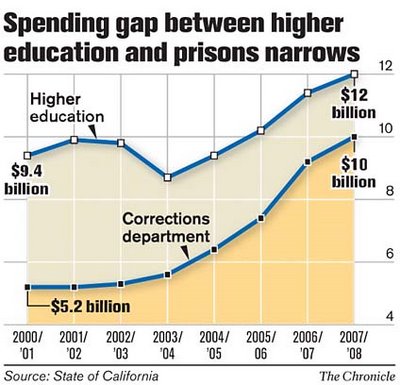
This is from a “SF Chronicle”:http://www.sfgate.com/cgi-bin/article.cgi?f=/c/a/2007/05/21/MNG4KPUKV51.DTL article on these trends, which look set to continue.
Over the past few years, sociologists “Bruce Western”:http://www.princeton.edu/~western and “Becky Pettit”:http://faculty.washington.edu/~bpettit/ have shown that incarceration has become a standard feature of the life-course for certain segments of society, especially young, unskilled black men. A “paper by Pettit and Western”:http://www.princeton.edu/~western/ASRv69n2p.pdf provides some estimates, notably the astonishing finding that in the cohort born between 1965 and 1969, thirty percent of black men without a college education — and _sixty_ percent of black men without a high school degree — had been incarcerated by 1999. Recent cohorts of black men “are more likely to have prison records (22.4 percent) than military records (17.4 percent) or bachelor’s degrees (12.5 percent).” Western develops the argument at greater length in a recent book, Punishment And Inequality in America, which you should really go and buy. As these shifts show up in the social patterning of individual biographies, so too will they be reflected in the Schumpeterian skeleton of the state budget.
by Chris Bertram on May 12, 2007
Simon Kuper, in today’s FT, “reviews Anne Goldgar’s _Tulipmania_, “:http://www.ft.com/cms/s/50e2255e-0025-11dc-8c98-000b5df10621.html a new study of the 17th century boom and bust in the Dutch tulip market. Disappointingly, it turns out that most of the stories are false. There was a boom, but it was a fairly marginal phenomenon in the Dutch economy, and people weren’t ruined: the deals were done when the plants were in the ground, but payment was due only when the bulbs were dug up. Most people simply refused to pay, or paid only a small fraction of what they owed.
by Henry Farrell on April 25, 2007
Bits and pieces from elsewhere on the WWW in lieu of a proper post.
Via “Tyler”:http://www.marginalrevolution.com/marginalrevolution/2007/04/dani_rodrik_is_.html, I see that Dani Rodrik now has a “blog”:http://rodrik.typepad.com/. And has just won the first “Albert Hirschman prize”:http://www.ssrc.org/press/firstprize/, which sounds to be an excellent institution, honoring “scholars who have made outstanding contributions to international, interdisciplinary social science research, theory, and public communication. Hirschman is notoriously a prophet without honour in his own discipline; he’s far more widely read by sociologists (see Kieran’s “article”:http://www.kieranhealy.org/files/drafts/moral-order.pdf with Marion Fourcade for further discussion) and political scientists than by economists.
Cory Doctorow is turning out, in the best of all possible ways, to be an “uncomfortable guest”:http://www.boingboing.net/2007/04/25/usc_students_try_to_.html at the University of Southern California. There’s a lot more background in this “interview”:http://chronicle.com/free/v53/i31/31a03001.htm he did with the _Chronicle_ a few weeks back, which I meant to link to at the time, and never quite got around to. More on this later today or tomorrow.
This “bit”:http://www.chrishayes.org/blog/2007/apr/05/library-homeless-shelter/ at Chris Hayes’ blog (which you should all be reading) is thought provoking:
My friend Nick Reville once said something about public libraries that has always stuck with me. “If libraries didn’t already exist, there’d be no way they could ever come into existence now. Can you imagine telling the publishing industry that the government was going to pay to set up buildings where they gave away their product for free?” That’s as good a summary of our current political-economy as any.
by Kieran Healy on April 24, 2007
Home sales are down a long ways. But why?
Sales of existing homes *plunged in March by the largest amount in nearly two decades*, reflecting *bad weather* and increasing problems in the subprime mortgage market, a real estate trade group reported today. … David Lereah, chief economist at the Realtors, attributed the big drop in part to *bad weather in February*, which *discouraged shoppers* and meant that sales that closed in March would be lower. … There was weakness in every part of the country in March. Sales fell by 10.9 percent in the Midwest. They were down 9.1 percent in the West, 8.2 percent in the Northeast and 6.2 percent in the South.
Clearly, the 9.1 percent sales drop in the West is directly attributable to the weather. Here in Arizona, it’s been a brutal mid-70s and sunny for about two months now. I can’t speak to the devastating effects of the moderate early morning shower we had last Saturday here in Tucson, though. The fact that the drop in the West was one percentage point larger than the drop in the Northeast is also obviously weather-related. The guys who get quoted in reports like this should just own up and change their job title from “Chief Economist” to “Chief Shaman for Rationalizing the Juju.”
by Kieran Healy on April 21, 2007
Not content with their Nobel Prize, Economists also emulate Mathematics with their Fields Medal analog, the “John Bates Clark Medal”:http://en.wikipedia.org/wiki/John_Bates_Clark_Medal. This year, for the first time, the winner is a woman: Harvard’s “Susan Athey”:http://kuznets.fas.harvard.edu/~athey/. Congratulations to her. (Hat tip: “Brad DeLong”:http://delong.typepad.com/sdj/2007/04/susan_athey_win.html.)
by Chris Bertram on April 2, 2007
Spotted at the “Economist’s Free Exchange blog”:http://www.economist.com/blogs/freeexchange/2007/03/airlines_and_inequality.cfm :
bq. According to the new tax data, the income gap has widened. This has led to more speculation that we will descend into a Dickensian dystopia full of the have and have nots. I recently experienced this type of reality when I had the opportunity to fly business class on a trans-Atlantic flight.
Possibly this is an attempt at irony by La Galt; possibly the gap between first-class and regular transatlantic passengers really does make her think of _Bleak House_ or _Oliver Twist_ . Either way, there’s a kind of disconnect here that I have trouble getting my head around.
by Maria on March 29, 2007
Rather worrying news from Ireland where figures from the last quarter of 2006 show that, as expected, new building is declining, but also that exports dropped by 10% when they’d been expected to rise by more than 2%. [click to continue…]
by Kieran Healy on March 14, 2007
James Joyner is perplexed by John Quiggin’s beard. Or, more precisely, by this:
bq. All manner of worthwhile charities hold events wherein people are “sponsored” based on how many miles they bike, laps they walk, hours they go without sleep, ropes they jump, or what have you. Why the need for the gimmick? Are there some significant number of people who don’t give a damn about curing leukemia but are nonetheless willing to donate to the cause for whatever pleasure seeing people shave their beard yields? Or who aren’t sure whether breast cancer is more worth curing than some other disease and make that determination based on what physical challenges the antis are willing to undergo to prove their point?
It’s a good question. But I think the answer will not be found in differences in degrees of pleasure or utility between “Cure for cancer” and “Cure for cancer plus John Quiggin having no beard.” Neither is it quite a question of uncertainty about one’s preference for giving money to a charity being clarified by the knowledge that someone is also doing a sponsored walk.
Instead, what we’re seeing here is the norm of reciprocity in action. You give me something, and that means I can give you something back. A cure for breast cancer or leukemia is very worthwhile but from the point of view of the immediate exchange it is a long way off. I know that my money will not buy a cure, at least not in any direct or immediate way. Moreover, when it comes to giving away my money, there are innumerable worthwhile charitable causes that might plausibly make a claim on some of it. What things like sponsored shaves or Walks for the Cure or a Free Car Wash (with a donation) do is establish a local gift relationship with someone in particular, for something in particular. Sure, the particular thing being given (a shave, a car wash) is trivial in comparison to the overall cause (a cure for cancer). Nevertheless, it is the small relationship of reciprocity that makes the exchange meaningful for the giver and thus makes it much more likely to actually take place.
In a strictly economic framework, these kinds of activities are analogous to the deadweight loss of Christmas gifts (why not just give money, after all?), or are simply advertising gimmicks whose only function is to attract attention. But the resolution to the puzzle is also similar: without the framework of mutual reciprocity, the exchange likely wouldn’t happen in the first place — even if in principle a more efficient (no shaving, no car-wash) solution would be available to narrowly rational agents with the right preferences. That is why almost all forms of charitable giving in fact involve some kind of reciprocal exchange, whether it’s something as trivial as getting a badge, or as heavily mediated as the performances by celebrities on a telethon.
by Henry Farrell on March 9, 2007
Tyler Cowen has a “new post”: which clarifies “why he objects”:http://www.marginalrevolution.com/marginalrevolution/2007/03/agreeing_on_uni.html to pro-union legislation.
Labor-run firms are common in law, book agency, real estate, landscaping, and many other sectors; we even see them in airlines. When labor in charge creates more value, labor starts its own firms or buys out the capitalist or buys greater control rights. Growing capital markets make these evolutions easier all the time. Cooperatives, which are governed by consumers, also are found. Mutuals, non-profits, and yes unionized firms are common too. I heart all of these organizational forms. Keep in mind that if both workers and customers will be better off, yes it probably can happen; it is naive to think that liquidity problems are the major issues preventing workers from enjoying greater control rights. In the short run, the mental model of the left-wing bloggers is a bunch of janitors trying to get better working conditions but opposed by employers. In the longer run what is striking is the competition across different organizational forms. It doesn’t always make sense to give labor residual control rights over capital goods, or the right to halt production.
[click to continue…]
by Kieran Healy on March 1, 2007
On Bloggginheads.tv, Virginia Postrel and Dan Drezner discuss organ markets, Virginia’s recent spat with Amitai Etzioni, and the importance of making clear that Kieran Healy Is Not A Libertarian. In the discussion, Virginia wonders what I think of Etzioni’s view. I have a post up over at OrgTheory about it.
by Harry on February 28, 2007
The newest book in the Real Utopias Project series is Redesigning Distribution (UK
(UK ). The books are all based on conferences held at Madison, and each one focuses on a particular “real utopian” proposal – an institutional proposal which is supposed to embody or further some egalitarian ideal but is supposed to be in principle implementable in the real world and, more importantly, to be self-sustaining in some hard-to-specify way. This volume compares Basic Income Grants with Stakeholder Grants. Philippe Van Parijs makes the case for a BIG, a universal grant that all citizens would receive on a regular basis from the age of majority, funded most likely out of general taxation; Bruce Ackerman and Anne Alstott argue by contrast for a Stakeholder Grant, a one-off payment of (in the US at current rates) $80k paid to all high school graduates at the age of majority, funded by an inheritance tax (and returnable, with growth, to the Treasury at death).
I’ll assume some familiarity with the proposals (for the details of BIG see here and for the details of the Stakeholder Grant see Ackerman and Alstott’s book). I’ll also say at the outset that although I’ve been familiar with both proposals for a long time, and find both very appealing, I haven’t got a stake in the debate really. But I was surprised how much new and interesting stuff was in the book, so I thoroughly recommend it whether you are a newcomer to the debate or an old hand.
[click to continue…]
by John Q on February 24, 2007
Felix Salmon gnashes his teeth at yet another incorrect report on discounting and the Stern review, by David Leonhardt in the New York Times.
Using his discount rate and other assumptions, a dollar of economic damage prevented a century from now is roughly as valuable as 7 cents spent reducing emissions today. (In fact, it’s less than that, because Stern adds another discount rate, called delta, on top of eta.)
Leonhardt says that “spending a dollar on carbon reduction today to avoid a dollar’s worth of economic damage in 2107 doesn’t make sense” – but this is a straw man, since Stern never comes close to saying that we should do such a thing. Leonhardt also spends a lot of time on the academic qualifications of Stern’s opponents, but neglects to mention that Stern himself, a former chief economist of the World Bank, is actually a real expert on discount rates, and understands them much better than most economists do.
Salmon is right, both about the Leonhardt piece and, unfortunately, about the limited understanding of discounting issues on the part of economists in general.
[click to continue…]
by Harry on February 19, 2007
From Avner Offer’s The Challenge of Affluence , perhaps the best first paragraph of an academic book:
Affluence breeds impatience and impatience undermines well-being. This is the core of my argument. For detail and evidence, go directly to the chapters; for implications, to the conclusion, which also has chapter summaries.
I’ve been longing to read this book since I first heard about it (several years ago) but, on reading the first paragraph, felt obliged to lend it to someone else for several weeks. I’ll tell you all about it when I’m finished with it. Be patient.
Other great academic first paragraphs?
by Henry Farrell on February 16, 2007
Charlie Cray forwarded me a link to this forthcoming “documentary”:http://www.indiesunderfire.com/index.html on the demise of independent bookstores and the rise of chains. This is something that I have more ambiguous feelings about than many lefty academics. On the one hand, there are independent bookstores in DC and elsewhere that I love, cherish, and try to shop in whenever I get a chance. But on the other, I grew up in a small town without a bookshop of any description whatsoever, a place which was a little like Penelope Fitzgerald’s “Hardborough”:http://www.nytimes.com/books/97/09/07/reviews/970907.07cunning.html?_r=1&oref=slogin before Ms Green arrives. A couple of times a year I would go to Fred Hanna’s when we visited relatives in Dublin, but the rest of the time I relied on what I could get from the local library or the small rack of paperbacks at the local newsagent. I’d have killed for a chain bookstore somewhere close by, and I find it hard to imagine that my teenage equivalent somewhere out there in the heartland today wouldn’t feel the same way.
There is something being lost as independent bookstores close; a lot of valuable, local knowledge possessed by smart, book-obsessed employees who could give good leads on other books that you ought to read if you liked or were interested in _x_. But the increase in choice provided by the spread of chains (and the Internet) to places that were badly served in the past isn’t to be discounted either. What is a more unalloyed tragedy in my eyes (and not only mine; I think I’m stealing this claim from Teresa Nielsen Hayden) is the demise of the kind of variegated paperbook rack in the newsagent/drugstore that got me reading in the first place. These mixed together bestsellers, unabashed junk, and all sorts of other obscure, semi-obscure and eccentric books. They got me hooked on reading. My impression is that these racks aren’t out there any more, in either Ireland or the US – the places that had them have either gotten rid of them altogether, or only use them to sell the same five or six bestsellers that everyone else is selling.
by Harry on February 5, 2007
Yesterday’s NYT carries an editorial on proposed fee hikes at Citizenship and Immigration Services. It turns out that the section concerned with issuing visas and granting citizenship has to pay for itself, and is planning to raise fees in order to reduce the extraordinary waiting times and to improve customer service from the currently less-than-stellar levels (native American citizens might not know what I mean by that, but the immigrants among you do):
The application fee for citizenship would rise to $595 from $330. The fee for permanent residency would increase to $905 from $325, and charges for bringing in a foreign spouse or employee would more than double
The Times blames Congress for requiring that immigrants pay for the service which serves them, and I’m sure that there is no sensible economic rationale for that. But, I fear, Congress is unlikely to heed the Times’ advice. So what about an alternative: a tax on citizenship?
[click to continue…]