by Chris Bertram on December 18, 2025
Having watched the film, I thought I’d get Robert Linhart’s book off the shelf and finally read it. I think I bought it in Oxford in the early 80s. To remind you, it depicts Linhart’s experience as a Maoist cadre who has chosen to get a job in a Citroen factory in Paris in order to foment “resistance”. There’s an English translation, apparently, called The Assembly-Line, long out of print.
One reason for my hesitance in reading, perhaps, is that I have quite a low opinion of Maoists, particularly Western ones, and I’m sure that Linhart had at the time all kinds of dubious opinions about the Moscow Trials or the Cultural Revolution, but there’s really none of that in the book where he comes across as a fairly generic far-leftist. Instead there’s a fascinating description by someone with real literaray talent of the human reality of mass production as it was in the 1960s and probably still is somewhere other than Europe. It aslo gives an account of the ethno-sociology of the workforce which was “multicultural” long before the rest of society meaningfully was. Possibly the best book ever written by a Maoist then.
When Linhart enters the factory it is very different to how he imagined it would be, which was an assembly line shifting in short bursts as workers performed their tasks. Instead, the line moves continuously with workers running to catch up trying do their jobs quickly so they can get ahead of the game and sneak a quick cigarette or taking too long and getting tangled up with the next section. A manager puts him in the hands of a spot welder, who makes his movements with speed, precision and grace. But when that same Arab worker hands over to Linhart the novice makes a complete mess, molten solder all over the place, and he’s a danger to others and himself with his blowtorch. In a break they get chatting and he discovers that his “trainer” is graded as an unskilled worker (despite showing consummate skill) whereas he, Linhart, has been taken on at a skilled grade. But it soon becomes clear that the assignment of workers to grades has nothing to do with the skills those grades nominally represent: blacks are at the lowest unskilled level, Arabs at the higher unskilled ones, Spanish and Portuguese at the lowest tier of “skilled” and white French people like himself a notch above that, even if they can’t actually do anything. Who says there’s no such thing as “white privilege”?
[click to continue…]
by Doug Muir on September 26, 2025
A while back I wrote a series of posts about the 1998-9 Kosovo conflict. If you’re interested, here they are: Prelude to War, The Serbian Ascendancy, Things Fall Apart, And So To War. This post continues that story up to the unsuccessful Rambouillet peace conference of February-March 1999.
So by early 1999, the Serbian province of Kosovo was the scene of an ugly guerrilla war. Civilian casualties were mounting rapidly. There were bombings and curfews and disappearances. Over 100,000 people were already refugees, and the situation was clearly going to get worse and not better.
There was a concerted effort to solve the problem by holding a peace conference in the spring of 1999. This was the Rambouillet Conference, and its goal was to produce a peace agreement between Serbia and the Kosovo Albanians. It failed, leading directly and immediately to the Kosovo War.
Does an unsuccessful peace conference from the previous century hold any lessons? Or is this purely of academic interest?
[click to continue…]
by Chris Bertram on May 12, 2025
A few weeks ago the historian Perry Anderson published an essay “Regime Change in the West?” in the London Review of Books. Like many of Anderson’s essays this is a wide-ranging splurge full of bon mots and *apercus” delivered from some quasi-Olympian height. My attention was caught, though, by the following couple of sentences which both expressed a widely-held belief, even a cliché, but one which I knew to be false despite the lazy “of course” which Anderson interjects:
Historically too, of course, the US is an immigrant society, as no European country has ever been [emphasis added]. That means there is a tradition of selective welcome and solidarity for newcomers that doesn’t exist at anything like the same emotional pitch in Europe.
The reason I knew this to be false is that, unlike Anderson, I had taken the trouble in my own (non-historical) work on immigration to read the work of France’s foremost historian of the phenomenon, Gérard Noiriel in his now-classic work, Le creuset francais: histoire de l’immigration (XIXe-XXe siècle) (Seuil, 1988). In his opening chapter “The dismissal of memory”, Noiriel addresses both the facts and the myth, pointing out that while in the US immigration is understood as an “internal” part of the constitutive history of the nation, in France it has been treated as something episodic and external. But when you look at the facts, immigration has played as much of a role, and perhaps more, in French society as American.
[click to continue…]
by Speranta Dumitru on April 26, 2025
Political philosophers are criticised for their idealism, but when it comes to immigration they try to be ‘realistic’. Their aspiration to ‘realism’ often leads to nationalism (which I have analysed elsewhere as an implicit but heavy bias), but I still don’t understand why they aspire to realism on this issue. Philosophers have neither voters to attract, like the politicians, nor believers to bring to church, like the Popes.
Why are Popes far more progressive than philosophers on the issue of migration?
[click to continue…]
by Doug Muir on March 17, 2025
Here are two groups of Western philosophers. We’ll call them Group A and Group B. Here’s Group A:
Plato, Epicurus, Plotinus, Aquinas, Duns Scotus, Francis Bacon, Hobbes, Locke, Spinoza, Newton, Leibniz, David Hume, Herbert Spencer, John Stuart Mill, Schopenhauer, Kant, Kierkegaard, Nietzsche, Wittgenstein, Jean-Paul Sartre, Kurt Gödel, Karl Popper, Jeremy Bentham, Alan Turing, Saul Kripke.
And here’s Group B:
Aristotle, Socrates, Descartes, Bishop George Berkeley, Rousseau, Heidegger, Hegel, Marx, Frege, Bertrand Russell, John Dewey, Albert Camus, Frantz Fanon, John Rawls, Willard Quine.
Okay, so: what distinguishes these two groups?
Answer under the cut, but… stare at those two lists. Take a moment; give it a try. Do you see it?
Hints: It’s something pretty straightforward. Frege is an edge case. And while Rousseau is formally part of Group B, he really belongs with Group A.
If you have a guess, put it in a comment, then come and look. [click to continue…]
by Doug Muir on February 21, 2025
“America is rock and roll.” — Alfred Howard
Did some of you find it hard to feel the love for President’s Day this year? Well, remember: the reason it exists is because we Americans, as a nation, couldn’t choose between Washington’s Birthday and Lincoln’s Birthday.
Washington is pretty great, but I’m a Lincoln guy myself. You probably know this photo:
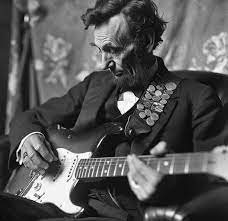
As various people have pointed out, this particular picture was photoshopped. A real ’62 Strat would have a maple fretboard and a single ply pick board. Also, it’s absolutely not true that Keith Richards gave Lincoln this guitar– Richards was always a Telecaster guy, and anyway he was just a little kid back then.
That said, it’s worth taking a moment to contemplate Lincoln’s musical career.
[click to continue…]
by Chris Bertram on April 9, 2024
I’ve posted a few times over the years about a trip I made with my partner to Leipzig in East Germany back in 1984, and I confess that the now-defunct country retains a kind of fascination for me. My rather banal judgement then and now is that the country, though marked by annoying shortages and inefficiencies, had a standard of living sufficient to give people an acceptable life in material terms, but that its lack of freedom, political repression, retention of its population by coercion were all unacceptable. I recently revisited an exchange I had with Tyler Cowen, 17 years ago, and I still think I was basically right and find it ironic that it was me, the leftist, championing freedom against the “libertarian” fixated on living standards.
I’ve just read Katja Hoyer’s wonderful Beyond the Wall: East Germany 1949-1990, which I would recommend to just about anyone. She traces the DDR from its origins to the fall of the Berlin Wall. The people who initially led the country were, of course, communists. But Hoyer reminds us that they were communists of a particular kind: the exiles who were left after Stalin had murdered most of them (he killed more of the German communist leadership than Hitler did). As such, they were cautious and conformist to a fault, and unlikely to strike out independently. They were also leading a ruined society, occupied by Soviet troops, with few natural resources and where, in contrast to the West, the victorious occupying power indulged in reparatory plunder rather than development aid. It was also a society initially seen as provisional, pending unification, and Hoyer argues convicingly that Stalin’s offer of a neutral unified Germany in 1952 as a means of preventing a NATO-aligned West Germany was sincere (though unlikely to succeed).
[click to continue…]
by Doug Muir on January 22, 2024
Part 4 and (for now) last of this series. Earlier installments can be found here.
So, by early 1999 various attempts to resolve the Kosovo situation had failed. In autumn 1998 the Americans had sent Richard Holbrooke as a special envoy to Belgrade. Holbrooke negotiated a deal that looked good on paper, with a ceasefire, partial Serb withdrawal, international observers, and negotiations leading to eventual elections. However, in practice the KLA ignored the deal – they hadn’t been consulted, after all – and the Serbs quickly began to foot-drag and renege. So, by January 1999, armed intervention was under serious discussion.
One theory of the conflict deserves mention here. This is the idea that US President Bill Clinton provoked the bombing campaign in order to distract public attention away from the Monica Lewinsky scandal and his subsequent impeachment. This idea was widely discussed at the time, usually referencing the 1997 movie Wag the Dog, in which a US Presidential administration concocts a war in Albania to distract from the President’s sexual misconduct.
[click to continue…]
by Doug Muir on January 15, 2024
Part 3 of a series on the Kosovo War. Part 1 is here and Part 2 is here.
So, Adem Jashari. Very short version: he was a guerrilla leader / local strong man. He lived in a region of Kosovo that was already challenging for the Serb authorities — rural, rugged terrain, and 100% ethnic Albanian. And in March 1998, the Serbs decided to make an example of him. They came into his village with hundreds of troops, surrounded his house, and just shot everyone in sight. They ended up killing about 60 people: Jasheri, almost his entire extended family, some of his guerrilla comrades, and some unlucky souls who just happened to be there.
This was intended as a show of force. It backfired spectacularly. Kosovar Albanian society was socially conservative and extremely family-oriented, so the idea of wiping out an entire extended family was utterly horrific. Also, say what you like about Jasheri, he and his group went out heroically — surrounded, guns blazing, fighting to the last. So Jasheri became an instant martyr, and his death became the incident that flipped Kosovar Albanian society from unhappy and restive to full-blown rebellion. The Serbs didn’t realize it at the time, but they’d tossed a lit match right into a pool of gasoline.
[click to continue…]
by Doug Muir on January 8, 2024
Okay, so we’ve talked about Bosnia and how that set things up for the Kosovo War. Now, what happened in Kosovo that made NATO want to get involved there?
Back when Serbia was part of Yugoslavia, Kosovo was a “special autonomous province” of Serbia. This meant that it had limited self-rule and its own regional legislature. Since the majority of Kosovars were ethnic Albanians, this means that under Communist Yugoslavia, Kosovo’s politics and its economy came to be dominated by Albanians. The Serbs — who were a majority in Serbia as a whole, but a minority in Kosovo — came to resent this. [click to continue…]
by Doug Muir on January 6, 2024
We’re just a few weeks away from the 25th anniversary of the Kosovo War, which started in March 1999. So, I’d like to do a retrospective on the war’s causes.
This is a long story! It’s going to take at least three posts, and they won’t be short. I think it’s interesting, but it may not be to everyone’s taste, so the rest is below the cut.
[click to continue…]
by Chris Bertram on July 4, 2023
I’m just back from France, where my direct experience of riots and looting was non-existent, although I had walked past a Montpellier branch of Swarkowski the day before it ceased to be. My indirect experience was quite extensive though, since I watched the talking heads on French TV project their instant analysis onto the unfolding anarchy. Naturally, they discovered that all their existing prejudices were entirely confirmed by events. The act that caused the wave of protests and then wider disorder was the police killing of Nahel Merzouk, 17, one of a succession of such acts of police violence against minorites. Another Arab kid from a poor area. French police kill about three times as many people as the British ones do, though Americans can look away now.
One of the things that makes it difficult for me to write blogs these days is the my growing disgust at the professional opinion-writers who churn out thought about topics they barely understand, coupled with the knowledge that the democratization of that practice, about twenty years ago, merely meant there were more people doing the same. And so it is with opinion writers and micro-bloggers about France, a ritual performance of pre-formed clichés and positions, informed by some half-remembered French history and its literary and filmic representations (Les Misérables, La Haine), and, depending on the flavour you want, some some Huntingtonian clashing or some revolting against structural injustice. Francophone and Anglophone commentators alike, trapped in Herderian fantasies about the nation, see these events as a manifestation of essential Frenchness that tells us something about that Frenchness and where it is heading to next. Rarely, we’ll get a take that makes some comparison to BLM and George Floyd.
[click to continue…]
by Henry Farrell on June 1, 2023
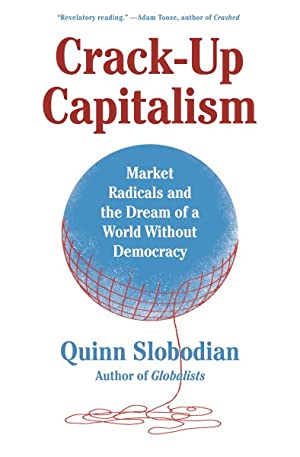
Quinn Slobodian’s new book, Crack-Up Capitalism is an original and striking analysis of a weird apparent disjuncture. Libertarians and classical liberals famously claim to be opposed to state power. So why do some of them resort to it so readily?
[click to continue…]
by Chris Bertram on December 30, 2022
A few days ago, I tooted at Mastodon about a Christmas message I’d had from a Russian friend. I intended my post to convey something hopeful about peace and reconciliation, but got immediate pushback from someone who asked why, if there are are some good Russians, they haven’t stopped the war. Meanwhile, over on Elon’s death site, the theme of holding Russians collectively responsible for the war seemed to be gathering momentum with vehement assertions that this isn’t just “Putin’s war” but one backed by “the Russian people”. I think claims such as these, particularly in their maximal forms are absurd, and become all the more absurd when the alleged collective responsiblity of “the Russian people” is extended to an attitude of hostility and blaming towards individuals, simply because they hold Russian nationality. And many members of “the Russian people” are, after all, children. Yet in rejecting such absurdities, I also want to leave room for those Russians who feel their own responsbility keenly and who feel shame at the Russian government’s actions and who want to take responsibility by resisting, in great or small ways, what that government is doing.
One obvious point to make is that Russia is not a democracy and that Russian citizens have no effective means to restrain their government, even if they wanted to. Rather, they live under a tyranny, quick to mete out savage punishments to its opponents, and where public opinion is partly shaped by relentless nationalistic propaganda. In this light, one might think of ordinary Russians as being among the victims of the regime, even though there are others, most notably Ukrainians, who are suffering much more at its hands. During the Soviet era, it is worth noting, Western governments were keen to frame ordinary Soviet citizens as victims of dictatorship rather than holding them individually or collectively responsible, but this approach has been abandoned in some reponses to the war, including by Baltic politicians who refuse to accept that Russians who refuse to fight for Putin are legitimate refugees.
[click to continue…]
by Chris Bertram on November 16, 2022
I discovered recently that my late Aunt Mary, who was in her time PA to the Postmaster General and a crack typist, had transcribed a letter from a distant relative of ours recounting a journey in 1865 from London to Aden (part of a journey to India). The letter seems sufficiently interesting to post here at Crooked Timber. Among the points of interest are the speed of the journey to Marseilles (remember, we are only 35 years into the railway era), seeing de Lesseps in Egypt — who has constructed the “Sweet Water Canal” (the Ismaïlia Canal) and has yet to complete the Suez Canal), impressions of the various places he passed through, and the tragic funeral of a young man who has died of drink. But much else besides. I’ve digitized by using the OCR on my phone and have checked the various oddities and spellings, so this should be an accurate reproduction.
S.S. Mooltan, Red Sea
22 December 1865
My dear Nelly,
I promised Mamma that I would send you all a letter but the old “Ripon” made such bad weather of it that although an old sailor I could not write very comfortably on board her and therefore all the writing that I did on board was either on business or to your dear Mother. We are now in a very fine large ship and as the weather is fine the sea very smooth and I have a cabin to myself, I can write in comfort and without being disturbed. You will I am sure like to have a kind of log or journal of my proceeding since I left you all on Monday and I will try and recollect the places that I have passed through and any little incidents that may be interesting and jot them down on paper to post at Aden, and although addressed to your dear Nelly you must understand that this letter is meant for all my dear children, and as I shall probably not write to your Mother from Aden, why, this will suffice to let her know also that I am in health and as happy as I can be while away from all I love.
[click to continue…]