by Daniel on November 4, 2004
Just tying up a few loose ends as the US election fervour comes to an end … I bet nobody else was planning to audit this one so I might as well …
After all the brouhaha and kerfuffle over the Guardian‘s Clark County Project, it turns out that the citizens of Clark County voted exactly the same way as the rest of Ohio: 51% Bush, 48.5% Kerry. You might possibly argue that there was a slight “anti-Guardian effect” because last time round Clark was slightly more Democratic than the rest of Ohio (50-46 for Gore when the state was Bush by half a percentag point), but if you did, I think I’d say you were data-mining.
Update I promise I wrote that sentence before I saw someone had done it.
by Kieran Healy on November 4, 2004
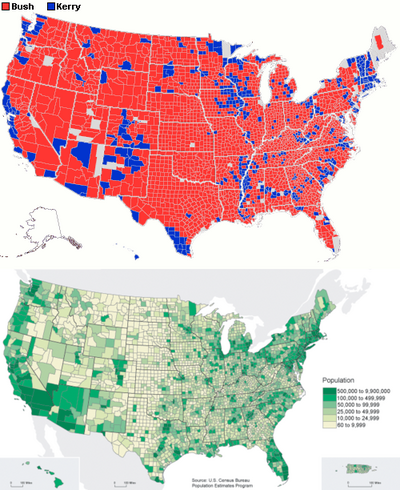
Via Pandagon I see that Michelle Malkin smugly presents us with a map (from USA Today) showing the apparently overwhelming predominance of Bush-supporting counties in the United States. That’s the top panel in the figure below. Looks like the GOP is overwhelmingly dominant, eh? Well, no, of course. It takes about ten seconds on Google to find the bottom panel of the figure, which shows you about how many people live in each county. The comparison is instructive. Of course, there are still a bunch of well-populated areas that Bush carried, but we know that already because, you know, he won the election.
Note also that the USA Today map has quite a few missing observations, shaded in grey, presumably because the final results weren’t available when they drew the map. Missing observations seem predominantly to be counties with large urban populations. Most of these (like Cook County, IL, and Palm Beach County, FL!) should probably be colored blue, as a comparison with the 2000 results shows. CT readers are probably too sensible to fall for invidious comparisons like this to begin with, but it does seem that the likes of Michelle Malkin think that complete dominance of the Prairie Dog and cowpat vote is what really matters. She should check to see how Leroy Chiao voted — maybe the GOP can claim the Solar System vote, too.
*Update*: Thanks to some pointers in the comments, below the fold I’ve included two other figures. The first is a cartogram from the New York Times that scales the states by their electoral college votes, and the section is a terrific map from Robert Vanderbei that gives a continuous rather than a binary representation of the county vote data, allowing us to see that “purple America” is more common than red or blue America.
[click to continue…]
by Eszter Hargittai on November 4, 2004
by Chris Bertram on November 4, 2004
Since 9/11 American nationalists have not been shy to tell us about the marvellous things that the United States have brought to the world. And I agree with them. The US Constitution, the struggle against slavery, the struggle for civil rights, the greatest city in the world (New York), the blues, jazz, soul. I could go on and on. I might even, on a generous day, include Hollywood. I love those Americas, and I always will. I’d like to thank them for standing against the strident nationalists and George W. Bush.
— The thirteen original states that brought us the Constitution voted overwhelmingly for John Kerry. [1]
— The states that didn’t secede and which fought against slavery voted overwhelmingly for John Kerry.
— Black America which brought us in Martin Luther King, one of the greatest moral exemplars of modern times as well as the blues, jazz and soul voted overwhelmingly for John Kerry.
— California, home of the modern motion picture industry, voted for Kerry.
These are the great American achievements: the United States’ lasting contribution to freedom, culture and progress. Sadly, that America, the America of which Americans have the most reason to be proud and foreigners have the most reason to admire, just lost. Again.
fn1. UPDATE This is ambiguous and, on one resolution of the ambiguity, false. Since some commenters are incapable of doing charitable disambiguation themselves, let me do it for them: an electoral college based on the original 13 states would have voted in Kerry by an landslide.
by John Q on November 4, 2004
Most of the post-election discussion I’ve seen has focused on the impact of religion, and quite a few commentators have suggested that the Democrats need to shift their policies to appeal more to religiously-motivated voters. This approach would entail some fairly substantial compromises in the search for marginal votes.
If we’re the mood for pragmatic populism, there’s a policy option that might well have delivered the Democrats the election, without the risk of fracturing the Democratic base as an appeal to the religious right would have done. That option is protectionism, of the kind espoused during the campaign by Gephardt[1]. Gephardt had his electoral problems, but I think he could have carried Ohio and his home state of Missouri, as well as having a good chance in West Virginia and even Indiana. He might have lost some coastal states but overall he would have had a better chance of a majority in both the popular vote and the electoral college.
[click to continue…]
by John Q on November 3, 2004
by Daniel on November 3, 2004
It has struck me that it is probably more cost-effective for me to make this point once, in a front page post on CT than to try to add it to every single comments thread in the Democrat blogosphere. OK, lads, it hurts to lose. But can I ask a couple of questions which seem to be unrelated to the topic of “whither the Democrats”, but which in fact are.
1. If a coin has a bias such that it comes up heads 52% of the time, how many flips of the coin would you need to make to be reasonably confident that it was not a fair coin? A) 1 B) 2 or C) a lot more.
2. If you flip a coin four times and it comes up heads, heads, tails, tails, then does it make even the slightest bit of sense at all to spend the next month thinking about what major structural changes need to be made to the coin if it is ever to come up heads again?
by Kieran Healy on November 3, 2004
What were the most important issues for voters in the election? If you were reading the polls, and listening to the media chatter before the election, the answer would have seemed clear: Iraq or the War on Terror and the state of the economy. In news coverage of the campaign, in the Presidential debates and in the blogosphere blather, the election was fought on these issues. But from about 10pm last night onwards, and increasingly so this morning, commentators suddenly started talking about the importance of moral values in the campaign. It was all over the news this morning.
The exit poll data show that 22% of the electorate thought that “moral values” was the most important issue in the election, and these voters went for Bush nearly 80% to 20%. The ratio is reversed for the 20% who thought that the Economy was the most important issue. In the case of Iraq and Terrorism, it’s interesting to see, first, that these are two separate options.[1] People who said “Iraq” (15%) went for Kerry 75% to 25%, while those who said “Terrorism” (19%) went for Bush 85% to 14%. But the main issue for voters was moral values and it seems to me that there was basically no sustained media analysis on this point prior to the election. I want to know why. Were the pollsters keeping quiet about it? Was it an error in their categorization? For instance, did they lump a bunch of things including moral values into an “Other” category early on and then just focus on the Economy vs Iraq/Terror trope for the campaign?
So it seems to me, in short, that Amy Sullivan's analysis has been vindicated by the results. She first articulated it in June of 2003, well before it was clear who was going to win the Democratic nomination and reiterated it more than once recently. Right now the Democrats don’t have a plausible spiel on morality. I don’t mean that they’re less likely to be moral people, just that they don’t have a coherent way of talking to their own base — let alone the electorate — about what they stand for in religious terms. The fact that it _is_ just a spiel can be seen from the fact that — as Sullivan has also pointed out — the upper reaches of the Bush Administration are not exactly staffed with devout Christians and the President, unlike Kerry, hasn’t been to Church in years.
Late in the day, Kerry’s began to talk about his faith a lot more explicitly in his stump speech. It does seem like his campaign was starting to see the importance of the issue to voters. But I didn’t see this question getting the kind of coverage the data show it merited.
fn1. I want to know whether voters are just asked to say what their view is, or whether they’re presented with a laundry list of choices. I imagine it would have to be the former.
by BillG on November 3, 2004
Gambier is a tiny town in rural Knox County, about 90 minutes northeast of Columbus. It’s where Kenyon College is and where my son cast his first vote. He tells me that there were only two machines for 1300 registered voters. There was an unprecedented turnout and one of the machines was frequently going out of service. Waits were up to 9 hours long.
Doubtlessly, needlessly long lines disenfranchised some Ohio voters. This is inexcusable. Does it help explain the apparent Bush victory? I doubt it.
What I saw on the street in Columbus was that the Republicans were better funded, better organized, and smarter about mobilizing their voters. I bet they also knew more about their people than the Democrats. The Democrats were polling, whereas the Republicans conducted a census. The Republicans were probably more successful in tailoring communications to individual voters and I’m sure they had a plan to get each one to the poll.
What will the Republicans do next with this machine? Rove and Norquist have been candid about plans for a political realignment. They are likely to have some success. Can the Democrats continue to block hard right judicial appointments? I also expect organized political pressure to bring the media into conformity.
by Henry Farrell on November 3, 2004
Mark Schmitt suggests that there’s a ray of hope for the Democratic party.
bq. But politically, it at least avoids a situation where Kerry would have borne the responsibility and blame for Iraq or for raising taxes. All accountability now rests with Bush and his party. Everything that’s been swept under the carpet until after the election will come creeping out. And the best use of all the resources of people, brains, money, and coordination that’s been built this year, in addition to developing a stronger base of ideas, is to find ways to hold Bush, DeLay et. al. absolutely accountable for their choices. I really believe that this will be like Nixon’s second term, and thus the seeds of a bigger long-term change than could have occurred just by Kerry winning the election.
I think he’s right – the emphasis over the next four years has to be on organizational groundwork, “the strong and slow boring of hard boards,” and holding the new administration responsible for its (likely) failings. As Schmitt says, the Democratic party has better organizational foundations, and less reliance on big donors than it has had in decades – if it can build on this, it has some prospects. However, I fear that a second Republican administration will do serious and perhaps fundamental damage to the fabric of the US political system. Both the aspirations of the current administration to an imperial presidency that is accountable to no-one, and the DeLay policy of systematically gerrymandering Congressional districts while denying the minority policy any voice in policymaking, mark serious setbacks to democracy, which are likely to be greatly reinforced over the next four years. It’s going to be very hard to roll this back.
by John Q on November 3, 2004
If Kerry does win after all, it will be under the worst possible circumstances. A minority of the popular vote, a hostile Congress and the need to prevail in a vicious legal dogfight in Ohio. The Republicans will be out for impeachment from Inauguration Day, if not before that. At this stage, a Kerry victory would produce the worst of all possible worlds – responsibility without power.
All things considered, I’d prefer a Bush victory at this point. That said, I think a second Bush Administration will be a disaster in all respects, economically, socially and internationally. To those who supported and voted for him, I’ll say “be careful what you wish for”.
The future looks awful, but I thought I’d sketch out the optimistic scenario, which is, roughly speaking, a repeat of Reagan’s second term.
[click to continue…]
by Ted on November 3, 2004
I’m going to bed; all your base are ably handled elsewhere. Just one thing…
It’s admirable that so many citizens were willing to wait for hours to cast their vote. But they shouldn’t have to. Four-hour lines shouldn’t function as inspiring symbols of human perseverance. They’re bugs in a voting system from which we have every right to expect better.
I can’t predict how this election is going to play out, but I suspect that we’ll all be too burned out to generate much interest in election reform for next time. That’s a shame.
by Kieran Healy on November 3, 2004
I know you’re all getting your election night news from CT anyway, so chat away if you like. The BBC has a nice flash application that’s feeding off AP Projections and the latest returns to give a good overall battleground map. CSPAN has a good map as well.
For the key swing states, there’s The Florida Department of State Count Page and the Ohio Secretary of State Count Page.
*Update*: So things are moving along nicely. It’s 7pm, I’m on my 3rd cocktail, and the closest thing to solid food I’ve seen since lunchtime is a bowl of Ben & Jerry’s New York Super Fudge Chunk. I feel just like Wonkette, except without the pathological desire to get fired from whatever job I have at the moment or the desperate, aching need to sell out to any television network whatsoever. The Food Network. CMT. Please. I don’t care. I can’t keep attending panels and affecting a superior attitude to these losers.
*Update 2*: The Republican legal strategy in Ohio seems to be premised on the idea that the fewer votes that are allowed to be cast, the less voter fraud there will be. This is like the old Argentinian strategy that, in order to keep the support of the silent majority, you have to keep the majority silent.
*Update 3*: It’s turning into a real nail-biter. Big Republican turnout in Michigan. Arkansas and Missouri to Bush. No clear resolution in Florida, and Ohio has Bush ahead. Florida is gearing up to count absentee votes till Thursday and the Republicans are already tying up the courts in Ohio in an effort to suppress the vote. It’s going to be a long night — possibly lasting till later this week. On the other hand, people are still in line to vote in places like Columbus and Oberlin. So I’m not giving up yet.
*Update 4*: I wonder whether you could do a county-level analysis of where the electronic voting machines were, to see whether that predicted any discrepancies between the exit poll data and the results as recorded. Tricky. (Mini-update: looks like the final exit polls were a negligibly different from the result, so never mind about that.)
*Update 5*: Well, looks like it’s going to be Bush — though Kerry is right not to concede until the votes have been counted in Ohio. It’s frankly amazing that the country is so evenly divided. I mean, what’s it going to take to break the deadlock in this country?
by Brian on November 2, 2004
Barring a Red Sox sized miracle comeback, Kerry will win this one. Red Sox sized miracles happen (just ask the Red Sox!) but it’ll be tough for Bush. Even if Kerry gets to 270 projected electoral votes (if he does), there’ll still be something to watch tonight though. I’m going to pay particular attention to whether he reaches two particular numbers – 297 and 317. The significance of 297 is that once he’s there, two state’s results will have to be overturned to make it a Bush victory. The significance of 317 is that once he’s there, *three* state’s results will have to be overturned to make it a Bush victory. At that point we can put away the lawyers, because there aren’t going to be three results overturned.
My credence that he’ll get to 317 is around 20%. He’d have to hold Ohio and Florida and pull off an upset somewhere – Colorado, North Carolina or Virginia seeming to be the main targets. It’s hard to make intuitive judgments about disjunctions like this one because obviously Kerry is behind the 8-ball in every one of those states. But I give some credence to the possibility he can pull off _one_ of them. If not, Court TV might be in for a ratings bonanza.
By the way, the Rep_L52 contract at Iowa is seriously underpriced. Nobody is exit polling Texas, and if Bush is running up the score there as much as Zogby is saying, he’s got way more than a 20% shot at the popular vote.
by BillG on November 2, 2004
Bush people were everywhere on our street this morning. German Village has narrow, brick-lined streets, and traffic backed up for blocks as they came in. Leaders with walkie-talkies were marshalling them to their assignments. They respected my lawn sign and were contrite when I complained about the W04 placard that had been placed on my windshield. This is an amazing effort.
Voting itself was anti-climatic. I got in line at 6:30AM, voted at 8:00AM. No challengers or operatives in the poll itself. Very quiet and neighborly (as befits Ohio). Ohio law forbids even wearing buttons in the polling place.