by John Holbo on December 4, 2019
Thanks for the good comments on yesterday’s post. Today, a brief follow-up. A discerning FB correspondent remarked I should have made the connection with my previous post – from way back in May! O, bad blogger am I – about my so-called ‘steelwool scrub’ fallacy.
These are both real, similar, they overlap, yet seem semi-distinct. Or perhaps the two ways of bringing it out just bring out different aspects of the same process. Hmmm. [click to continue…]
by John Holbo on December 3, 2019
It’s been months since I posted! I’ve migrated to twitter. (The flesh is weak – but feel free to follow me!)
I’m going to try to start doing the sane thing. Long posts at CT, like God’s infinite mind intended. Short thoughts on Twitter, like humanity’s mayfly attention span tolerates.
Today I propose a new term in political theory. Vavilovian philosophical mimicry! [click to continue…]
by John Holbo on May 7, 2019
This case is picture-perfect for making a simple point in debates about religious liberty: ‘sincere religious belief’ is not a ‘get out of bigotry free’ card. It is no carte blanche defense (legal or moral).
The man is nothing if not religiously sincere. Anyone who wasn’t would have kept his mouth shut, not blurted the following: [click to continue…]
by John Holbo on March 10, 2019
I teach Plato’s Meno. I emphasize that, despite it being a hard dialogue, Meno, the guy, isn’t hard to size up. ‘Virtue’ is success. Meno is a get-ahead guy. Are some guys born with it, do you get it by practice, is there intellectual secret sauce? I talk to my students about self-help books. What good, do you think, can a book like How To Win Friends and Influence People do you?
You can read my commentary chapter on Meno here. There’s quite a bit of self-help stuff in it. (You can always buy my book on Amazon! [Associates link.])
Since this is my angle, I should keep up with the self-help scene, shouldn’t I? But, I confess, I didn’t keep tabs on the meteoric rise of Jordan Peterson. At first, when I heard folks complaining, I thought: stern Canadian Jungian? Sweet Tiamat in Toronto, sounds Abzulutely fabulous! Like the premise for a Guy Madden film.
Recently I tried to find time to familiarize myself better. Let me share with you a bit from one exchange that struck me as especially … well, yes, funny. It’s from a 2-hour episode of the Rubin Report, from November 30, 2018. It’s Jordan Peterson, Ben Shapiro and Dave Rubin talking “religion, trans activism, censorship, the IDW and more.” (Hey. I study the metaphysics of self-help literature. I gotta dance with the one what brung me.)
Round about minute 52 it runs sort of like this. (Very rough transcript, not word-for-word. but I’ve tried to be fair, not omitting anything that changes the sense. You can check it against audio. If I have made transcription errors or left out any detail that changes the sense, I will correct.) [click to continue…]
by John Holbo on March 2, 2019
I thought it was hilarious.

by John Holbo on March 2, 2019
Corey caught flack for his “Historovox” piece. I have since been intermittently failing to write a useful response. Maybe this one will go better.
There are two thoughts behind the piece.
1) Trump is weak.
2) ‘Historovox’ affords a distorted view.
The connection – the thesis – is that,
3) Because 2, many have been slow to see 1.
If 1 and 2 are true, this is plausible. But 1 and 2 are such distinct thoughts that the link – even if it holds – doesn’t hold the piece together. There are too many angles of pushback and complication. Dealing with 1 and 2 together is too hard. To put it another way: Corey’s piece is framed kind of like a proof of 2, via 1. But since you need 3 for the proof, and 2 for 3, it’s kind of circular. Or is it? In fact it needn’t be viciously so. You know what? I suggest we pocket 3 as interesting, but hard to gauge. Think about 1 and 2 separately. In this post I will talk about just 2. [click to continue…]
by John Holbo on February 18, 2019
by John Holbo on February 11, 2019
I’m done with Art Young, but I had an afterthought. My final quote from Young mentioned earlier imaginative greats – like Jacques Callot. In my experience, everyone knows about Hieronymous Bosch but, oddly, fewer are familiar with Callot. So I uploaded one of his more impressive pieces to Flickr (I just snagged it from Wikimedia). I can’t say it’s Seussian, exactly. But it’s pretty great old stuff. From 1635.

by John Holbo on February 9, 2019
Governor Ralph Northam is fighting to stay, so he says, because the alternative is being unfairly tarred for life as a racist. (Sorry, I can’t find the quote. Correct me if I’m wrong. But somewhere in this blizzard of articles on the controversy he has said something to that effect. He is obviously thinking it.) This is so backwards. The correct solution is he should leave and, on the way out the door, he gets sympathy for his political misfortune and … yes, forgiveness and absolution. Go, and sin no more. But go.
He needs to leave, not because of what is or isn’t in his heart – or was or wasn’t in his heart – but because his continued presence makes it impossible for Democrats to take a strong, consistent, stand against racism. If any Democrat knows that, by staying in office, they hinder – rather than helping – he or she should step back for the good of the party, on behalf of the values it stands for. That said, there is no reason on earth to doubt that Northam is a different man from the one in that picture. Morally. It’s common sense – not just common courtesy – to believe he’s changed and would not do that today because he knows better. (That guy in the picture was a Gillespie voter, for sure.) [click to continue…]
by John Holbo on February 6, 2019
Today I conclude my reflections on Art Young, occasioned by the great new book about him [amazon associates link]. For those disinclined to purchase, I found a copy of one of his books, On My Way (1928), in free PDF form. (Doc announces itself as legal. No copyright renewal, so it seems.) Anyway, in honor of my earlier, literary maps post: say! the endpapers make a swell map!
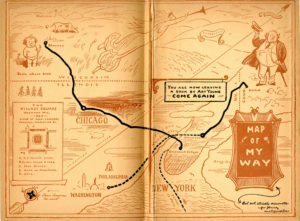
But the Art path I shall trace in this post is not from Monroe, WI, to Bethel, Conn. A few years back I published a survey article on ‘caricature and comics‘. On the one hand, caricature is a minor art form – not necessarily low but distinctly niche. Funny line drawings of celebrities. On the other hand, formally, caricature is very old and very broad. This produces categorial dissonance. Caricature techniques are at the root of styles we don’t think of as caricature. This is the main thesis of Gombrich’s Art and Illusion, by the by. (No one seems to have noticed, but it’s true.)
In that essay I make some points with reference to the case of caricaturist-turned-Expressionist, Lyonel Feininger, but I could have used Art Young.
But let me start at the beginning, regarding Young. I like reading stories of youthful artistic influence, so here is his, pieced together from the new book and other sources. [click to continue…]
by John Holbo on January 28, 2019
I don’t have time for a full appreciation of Art Young today, but I’ll re-recommend the new Fantagraphics book about him [amazon associates link] and advance one art historical thesis: Young was a significant influence on the style of Dr. Seuss. I have never seen this point made before. I didn’t realize it myself until a week ago. As an avid, amateur Seussologist, and student of lines of graphic influence in American cartoon art in the early 20th Century, I’m interested to see it. [click to continue…]
by John Holbo on January 27, 2019
I got on Twitter.
Honestly, I deserve some credit. I joined a couple years back because, suddenly, every time I landed on any Twitter page it was all in Arabic. Weird. I figured if I signed in I could adjust the language setting. But then the problem resolved itself. I never bothered. But I follow enough people I should be on the platform, but if I’m on the platform … So I logged in. Erased the Arabic script handle Twitter had wisely chosen as my default. Reset my country of origin from the default: Hungary. And Bob’s your uncle!
So what do we think of the ethics of Twitter? I mean: how can one live a flourishing life on Twitter?
It’s just the worst, right? I’ve made a terrible mistake.
by John Holbo on January 26, 2019
Our Corey is in The New Yorker! I was going to boost it for him but he got to it first.
But I’ll do it anyway.
The political convert was the poster child of the Cold War. The leading ideologues of the struggle against Communism weren’t ancient mariners of the right or liberal mandarins of the center. They were fugitives from the left. Max Eastman, Arthur Koestler, Whittaker Chambers, Sidney Hook, James Burnham, and Ignazio Silone—all these individuals, and others, too, had once been members or fellow-travellers of the Communist Party. Eventually, they changed course. More than gifted writers or tools of Western power, they understood what Edmund Burke understood when he launched his struggle against the French Revolution. “To destroy that enemy,” Burke wrote of the Jacobins, “the force opposed to it should be made to bear some analogy and resemblance to the force and spirit which that system exerts.”
Corey’s puzzle, per the subtitle: “defectors from the left have often given the right a spark and depth. Why doesn’t it work the other way around?”
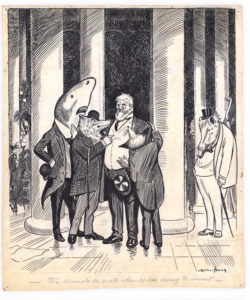
We’ll get to that. But first I would like to report a coincidence. I’ve just been brushing up on Max Eastman myself. (Here’s a good Dissent piece, in case you need a refresher or introduction.) That’s because I’ve been reading about a different forgotten figure — the great cartoonist Art Young! Young is the subject of a new Fantagraphics books that is absolutely tops, and if you are the sort of person who might be remotely interested in anything of the sort, you should get it. It is To Laugh That We May Not Weep: The Life and Art of Art Young [publisher]. The Kindle version is cheap on Amazon [amazon associates link]. I don’t know how long that happy condition will last. If you don’t wanna pay, this site is pretty ok, too. The thing is: the new book contains lots of high quality reproductions of the original art, rather than just scans of the poorly printed originally published versions. The original art, properly reproduced, just pops to an incredible degree. The crosshatching. I’m in awe. Tomorrow or the next day I’m going to try to work up an appreciation of Young’s art. He was a pen and ink master. Just look at this nice stuff!
But politics. First, politics. [click to continue…]
by John Holbo on January 23, 2019
I have an idea that there is sort of a hole in the ethics literature. I could be wrong! So tell me where I’m wrong.
The idea is this: transhumanism is virtue ethics. But no one seems to call it that. “Man remaining man, but transcending himself.” That’s Huxley, introducing transhumanism, and it specifies a delicate virtue balance to be maintained, if I make no mistake. Yet ‘virtue ethics’ is associated with conservative opposition to this sort of radical change option. (Here is Steve Fuller saying so. Not that him saying so proves it is so. But he says exactly what I expect lots of people to say, and it was the first Google hit.)
It’s like there’s this open question: what sort of people should there be? [Amazon – damn, Glover used to offer it free from his personal site, but it appears to have evaporated.] And ‘virtue ethics’ names only views that answer conservatively. Virtue ethics says: the sort we’ve already got. A subset of that.
Why not also call it ‘virtue ethics’ if the answer is: some new sort we haven’t got yet?
It isn’t mysterious that virtue ethics is associated with conservative attitudes towards virtue, given its connection with natural law thinking and grumpy old After Virtue and a bunch of other stuff. But that ought to be regarded as a contingent link.
Glover has an epigraph from Olaf Stapledon, Last and First Men: [click to continue…]
by John Holbo on January 21, 2019


