by Chris Bertram on December 2, 2021
For just over a year before Crooked Timber started, I had a blog called Junius. As the American right get more and more attracted by “natcon” views, I remember how shocked I was that even back then they could be quite sympathetic to the Franco regime. And I remembered I posted this (from May 2003):
Sasha Volokh, in the middle of a trip to Spain, comments on the Spanish Civil War and, frankly, shocks me:
…with every revolutionary construction of the war, Franco becomes more and more palatable to people like me, which means losing the support of any of the middle class or landowners and possibly even getting some of the Western democracies to intervene on Franco’s side. (I don’t know whether those countries would have the ability or desire to do that, but at least I, as a potential 1930s French or English voter (or Spanish resident), would have little difficulty choosing between Communists and Franco.)
This from someone who styles himself as a “libertarian” (I suspect these remarks reveal a greater concern for private property than for liberty). There were brutal massacres on both sides in the civil war, but the numbers slaughtered by the Francoists far exceeded those killed by the Republic and the graves of those executed are still being discovered today. What of the Francoist vision of society? Here’s Antony Beevor from his The Spanish Civil War, describing the social order imposed by the Francoists:
Every Spaniard was decreed to be a Catholic; divorce and civil marriage had been instantly abolished in Nationalist territory; and the penalty for abortion was made even greater than under the monarchy. The orphans of Republicans killed in the purges were forcibly baptized and given new Christian names. The church was in a position to establish a thorough control of public morals. One of their posters ordered: ‘No immoral dances, no indecent frocks, no bare legs, no heathen beaches.’ (The Falange, meanwhile, seized girls on the street whom they considered to be immodestly dressed and cropped their hair forcibly.(p. 385)….
According the the Falange, the state would only be ‘strong if the woman at home is healthy, fecund, hard-working and happy.’ She was therefore liberated ‘from having to work outside the home’, which meant that she was barred from practically all jobs except that of a domestic servant.(p. 387)
There are pages of this kind of thing. I realize that Mr Volokh may have good reasons for hostility to the Communist Party, but in the passage I quoted from him he is explicitly imagining himself as an English, French or Spanish person of the 1930s (I wonder how he can be so sure of what his reactions would have been?). The regime imposed by the Francoists had many Taliban-like features and even middle-class voters with property have daughters! Of course, the Taliban (not to mention many other brutal dictatorships) owed their success to a similar anyone-but-the-communists attitude.
by Chris Bertram on November 30, 2021
A key element of the the ideology of the new populist far right (Trumpian, Faragist, Zemmourian etc) is some version of the “great replacement” theory, the idea that Western civ is under threat from migrants, Muslims, black people, brown people, yellow people and the rest. In some version or another, it actually goes back a long way, and was the main driver of things like the White Australia policy and similar paranoias elsewhere about white settlers being overwhelmed by coolie labour. I happen to think the fears are overblown and that the good stuff in Western civ – Bach, Shakespeare, Gothic architecture, science, ymmv – is going to survive any amount of demographic change. But the question I’d like to pose here is, how bad would it be, morally speaking?
[click to continue…]
by Chris Bertram on November 28, 2021
by Chris Bertram on November 25, 2021
Around thirty people are dead, drowned in the English Channel. And everyone knows why they died. Because the UK government, like all governments of wealthy countries, makes it impossible for people who want to claim asylum to enter the country by the ways you and I travel. So people who want to do so – as is their human right – have to enter by clandestine means. And because states are powerful, have border guards, fences, technology to detect people etc, they have to make use of smugglers to get across international borders.
Whenever there’s a major loss of life, the same politicians who have done everything they can to make it impossible for people to arrive by safe means, blame the smugglers and criminal gangs whose businesses would not exist without the measures they themselves put in place. They deplore people who make a profit at the expense of the vulnerable, but make sure that they also criminalize people who would help those people for free from humanitarian motives.
[click to continue…]
by Chris Bertram on November 21, 2021
by Chris Bertram on November 14, 2021
by Chris Bertram on November 11, 2021
Lately, I find I’ve been spending more and more time looking at Facebook groups of old photographs of Bristol, the city where I live. I particularly enjoy the aerial photographs of the interwar period, often colorized. There are lots of reasons for this: I like photographs, I like history, I like cities. But it isn’t just Bristol, I can also spend hours on the Shorpy site, sometimes going to Google Street View for a modern take, and I own several books comparing the Parises of Marville and Atget and the New York of Berenice Abbott to the same scenes today, as well as multiple volumes of Reece Winstone’s collection of historic Bristol pictures. So what’s the attraction, indeed the compulsion? What is drawing me and others to these scenes? And does this attraction also have a problematic side to it?
One common response to the images is a sense of thwarted possibility. You see a functioning, bustling city, full of life, and full of beatiful surviving buildings, densely packed. The train is everywhere, with bridges, tracks, sidings, sheds to match. Sometimes a locomotive is in view. The rail infrastructure criss-crosses with the water, canal and harbours. Factories with their chimneys sit adjacent to medieval churches with their towers and spires. The technology often looks amazing, as with the Ashton Avenue Bridge (1905)(covered for photoblogging a while back), which in its day was a double-decker swing structure, with road on the top deck and rail running below. These days it has but one functioning level – the old rail deck is for pedestrians and cyclists – and it hasn’t swung since 1951. The “then” pictures give us the romance of industrial modernity combined with the charm of the medieval.
[click to continue…]
by Chris Bertram on November 7, 2021
by Chris Bertram on October 31, 2021
by Chris Bertram on October 24, 2021
We took a day to drive up the Wye Valley, which is close to Bristol, inspired by the scenery in the (highly recommended) Netflix drama Sex Education. This is the view from Symonds Yat Rock.

by Chris Bertram on October 17, 2021
by Chris Bertram on October 4, 2021
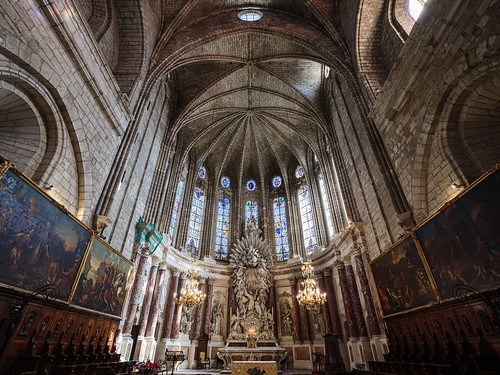
You have to look very hard to discover that this building replaced the structure destroyed when anti-Cathar crusaders massacred up to 20,000 people in 1209, an episode during which the crusader commander Simon de Monfort, faced with the difficulty of distinguishing heretics from Christians, infamously uttered the words “kill them all! God will know his own.”
by Chris Bertram on October 3, 2021
The other day I tweeted what I took to be a fairly banal sociological observation and one that took no normative position, as such. I observed that people in families or smaller communities are, as a condition of participating in many everyday social activities, under some pressure to be more tolerant of people with divergent moral, religious or political views to their own than are people in large communities or networks such as cities or the internet. People in larger networks typically have more choice about who they interact with and so can restrict themselves more easily to others who think like they do. Notice that there aren’t necessarily two distinct groups of people here. People interact both in small family groups for some of their time but also in wider networks. In the first, there’s pressure to put up with the disagreeing other, to some extent, in the latter there’s much less pressure since you don’t have to engage.
Some people reacted a little negatively, or so I took it, to my observation. It was suggested that I was “lauding small towns” over cities, though I was not. Others, more supportive, chimed in to say that growing up in small places they’d been under more pressure to justify themselves and their views to others with whom they disagreed, whereas in cities they’d not had to bother. And some people notices that the working-age population did indeed have to tolerate people with different opinions to their own since they had no choice but to be in the workplace, while perhaps retirees could select co-thinkers and screen out unwelcome opinions.
My banal observation didn’t just come out of nowhere. On the contrary it arose from the comparatively privileged experience of living in two quite different places. In the one, I can have a social life where I end up hanging out with people who are pretty similar to myself; in the other, if I am to have any social life at all, it has to be with relatively small numbers of people who just happen to be in the town and know one another. That can be enriching, since I end up having conversations with people different to myself and learning about points of view quite other to my own. But there’s also a pressure to self-censorship, to avoiding certain topics in case they cause ill-feeling and to letting remarks go when they are possibly but not obviously freighted with racism and sexism. Generally, I think exhortations to people to get out of their bubble and to speak across divides are a waste of breath. But put people in different circumstances with others with whom they disagree and they will find ways to rub along and communicate, with a mix of challenge and restraint.
by Chris Bertram on September 27, 2021
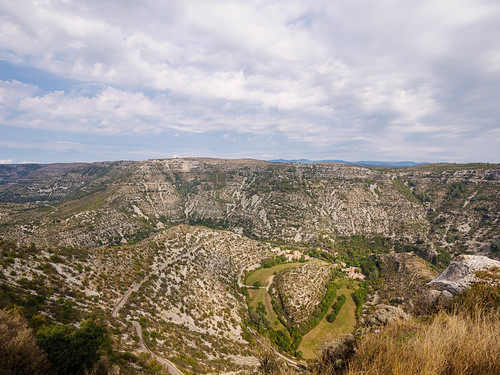
The always-spectacular Cirque de Navacelles on the border between Gard and Hérault drawn by the River Vis, of which this was a meander from which the river diverted about 6000 years ago.
by Chris Bertram on September 19, 2021
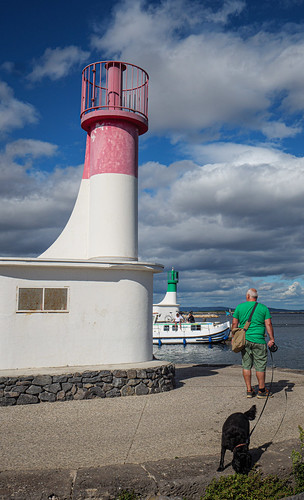
Marseillan, this afternoon.