From the category archives:

World Politics

Sunday photo(re)blogging: the Wall then, and borders now

by Chris Bertram on November 9, 2014

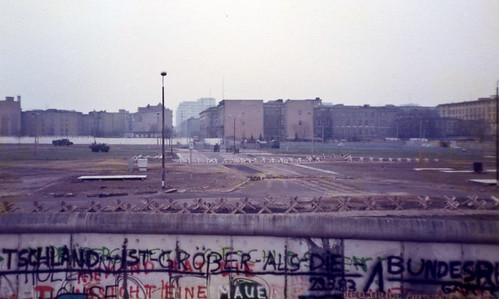
Yesterday I was listening to BBC Radio 4, and they were remembering the people who died, shot by East German border guards. It doesn’t seem to occur to our official voices of commemoration that there are parallels today with the thousands who die trying to escape tyranny, war or poverty and who drown in the Mediterranean, perish from thirst in the Arizona desert, or with those who the Australian government turns back at sea or interns offshore. Nor do such barriers as the “separation wall” in Palestine seem to evoke such horror in those voices as the Berlin Wall did then. These newer barriers are treated as necessary and normal and those deaths as self-inflicted by people naive enough to believe that a better life awaits in prosperous liberal democracies. Not that free movement is the only thing where official attitudes have changed. It isn’t long since the comprehensive surveillance of citizens depicted in Anna Funder’s *Stasiland* and in the film *Das Leben der Anderen* was emblematic of how communist states would trample on the inalienable rights of people in pursuit of state security. Today we know that our states do the same. I’m not making the argument that Western liberal democracies are “as bad” as those states were, lest any commenter come along and moan about “moral equivalence”. But I note that these kinds of violations were not seen back then as being impermissible because those states were so bad in other ways — undemocratic, dirigiste — but rather were portrayed to exemplify exactly why those regimes were unacceptable.

Here’s my photoblog from five years ago:

Berlin Wall

Swords into ploughshares

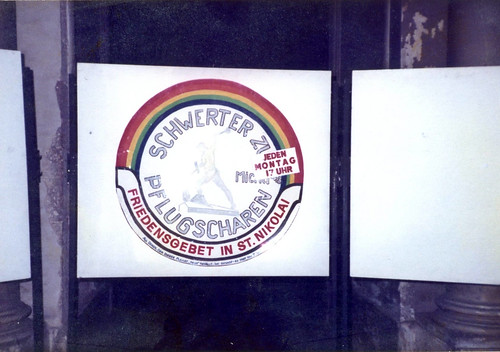
Two photos today. My partner, Pauline Powell and I visited East Germany and West Berlin in 1984. The first picture is a shot of the Berlin Wall from the western side, and seems appropriate as tomorrow is the 20th anniversary of its fall. The second shot, taken inside the Nikolaikirche in Leipzig, announces one of the prayers for peace meetings that helped to build the popular movement that would eventually contribute to the fall of the regime. Both pictures are Pauline’s, not mine (all rights reserved etc). We believe the swords into ploughshares picture is unique on the web, though perhaps others exist as prints. As such, it is something of a historic document.

Reagan and the Great Man in history

by John Q on August 8, 2014

The latest controversy about Rick Perlstein’s new book is an opportunity to post a couple of thoughts I’ve had for a long while.

First, the outsize Republican idolatry of Reagan is explained in part by the fact that there’s no one else in their history of whom they can really approve. The Bushes are a bad memory for most, Ford was a non-entity and Nixon was Nixon. Eisenhower looks pretty good on most historical rankings, but he’s anathema to movement conservatives: Eisenhower Republicans were what are now called RINOs. Going back a century, and skipping some failures/nonentities, Theodore Roosevelt is problematic for related but different reasons. Going right back to the beginning,and skipping more nonentities and disappointments, some Repubs still try to claim the mantle of the “party of Lincoln” but that doesn’t pass the laugh test. As many others have observed, the “party of Jefferson Davis” is closer to the mark. So, they have little choice but to present Reagan as the savior of the nation.

Something of the opposite problem is found on the left. I haven’t read Perlstein yet, but a lot of the discussion is based on an implicit or explicit assumption that the shift to the right in the US since the 1970s can be explained by the successful organizing efforts of movement conservatism, culminating in Reagan’s 1980 election victory. That’s an explanation with a lot of contingency attached. Suppose, for example, that the attempted rescue of the Iranian embassy hostages in April 1980 had been a success. That, along with some fortuitous good economic news, might have been enough to propel Carter to victory. By 1984, Reagan would have been too old to run as a challenger, and Bush senior would probably have been nominated.

I don’t think, however, that this would have had a huge effect on economic-political developments in the US. Other English-speaking countries, with very different political histories followed much the same route, ending up, by the late 1990s, with a hard-line rightwing conservative party driving policy debate and a “Third Way” centre-left alternative trying to smooth off some of the rough edges. The election of Carter, a conservative by the standards of the times, was a step towards that outcome.

I don’t want to overstate the determinism here. Individuals matter, and national circumstances differ. Still, I think we are talking about variations on a common theme, driven by global economic events, rather than a US-specific story beginning with Reagan’s 1964 address in support of Goldwater.

My apologies for the delay in posting the second half of my reply to the symposium. I was traveling. Let me repeat at the outset my deep appreciation for the insightful comments provided by the contributors to this symposium. This is the sort of exchange that makes intellectual life rewarding. Given the delay since the original postings, I did not want to assume that readers of this post would remember what was said in the earlier ones, and I’ve tried to write this in a way that will be intelligible on its own. I take up here the six contributions that I did not discuss in the previous post. I’ll begin with David Owen, Michael Blake, Kieran Oberman and Ryan Pevnick, all of whom have related concerns. At the end, I’ll discuss the posts by Brian Weatherson and Patti Lenard.

In various, sometimes overlapping ways, David, Michael, Kieran and Ryan have raised questions about my theory of social membership. To recall (or, for those who have not read the book, to summarize), the central claim of that theory is that immigrants become members of society over time and their social membership gives them a moral claim to most of the legal rights that citizens enjoy and eventually to citizenship itself. It is important to note, however, that I do not start with a general theory of social membership that I try to justify on the basis of abstract principles and then apply to particular issues. Rather I start with the actual practices of democratic states and ask whether these practices seem to make moral sense. It is only after I have explored arguments about particular practices that I try to show that the idea of social membership is a common thread in many of these arguments. Moreover, my theory of social membership is not presented as a full account of why immigrants are morally entitled to legal rights. I contend that immigrants also have claims to legal rights based on the duty of every state to protect the human rights of anyone within the state’s jurisdiction and based on other considerations like reciprocity and proportionality as well. I think that this way of doing political theory “from the ground up” differs from the approach of some of my interlocutors, especially Kieran and Ryan. My approach is likely to be less systematic and involve more balancing of competing considerations, but I think that it is more closely connected to ordinary moral views, even when, as in the open borders chapters, it leads to radical conclusions.
[click to continue…]

The Ethics of Immigration symposium: index

by Chris Bertram on June 4, 2014

The first part of our symposium on Joseph Carens’s The Ethics of Immigration is now concluded. While we wait for Joe to compose his reply, here’s an index of the contributions:

Update: Joe Carens’s replies in two parts: Part One and Part Two.

Political theorists are much indebted to Joseph Carens for his 1987 article “Aliens and Citizens: the Case for Open Borders”. Written in a period of increased restrictions on migration, Carens’s article was pioneering in two ways: it introduced the migration question to political theory’s agenda and set the terms of the debate from the free movement side. Carens’s recent book, The Ethics of Immigration, is less pioneering. It explicitly aims to engage with the “conventional view of immigration” and to show that it can accommodate some measures which improve citizenship and admission policies. The open borders argument is not abandoned but is left to only one of the twelve chapters. Carens’s main concern, however, is to show that the open borders argument does not conflict with the measures he proposes.

It is possible to have the opposite concern: are the proposed measures a way to advance towards a  world of open borders? In other words, is Carens still advocating open borders? My analysis here will be limited to the first measure he proposes in the book, this is that “justice requires that democratic states grant citizenship at birth to the descendants of settled immigrants” (p. 20). Whether justice requires this or not, many “democratic states” already conform to this principle and my argument is not that they should stop. Rather, my worry is that such an argument is not a way to advance towards an open borders world.
[click to continue…]

Why the case for open borders is crucial to defending the rights of resident migrants

Joseph Carens’s important, engaging and superbly written book aims to offer “a general account of how democrats should think about immigration” (p10) based on “fundamental democratic principles” that Carens believes most people in Europe and North America already hold (p5). This methodological stance dictates the structure of the book. What is most controversial is pushed to the back. Chapters 11 and 12 make the argument Carens is most famous for: the case for open borders. Chapters 1-10 set that all aside to address a range of everyday migration controversies, from naturalisation to religious dress codes, under the assumption that states have a broad right to control immigration as they wish. The boast of the book is that it can adopt this underlying assumption and still defend a set of progressive policy proposals requiring states to extend a variety of rights to migrants. The case for open borders is meant to be Carens’s encore – a treat performance once the main show is over – not a premise upon which the whole thing hinges. Does Carens pull it off? In my view, no. Most of the arguments that Carens makes for migrants’ rights in Chapters 1-10 fail unless the right of states to control immigration is called into question. Conversely, if one accepts not only the common assumption that states have a right to control immigration but also the common beliefs that lie behind that assumption, then one has reason to resist the extension of rights to migrants.
[click to continue…]

Right wing tribalists: A lost cause

by John Q on April 30, 2014

Rightwing tribalism seems to be the topic du jour, or maybe I’m noticing it more having just done a long-planned post on the topic. Here are some recent examples

* Jamelle Bouie in Slate, headed “Conservative Tribalism” with the write-off

Mass transit. Common Core. Light bulbs. Conservatives hate these things for no better reason than that liberals like them.

* Tim Donovan in Salon, on The Right’s Paranoid Tribalism

and relatedly

* Digby in Slate on Southern white males as a voting bloc unremittingly hostile to the Dems on tribal grounds (my thoughts on this here)

Over the fold, I’ve reprised the piece (from a 2007 review of Clive Hamilton’s book Scorcher) when I first realized the central role of tribalism, as opposed to ideology or economic self-interest, in contemporary rightwing politics. Rereading it, I’m happy with most of the analysis, though obviously, with my characteristic over-optimism and shortening of time-frames, I did not anticipate the full tenacity of rightwing resistance on this issue.

What can be done about rightwing tribalism? There’s no point in traditional strategies of compromise and bargaining. The right don’t hate policies, they hate the people and groups they see as proposing those policies. So, as Bouie observes, the moment Obama adopts a policy favored by the right, they turn against it.

The strategy of trying to frame issues in rightwing terms, pushed by Lakoff and others, is similarly hopeless: it’s not the issues, but the people that are the problem. There’s one big exception to this: if they issue can be framed as Big Government vs the little guy, as in the cases of NSA surveillance and, more interestingly, of attempts by utilities to suppress rooftop solar power using ALEC-backed legislation, it’s possible to make common cause with at least some on the right, who hate “the guvment” even more than liberals and environmentalists. But that’s only true of a minority of the right, and a handful of issues.

Most of the time, none of these strategies will work. The only thing that will work is persuading rightwing tribalists to abandon their tribal identity, and persuading non-tribalists of conservative inclinations that they should not ally with this group. And of course, waiting for time and demography to take their course, as has already happened to a substantial extent.

[click to continue…]

Tu Quoque

by John Q on April 21, 2014

I’ve written many posts and articles making the point that the political right, in most English speaking countries[^1] has been taken over by a tribalist post-truth politics in which all propositions, including the conclusions of scientific research, are assessed in terms of their consistency or otherwise with tribal prejudices and shibboleths.

Very occasionally, intellectuals affiliated with the political right (conservatives and libertarians) will seek to deny this, arguing that isolated instances are being blown out of proportion, and that the right as a whole is committed to reasoned, fact-based argument and acceptance of “inconvenient truths’ arising from the conclusions of scientific research[^2], [^3].

But, far more often their response takes the form of a tu quoque or, in the language of the schoolyard, “you’re another”. That is, they seek to argue that the left is just as tribalist and anti-science as the right. Favored examples of alleged left tribalism included any rhetoric directed at rightwing billionaires ( Murdoch, the Kochs and so on). The standard examples of alleged left anti-science are GMOs, nuclear power and anti-vaxerism, but it is also sometimes claimed that US Democrats are just as likely as Republicans to be creationists.

I’ll argue over the fold that these examples don’t work. What’s more important, though, is what the tu quoque argument says about those who deploy it, and their view of politics. The implied claim is that politics is inherently a matter of tribalism and emotion, and that there is no point in complaining about this. The only thing to do is to pick a side and stick to it. What passes for political argument is simply a matter of scoring debating points for your side and demolishing those of the others. So, anyone who uses tu quoque as a defence, rather than seeking to dissuade their own side from tribalist and anti-science rhetoric, deserves no more respect than the tribalists and science deniers themselves, who at least have the defence of ignorance.

[click to continue…]

Ukraine: who to read, what to believe?

by Chris Bertram on March 3, 2014

As a non-expert, I find myself scouring the various news columns and op-eds trying to work out what’s true and false about the situation in the Ukraine, who to believe, what to trust. It isn’t easy, given that the two “sides” (or is that three or four) fail to sort themselves neatly into the mental maps we all have to organize this kind of thing. One such map, beloved of the “decent left” tries to fit everything into a 1938. That’s tempting, but then who is Hitler, who are the Nazis, who are the Sudeten Germans? Things don’t quite line up. And then there’s the narrative of the plucky little insurrectionists against their post-Soviet overlords: Hungary 56, Prague 68? But once again, people aren’t fitting neatly into the little boxes. Then think of those crises, Hungary in particular, or the East German revolt. How many Western leftists tried to read them (and misread them) through the glass of Soviet opposition to Nazism? During the Balkan wars of the 90s my own imaginary had plucky multi-ethnic Bosnia as the incarnation of liberal republicanism, resisting the ethnic tyranny of the Serbs. But there were plenty of of leftists who saw things in terms of the dastardly German-collaborating (and backed) Croats with their UstaÅ¡e past, versus the Serbian partisans. One friend from Northern Ireland said on Facebook that a relative had told him that the key to understanding any conflict was to work out who are the “Protestants” and who are the “Catholics”. I can’t think that’s going to help here (or in Syria for that matter): we all get trapped by these heuristics.

Reading Christopher Clarke’s The Sleepwalkers last night, I came across a discussion (I’ve only just started the book) of Serbia’s Foreign Minister Milovanovic and his predicament in the crisis of 1908: a moderate and pragmatist trapped by the rhetoric of the more extreme nationalists, who could and would denounce any compromise with the enemies of the people. Hard not to think or parallels with Vitali Klitschko and the other opposition leaders who cut a deal with Yanukovych but couldn’t make it stick with the Euromaidan for fear of being howled down as traitors themselves. Presumably they saw that running Yanukovych out of town on the day after the deal would be certain to get a nasty reaction from Putin, but what else could they do? And now here we are, with the Russians in the Crimea, the rouble plummeting and the prospect of a new cold war, with everyone apparently fated to play their allotted roles. Meanwhile, the hapless John Kerry tells us – with no self-awareness whatsoever – that, in the 21st century, you can’t invade foreign countries on trumped-up charges.

For what it’s worth I found Mark Ames useful, Paul Mason insightful and Timothy Snyder propagandistic. And here’s Ben Judah on why Russia no longer fears the West. With my political philosopher hat on, I can say that just states find ways to integrate their citizens across ethnic and linguistic divides, that the boundaries set by history should not be sacrosanct, but that people shouldn’t try to change them by force of arms. Political philosophy will not have much impact on how this all turns out.

A note on an argument about open borders

by Chris Bertram on February 28, 2014

Open borders advocates often advance an argument in terms of a duty to help the global poor. Poor people who succeed in making the journey to more advanced economies are usually more productive; those who are locked out of such economies by hard border controls are kept in dire poverty, often within sight of great riches. And those who are admitted are often an important source of income to family left behind. Those who defend border controls and the right of states to exclude often make the following move: they concede a duty to help the poor, but say that such a duty can be discharged in ways other than admitting poor would-be migrants to wealthy countries. In particular, they argue that such a duty could be discharged by supporting the economic development of poor countries via development aid (Christopher Heath Wellman is an example).

But the problem with such an argument is that it has two parts. The first (conditional) part, says that it is false that we must open our borders to discharge our duty of assistance IF we can discharge that duty some other way. The second empirical part is the claim there is another way, because development aid is an effective way of helping the global poor that is comparable in its beneficial effects to (much more) open borders. In other words, the claim by philosophers and political theorists that the duty could be discharged by development aid needs to be backed up by sound economic evidence that development aid really is an effective means of helping the global poor. Economists such as William Easterly are skeptical that we know enough about economic development to make effective use of development aid. They may be wrong, but philosophers and political theorists shouldn’t make the easy argumentative move to development aid as an alternative to (more) open borders without being sure that the economics supports them.

The general reaction to various revelations of spying by the US on its friends and allies, particularly in contexts such as trade negotiations has been “everyone does it” and “in any case, there’s nothing anyone can do about it”. And, as regards direct retaliation against the US, that’s pretty much right. The situation is a bit different for junior members of the Five Eyes[^1], such as Australia. A case now being heard at the Permanent Court of Arbitration in The Hague could set a precedent that will make such spying a high risk exercise.
[click to continue…]

Why TPP Counts

by Henry Farrell on December 13, 2013

“Paul Krugman yesterday:”:http://krugman.blogs.nytimes.com/2013/12/12/tpp/

I’ve been getting a fair bit of correspondence wondering why I haven’t written about the negotiations for a Trans Pacific Partnership, which many of my correspondents and commenters regard as something both immense and sinister. The answer is that I’ve been having a hard time figuring out why this deal is especially important. … The big talk about TPP isn’t that silly. But my starting point for things like this is that most conventional barriers to trade — tariffs, import quotas, and so on — are already quite low, so that it’s hard to get big effects out of lowering them still further. The deal currently being negotiated involves only 12 countries, several of which already have free trade agreements with each other. It’s roughly, though not exactly, the TPP11 scenario analyzed by Petri et al (pdf). They’re pro-TPP, and in general pro-liberalization, yet even so they can’t get big estimates of gains from that scenario — only around 0.1 percent of GDP. And that’s with a model that includes a lot of non-standard effects.

[click to continue…]

Mandela sanitized

by Chris Bertram on December 6, 2013

The great Mandela is dead. A political prisoner for 27 years, a courageous fighter against racism and injustice, and finally a great statesman. There is much to remember there and much to mourn. Those who suffered under apartheid, the exiles, those who were active in solidarity overseas: all will have their memories of the struggle. Some of their voices will be heard. But sadly, they have to share a stage with the official voices of commemoration: politicians and others who cared little for the ANC or who actively opposed it. In the UK it is sickening to hear eulogies from the braying Tories, the Bullingdon-club types and ex-members of the Federation of Conservative Students who sang “hang Nelson Mandela” in the 1980s. No doubt, in the US, there will be some prominent Reaganites who utter similar word of appreciation. There’s an implicit narrative emerging that everyone recognized his greatness after 1990. But this isn’t so. The warbloggers and Tea Partiers (and their followers in the UK) were vilifying him when he criticized US policy under George W. Bush or said something on Palestine that deviated from the standard US-media line. Just as with Martin Luther King, we are witnessing the invention of a sanitized version of the man, focused on reconciliation with those who hated him – and who still hate those like him – and suppressing his wider commitment to the fight against social and global injustice.

I knew folks on the right were going to be upset about the Iran deal, but isn’t this a bit much? The Corner has gone Everyday-is-like-Munich full neocon.

OK, maybe there’s no point in even bothering, but just look at this post, “Munich II”, by James Jay Carafano (vice president of foreign- and defense-policy studies at the Heritage Foundation.) He is banging on about how ‘realism’, presumably in the I-R sense, opposes this deal. But, even as he’s trying to make the case, he can’t help inadvertently making the case that the other side has got the better realist case. [click to continue…]

Something Changed on the Internet

by Maria on November 19, 2013

It’s only been five weeks since the organisations that manage the Internet’s technical infrastructure dropped the bombshell that they want the oversight of ICANN and IANA to be done by all governments and stakeholders, and not just the US. In a statement made in Montevideo, ICANN, ISOC, the IETF, all the world’s regional Internet registries, the Internet Architecture Board and the World Wide Web Consortium all called out the Snowden revelations as having ‘undermined the trust and confidence’ of users so much that it’s now time to get on and build truly ‘global multi-stakeholder Internet cooperation’.

What does all that mean? Basically, the people who built and run the global Internet no longer trust the US government to be its sole public-interested global steward. Despite a six-month scrum of self-satisfied lobbyists falling over each other to say ‘everyone knew what was going on’ and nothing fundamental has changed since Snowden; everyone only thought they knew what was going on and something fundamental has changed since Snowden.

Whether you think real ethical and legal issues are raised by mass surveillance or that the uproar is just an opportunistic response to one country spying merely too successfully on all the others, it is very clear that the US security services stepped far, far over the line when they took part in IETF technical working groups to purposely undermine the security of the Internet. It’s one thing to play an ‘all’s fair in love and war’ game to exploit networks and business relationships to surveil the population, quite another to knowingly introduce vulnerabilities that your enemies can also exploit. This, and disquiet at how some large US corporations act – forced or willingly – as arms of that state, is the basis of the breach of trust.

You don’t get to invent the Internet, export it around the world as a force for free markets, innovation and human progress, oversee the volunteer organisations that make it work, host the most important companies that deliver and use it, and then say it’s not fair that other countries think you are unfairly exploiting a home advantage. You also don’t get a pass on what Milton Mueller calls out as a strange blindness to the privileged role of your own government when you go around the world proselytising that ‘governments should stay out of running the Internet’.

Before Snowden, Russia’s and China’s paranoia and distrust of Internet freedom as a merely tool of US foreign policy designed to weaken their states could be dismissed as the kind of twisted thinking you expect from authoritarian states that simply can’t imagine not abusing a global common pool resource under their control. That’s how they would behave, so of course they think it’s how we would.

After Snowden, we live in a world where country after country has taken steps to distance itself from the current status quo on who oversees the Internet, and to condemn the US for abusing its role. But neither the US nor its junior partner in electronic surveillance, the UK, has made a concerted public effort to counter the claims of moral equivalence made by our rivals in the battle for Internet control; Russia, China, Iran and Saudi Arabia.

The silence of what are, after all, democratic governments about what legal constraints the UK and US’s spying systems operate within – and how those frameworks can and should be improved – means that rival states are controlling the narrative. Controlling the narrative means getting to decide its ending. Lots of us saw this coming. At a national meeting in September we urged the UK to develop a positive response to its role in global surveillance. Snowden wasn’t even on the agenda. But our governments seemed to slope off to the annual global Internet Governance Forum in Bali with no story to tell about itself, merely the plan to slip a few words in the right ears in the corridors outside public meetings, and to hope for the best.

Meanwhile, the business lobbyists swarmed everywhere repeating the mantra that ‘everyone knew; nothing has changed’, hoping their claim of knowing and worldliness would make anyone who disagreed feel like an ignorant rube, hoping repetition would drown out incredulity. That was both stupid and wrong.

By September, there was a fundamental breach of trust between the US government and the global technical communities, between the US and UK and pretty much every envious middle-income country on earth. But instead of facing up to the problem, the West and its international business community put their fingers in their ears and pretended everything was the same as before, or, at worst, just a little bump on the yellow brick road.

Let’s look at what happens when parts of a powerful institutions go bad and the whole institution ignores, denies and then attacks the accusers; for example, the Catholic Church. First, the people who accused the Church of systematically protecting abusers were written off as kooks. Remember the response to Sinead O’Connor ripping up the picture of the Pope. (Tinfoil hat brigade, anyone? How smoothly those ‘in the know’ transition from laughing at conspiracy theorists to claiming everyone always knew what only paranoids used to claim. But of course we’ve always been at war with Oceania.)

Then came the denials – refusals to cooperate with investigations, claims of special privilege, attacking the victims and accusers and writing them off as ne’er do wells, misfits, the terminally damaged. All that was predictable enough. But the point where the Church really lost its flock – and I’m thinking here specifically of the moment church attendance in Ireland dropped right off the cliff – was when, even though they seemed to be facing up to the need for due process and redress, they just couldn’t fathom the depth of the breach of trust. There was and still is a complete disconnect between what the Church did wrong and what it thinks it did wrong. Many elements of the Church still feel truly hard done by because they fundamentally do not understand why they lost the trust of the people they served. And now it’s too late. People voted with their feet and they’re never coming back.

What the US did to the Internet isn’t the same as the Catholic hierarchy protecting paedophiles, not even remotely. But what is eerily similar is its utter refusal to face up to the fact it they lost the people, it lost the battle, it may just have lost the war.

Getting proxies to run around international meetings saying nothing had changed – and that everyone who thought it had was either knavishly opportunistic or ridiculously naive – was a stupid mistake, a tactical error rooted in an inability to accept that the strategic environment had fundamentally changed. It was a car crash in slow motion. Someone had to do something. Someone did.

More on that anon.