We’re just a few weeks away from the 25th anniversary of the Kosovo War, which started in March 1999. So, I’d like to do a retrospective on the war’s causes.
This is a long story! It’s going to take at least three posts, and they won’t be short. I think it’s interesting, but it may not be to everyone’s taste, so the rest is below the cut.
[click to continue…]
From the category archives:
History
I’m just back from France, where my direct experience of riots and looting was non-existent, although I had walked past a Montpellier branch of Swarkowski the day before it ceased to be. My indirect experience was quite extensive though, since I watched the talking heads on French TV project their instant analysis onto the unfolding anarchy. Naturally, they discovered that all their existing prejudices were entirely confirmed by events. The act that caused the wave of protests and then wider disorder was the police killing of Nahel Merzouk, 17, one of a succession of such acts of police violence against minorites. Another Arab kid from a poor area. French police kill about three times as many people as the British ones do, though Americans can look away now.
One of the things that makes it difficult for me to write blogs these days is the my growing disgust at the professional opinion-writers who churn out thought about topics they barely understand, coupled with the knowledge that the democratization of that practice, about twenty years ago, merely meant there were more people doing the same. And so it is with opinion writers and micro-bloggers about France, a ritual performance of pre-formed clichés and positions, informed by some half-remembered French history and its literary and filmic representations (Les Misérables, La Haine), and, depending on the flavour you want, some some Huntingtonian clashing or some revolting against structural injustice. Francophone and Anglophone commentators alike, trapped in Herderian fantasies about the nation, see these events as a manifestation of essential Frenchness that tells us something about that Frenchness and where it is heading to next. Rarely, we’ll get a take that makes some comparison to BLM and George Floyd.
[click to continue…]
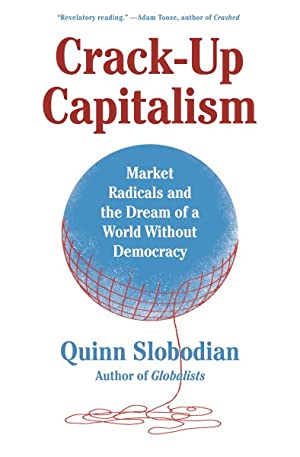
Quinn Slobodian’s new book, Crack-Up Capitalism is an original and striking analysis of a weird apparent disjuncture. Libertarians and classical liberals famously claim to be opposed to state power. So why do some of them resort to it so readily?
A few days ago, I tooted at Mastodon about a Christmas message I’d had from a Russian friend. I intended my post to convey something hopeful about peace and reconciliation, but got immediate pushback from someone who asked why, if there are are some good Russians, they haven’t stopped the war. Meanwhile, over on Elon’s death site, the theme of holding Russians collectively responsible for the war seemed to be gathering momentum with vehement assertions that this isn’t just “Putin’s war” but one backed by “the Russian people”. I think claims such as these, particularly in their maximal forms are absurd, and become all the more absurd when the alleged collective responsiblity of “the Russian people” is extended to an attitude of hostility and blaming towards individuals, simply because they hold Russian nationality. And many members of “the Russian people” are, after all, children. Yet in rejecting such absurdities, I also want to leave room for those Russians who feel their own responsbility keenly and who feel shame at the Russian government’s actions and who want to take responsibility by resisting, in great or small ways, what that government is doing.
One obvious point to make is that Russia is not a democracy and that Russian citizens have no effective means to restrain their government, even if they wanted to. Rather, they live under a tyranny, quick to mete out savage punishments to its opponents, and where public opinion is partly shaped by relentless nationalistic propaganda. In this light, one might think of ordinary Russians as being among the victims of the regime, even though there are others, most notably Ukrainians, who are suffering much more at its hands. During the Soviet era, it is worth noting, Western governments were keen to frame ordinary Soviet citizens as victims of dictatorship rather than holding them individually or collectively responsible, but this approach has been abandoned in some reponses to the war, including by Baltic politicians who refuse to accept that Russians who refuse to fight for Putin are legitimate refugees.
[click to continue…]
I discovered recently that my late Aunt Mary, who was in her time PA to the Postmaster General and a crack typist, had transcribed a letter from a distant relative of ours recounting a journey in 1865 from London to Aden (part of a journey to India). The letter seems sufficiently interesting to post here at Crooked Timber. Among the points of interest are the speed of the journey to Marseilles (remember, we are only 35 years into the railway era), seeing de Lesseps in Egypt — who has constructed the “Sweet Water Canal” (the Ismaïlia Canal) and has yet to complete the Suez Canal), impressions of the various places he passed through, and the tragic funeral of a young man who has died of drink. But much else besides. I’ve digitized by using the OCR on my phone and have checked the various oddities and spellings, so this should be an accurate reproduction.
S.S. Mooltan, Red Sea
22 December 1865
My dear Nelly,
I promised Mamma that I would send you all a letter but the old “Ripon” made such bad weather of it that although an old sailor I could not write very comfortably on board her and therefore all the writing that I did on board was either on business or to your dear Mother. We are now in a very fine large ship and as the weather is fine the sea very smooth and I have a cabin to myself, I can write in comfort and without being disturbed. You will I am sure like to have a kind of log or journal of my proceeding since I left you all on Monday and I will try and recollect the places that I have passed through and any little incidents that may be interesting and jot them down on paper to post at Aden, and although addressed to your dear Nelly you must understand that this letter is meant for all my dear children, and as I shall probably not write to your Mother from Aden, why, this will suffice to let her know also that I am in health and as happy as I can be while away from all I love.
Earlier this year, I wrote a piece in defense of presentism, discovering just before I posted, that the same title had been used (also this year) by David Armitage, Professor of History at Harvard.
It was good to know that I wasn’t alone, but as Armitage made clear, “presentism” has been “a term of abuse conventionally deployed to describe an interpretation of history that is biased towards and coloured by present-day concerns, preoccupations and values”. A fairly standard version of the critique was given by Lynn Hunt, then President of the American Historical Association, in 2002 [1]
It seems however, that things are changing fast. A couple of weeks ago, James Sweet, Hunt’s successor as AHA President, wrote a more or less routine denunciation of presentism , which unsurprisingly picked on the 1619 Project as Exhibit A (for balance, the article also criticised the misuse of historical evidence by Justices Thomas and Alito). This produced a hostile response which forced Sweet to attach an apology to his piece.
The negative response to Sweet’s article reflects in part the intensity of the debate around racism in the US and about the 1619 Project in particular. But it also attracted more fundamental critiques, like this one from Kevin Gannon who concludes “all history is presentism”. As Gannon observes,
the very act of selecting a topic, arranging evidence , and presenting one interpretation of all that as more legitimate than the others—this scholarly ritual is absolutely shaped by the concerns of our present. That it even exists is because of “the concerns of the present.”
As I mentioned, exactly this point was made long ago by critics of “value-free economics”. Hopefully, value-free history will soon join value-free economics in the dustbin of intellectual history. At a minimum, we should see the end of the lazy use of “presentism” as a pejorative.
fn1. This orthodoxy is commonly traced back to Herbert Butterfield’s critique of the Whig Interpretation of History, but I’ve seen some suggestions that this is a misreading.
More than forty years ago, before I went to university, I was living in Paris and became an “organized sympathiser”, a candidate for membership, of the Trotskyist sect Lutte Ouvrière. The training for people like me consisted, of course, of reading some Marxist classics, but also of making one’s way through a list of novels that included, as I recall, Zola’s Germinal, Christiane Rochefort’s Les Stances à Sophie, Malraux’s Les Conquérants and La Condition Humaine, Orwell’s Homage to Catalonia, London’s The Iron Heel and certainly some others that I forget. One of the books that I never got round to was Ousmane Sembène’s Les Bouts de bois de Dieu, and I had more or less forgotten about it until a contact on social media with whom I share many mutual friends reported reading it after a trip to Senegal. So I thought I would give it a go.
It is one of the most remarkable novels I have read in the past several years and deserves to be widely knows as a classic. It is an epic constructed somewhat in the manner of a great Russian novel (think of Grossman’s Life and Fate, for example) and centres on a strike of African railway workers, against the French rail company and the colonial administration in 1947-8. The strikers are poor, many of them are illiterate, they are Muslims, many are in polygamous families and they are regarded by the French as savages and by their religious leaders as people who ought to be grateful and know their place. Yet they have their dignity and cannot accept that they are worth less than the whites who work on the railway, that they should have no entitlement to family support, or to a pension in their old age. So they strike, heedless of the advice of their elders who had done the same ten years before.
[click to continue…]
I’ve just finished Erin Pineda’s Seeing Like an Activist: Civil Disobedience and the Civil Rights Movement (Oxford University Press, 2021), and it is a very welcome addition to the literature on both civil disobedience and the history of the US civil rights movement that anyone interested in either topic should read. Pineda is keen to push back against a particular liberal constitutionalist theory of civil disobedience, associated with Bedau and Rawls that purports to draw on the US civil rights movement but which, according to her, ends up both falsifying the history and provides succour to a narrative about civil rights that is used to discipline subsequent movements (such as Black Lives Matter) as failing to live up to the standards set by the activists of the 1960s. That narrative and theory also supports what we might call a form of soft white supremacy, according to which a nearly-just republic composed largely of white citizens was already in place and the task of civil disobedience was to communicate the anomalous exclusion of black Americans from the polity, so that white citizens, apprised of this injustice and stricken by conscience, would act to rectify things.
This standard liberal narrative around civil disobedience has fidelity to law and an acknowledgement of the basic justice and legitimacy of the established order at its heart. The task of civil disobedients on this view is to act non-coercively and non-violently but to break the law (a bit) only to raise the awareness of citizens considered as fellows who are thought of not as themselves implicated in the injustice but as basically good people who would act if only they knew. The civil disobedient on this view submits willingly, even eagerly, to punishment in order to testify to injustice whilst also accepting the shared framework of law. The tacit framework here is also a nationalist one (or at least a statist one) of shared co-operation among fellows who want to establish a just order on national territory together.
[click to continue…]
I was reading a book on migration ethics recently – I may write a review later 1 — and it reminded me how a certain picture of the normal liberal state and its place in the world figures in a lot of political philosophy. Although the normative arguments are supposedly independent of historical facts, history is to be found everywhere, but only in a highly selective version that reflects the dominance of the United States within the discipline and the prominence of prosperous white liberals as both the writers of the important texts and as the readers and gatekeepers. 2 Their assumptions about the world and the US place in it shine through and form a "common ground" that is presupposed in much of this writing.3
In this vision, all the world is America 4 — though not one that corresponds to the actual history of the US — and the rest of the world mostly consists of little proto-Americas that will or should get there in the end (thereby echoing Marx’s dictum that the more developed country shows the less developed one a picture of its own future). This imaginary, but also not-imaginary, state is a sort-of cleaned-up and aspirational version of the actual one, cleansed of embarrassing details that are mere contingencies that detract or distract from what US liberals suppose to be its real essence or telos. Crucially, it is also considered as a basically self-contained entity, where all the important relationships are ones among people on the territory.5 It is an association of free and equal persons that has simply arisen on virgin soil. Both the actual United States and other countries fall short of this model, of course, but with time and good will wrinkles and carbuncles will be removed. 6
I was planning a post with this title, but after some preliminary discussion, a commenter on Twitter pointed me to this piece by David Armitage, which not only has the title I planned to use[1], but a much more complete and nuanced presentation of the argument, as you might expect from the chair of the Harvard history department.
I won’t recapitulate his points, except to make an observation about disciplinary differences. The dominant view in history described by Armitage as “professional creed: the commitment to separate the concerns of the present from the scientific treatment of the past” is identical, with a slight change in terminology, to the central claim of “value-free economics”, that it is possible to separate the positive science of economics, from the normative question of what economic choices should be made. [2]
What’s striking here is that the idea of “value free” economics has been the subject of severe criticism for decades, starting in the 1950s with Gunnar Myrdal [3]. Hardly anyone now puts forward claims of this kind in the strong version presented most notably by Milton Friedman. This view is routinely denounced as a residue of “logical positivism”, an pejorative with much the same valence as “Whig history”, except for a reversal of sign.
Armitage’s defense of presentism runs along very similar lines to the critiques of value free economics. Most notably, he observes
can we plausibly deny that we choose our subjects according to our own present concerns and then bring our immediate analytical frameworks to bear upon them?
Referring to history specifically, he says
only history—again, only our individual experiences and that collective record of the human past in all its forms, from the cultural to the cosmic—can supply the information and the imagination to shape our choices, in the present, among multiple potential paths into the future. If historians too freely use presentism as a slur or as a taboo, then we may be guilty of depriving our readers, and indeed ourselves, of one valuable resource for promoting human flourishing: history.
Lately, I find I’ve been spending more and more time looking at Facebook groups of old photographs of Bristol, the city where I live. I particularly enjoy the aerial photographs of the interwar period, often colorized. There are lots of reasons for this: I like photographs, I like history, I like cities. But it isn’t just Bristol, I can also spend hours on the Shorpy site, sometimes going to Google Street View for a modern take, and I own several books comparing the Parises of Marville and Atget and the New York of Berenice Abbott to the same scenes today, as well as multiple volumes of Reece Winstone’s collection of historic Bristol pictures. So what’s the attraction, indeed the compulsion? What is drawing me and others to these scenes? And does this attraction also have a problematic side to it?
One common response to the images is a sense of thwarted possibility. You see a functioning, bustling city, full of life, and full of beatiful surviving buildings, densely packed. The train is everywhere, with bridges, tracks, sidings, sheds to match. Sometimes a locomotive is in view. The rail infrastructure criss-crosses with the water, canal and harbours. Factories with their chimneys sit adjacent to medieval churches with their towers and spires. The technology often looks amazing, as with the Ashton Avenue Bridge (1905)(covered for photoblogging a while back), which in its day was a double-decker swing structure, with road on the top deck and rail running below. These days it has but one functioning level – the old rail deck is for pedestrians and cyclists – and it hasn’t swung since 1951. The “then” pictures give us the romance of industrial modernity combined with the charm of the medieval.
[click to continue…]
I’ve been listening to longform radio documentaries ever since I started listening to Radio 4/The Home Service more than 50 years ago. I can’t remember anything better than this series about the Brixton Riot of 1981, hosted by a chap called Big Narstie (of whom I had never heard, but who my somewhat-cooler-than-me son-in-law assures me is a generally good chap). The combination of careful historical analysis, eyewitness testimony, dramatic recreation (of which I am generally skeptical, but is done, here, carefully and sparingly) is brilliant. Mr Narstie himself is charming. He seems genuinely moved by some of the stories within the story, and manages to convey his enthusiasm about just how much progress has been made while insisting that much is left to do. It’s not until episode 7 (of 8) that we get to the riot itself. What the series does is explain why the riot (and the riots that followed in the summer of 81) happened, and to do that it traces the history of police/community relations in south London from the mid-1960’s. It’s not perfect. There’s no real discussion of the St. Paul’s riot from the previous year. And the thread about the New Cross house fire loses steam a little bit: it is not made clear to the listener that forensics eventually established that the fire began inside the house, which is a pity, because the relevance of the New Cross fire is that however it was started no reasonable person in that community could believe anything that the police told them.
Two police officers from the time tell their stories. One is frank and straightforward – the police force he joined was populated substantially by racist criminals, and almost entirely, otherwise, by people who were either implicated in, or happy to turn a blind eye to, the lawlessness of their colleagues. (Political scientists can correct me here, but from casual observation there does seems to be a pretty general rule: when you’re trying to explain rioting during peacetime in liberal democracies a good starting point is police/community relations, and it’s not unusual to find a long history of criminality toward the rioting community on the part of the police). The other officer is much more defensive, tarring the young men who were regularly stopped and searched under the Sus laws, beaten up, arrested, and “fitted up”, as criminals. But there is one amusing moment, in which he says, probably with at least an element of truth, something to the effect of “People say we were racist. But Blacks had moved into that area, and we treated them the way that we treated the people who had lived there before”.
Many of the stories of individual encounters with police officers that are told in the first few episodes are shocking and should be very hard to believe. I think it is worth dwelling a little, as the podcast doesn’t, on just why so many people not directly affected by the way Brixton and other Black communities were policed, did not understand the problem. To understand it you had to be willing to believe that (often violent) lawbreaking was the norm in the Metropolitan Police. Think of your own workplace. Imagine that you violently assaulted a someone you had just grabbed off the pavement/sidewalk in front of 10 of your colleague. How much push back would you get? Wouldn’t somebody get a little nervous that you, or they, would get into trouble? Now imagine that you do it again the next day. Now imagine that several of your colleagues do the same thing in the next few weeks. And then boast about it in the cafeteria. Most people in my parents’ and grandparents’ generations did not inhabit workplaces where that was normal, and, I think, found it very hard to take seriously the idea that the police, in particular, were like that. Especially if they lived in part of the country (and there were some) which was relatively well policed. [1]
Unless, of course, you had some direct experience of the Met yourself.
I’m nearly through reading Barbara Kingsolver’s *The Poisonwood Bible* at the moment, and very good it is too. For those who don’t know, the main part of Kingsolver’s novel is set in the Congo during the period comprising independence in 1960 and the murder of its first Prime Minister, Patrice Lumumba, on 17 January 1961 at the hands of Katangan “rebels” backed by Belgium and the US. And DR Congo (sometime Zaire) has been pretty continuously violent and unstable ever since. With its origins in King Leopold’s extractive private state (rubber), Congo has been coveted and plundered for the sake of its natural resources ever since. At the time of the Katanga crisis copper was the thing. But now what was previously a little-wanted by-product of copper extraction, cobalt, is in heavy demand because of its use in batteries.
My attention was caught yesterday by [a press release from the UK’s Natural History Museum](https://www.nhm.ac.uk/press-office/press-releases/leading-scientists-set-out-resource-challenge-of-meeting-net-zer.html), authored by a group of British geoscientists:
> The letter explains that to meet UK electric car targets for 2050 we would need to produce just under two times the current total annual world cobalt production, nearly the entire world production of neodymium, three quarters the world’s lithium production and at least half of the world’s copper production.
A friend alerted me to a piece by Asad Rehman of War on Want, provocatively entitled [*The ‘green new deal’ supported by Ocasio-Cortez and Corbyn is just a new form of colonialism*](https://www.independent.co.uk/voices/green-new-deal-alexandria-ocasio-cortez-corbyn-colonialism-climate-change-a8899876.html) which makes the point:
> The demand for renewable energy and storage technologies will far exceed the reserves for cobalt, lithium and nickel. In the case of cobalt, of which 58 per cent is currently mined in the DR of Congo, it has helped fuel a conflict that has blighted the lives of millions, led to the contamination of air, water and soil, and left the mining area as one of the top 10 most polluted places in the world.
People who are optimistic about the possibilities of decarbonizing without major disruption to Western ways of life and standards of living are often enthusiastic about new technologies, battery developments etc. I’ll include CT’s John Quiggin in that (see John’s piece from CT [Can we get to 350ppm? Yes we can from 2017](https://crookedtimber.org/2017/07/22/42710/)). John tells me he’s sceptical about claims that we are about to run out of some scare resource. Maybe he’s right about that and more exploration will reveal big reserves of copper and cobalt in other places. But even if he is, we still have to get that stuff out of the ground, and that’s predictably bad for local environments and their people, and in the short to medium term it may yet be further bad news for the people of DR Congo who have already endured seventy plus plus years as a “free” country (and 135 years since Leopold set up in business) in conditions of violence and exploitation, whilst already wealthy northerners get all the benefits.
 We visited the Cave of Pech Merle yesterday, which is famous for its prehistorical paintings of bisons, mammoths, horses, and other animals. Those paintings have been made by people who, according to our guide, were almost identical to us, except, she said, that they were taller than us – on average 1 meter 85 centimeter. Pech Merle has a website that is a bit slow (at least, given my present internet-conditions), but it has a very interesting part where you can enter the cave virtually.
I’ve visited many caves in my life, but never one with prehistorical paintings, and was very impressed. If you ever get a chance to see them, do go see them! Although the crown piece of the cave are two dotted horses, which are large and in excellent condition and include something of an optical illusion (avant la lettre?) — I was especially touched by the painting of the hands of the people. There are a number of hands, painted in black, close to the dotted horses, presumably by a man (or several men); and then there is this single hand in red, which is presumably from a woman. At first, I was surprised to note that the hands touched me more than the animals (which may be seen as artistically more sophisticated). I guess that seeing a hand brings the presence of the human being closer than seeing a non-human animal. People, almost identical to us, who made paintings in a cave, some 20.000 years ago, that we can still watch today…
Relevant to the scandal in Britain about material being ‘lost’ from the National Archives, this bit from Margaret Levi’s book, _Consent, Dissent and Patriotism_ (p.13)
More arcane is the account of a small fire that destroyed relevant materials from World War I and World War II in the Australian War Memorial. The representatives of the British government operate under strict rules of secrecy concerning a very large amount of military-related material and they uphold these rules rigorously. The Australian government operates with a greater openness. The problem arose because in the Australian war memorial were records that the British deemed secret and the Australians did not. The problem was resolved by the British, or so my reliable source tells me, by planting a mole archivist in the War Memorial. This mole lit a small fire in the relevant stacks and disappeared.