by John Q on November 30, 2025
I’ve been seeing more and more alarmism about the idea that, on current demographic trends, the world’s population might shrink to a billion in a century or two. That distant prospect is producing lots of advocacy for policies to increase birth rates right now.
One of the big claims is that a smaller population will reduce the rate of scientific progress I’ve criticised this in the past, pointing out that billions of young people today, particularly girls, don’t get the education they need to have any serious chance of realising their potential. But it seems as if I need to repeat myself, so I will do so, trying a slightly different tack
It’s surprisingly difficult to get an estimate of the number of researchers in the world, but Google scholar gives us a rough idea. Google Scholar indexes research across all academic disciplines, including social sciences and humanities. No exact count is available, but I’ve seen an estimate that 1.5 million people have Google scholar profiles. I’d guess that this would account for at least half of all active researchers, for a total of 3 million.
[click to continue…]
by Chris Bertram on November 30, 2025
by Doug Muir on November 27, 2025
“I am especially to speak to you of the character and mission of the United States, with special reference to the question whether we are the better or the worse for being composed of different races of men.”
— Frederick Douglass, Composite Nation, 1869
Today is Thanksgiving Day in the USA. So, here’s a Thanksgiving cartoon from 1869, by the great American cartoonist Thomas Nast.

You may have seen it before. But it’s an interesting piece of work, and rewards close attention.
[click to continue…]
by Eszter Hargittai on November 27, 2025

I think a fair bit about how generative AI can help our everydays. (I also think a lot about its challenges, but this post is not about that.) Here is a good example for how it can be useful with a complex meal prep situation for which Thanksgiving is the ultimate case (which I’m celebrating in Zurich this year having taken a day off work since of course it’s not a holiday here, but my cooking requires more than a few hours).
Assuming limited stove top, oven, and counterspace (a very fair assumption in the Zurich housing market), it is important to optimize the order of preparing the various dishes that require a complex mix of preparations. One example is needing to roast some garlic for 30 minutes as just one ingredient in this amazing mashed potatoes and yams dish that I have been making annually for 25 years (I seem to have blogged about it already 20 years ago).
So how can Gen AI help? Give it your list of recipes and ask it to optimize the process for you. I used Google’s NotebookLM for this as cooking optimization is something I want to keep long-term and I like having a separate saved notebook for it (handled well by some AI tools, but not so much Gemini, which is where I have a subscription). (As much as I like NotebookLM – as far as I can tell it requires a Google account – I do wish they would introduce folders.. available as browser add-ons, I know.) This should all work with your preferred Gen AI tool as well, or if it doesn’t then you may want to rethink your Gen AI choices. ;-)
My prompt was simple: [click to continue…]
by John Q on November 22, 2025
The US is one big grift these days: the Trump Administration, traditional and social media, corporations, crypto, financial markets are all selling some kind of spurious promise. It’s hard to pick the most egregious example. But for me, it’s hard to go past Tesla. Having lost its dominant position in the electric car market, the company ought to be on the edge of delisting. Instead, its current market capitalisation is $US1.33 trillion ($A 2 trillion). Shareholders have just agreed on an incentive deal with Elon Musk, premised on the claim that he can take that number to $8.5 trillion.
Having failed with the Cybertruck and robotaxis, Tesla’s value depends almost entirely on the projected success of the Optimus humanoid robot. There’s a strong case that Optimus will be outperformed by rivals like Unitree But the bigger question is: why build a humanoid robot at all?
[click to continue…]
by Chris Bertram on November 20, 2025
I have a piece over at the London Review of Books Blog about the UK government’s appalling changes to the way refugees are treated in the country.
“After the home secretary, Shabana Mahmood, announced the government’s new policies for ‘Restoring Order and Control’ in the House of Commons yesterday, one MP after another stood up to commend the British people for their ‘proud tradition’ of giving sanctuary, for their openness and toleration, before moving onto questions of ‘stopping the boats’, ‘fairness for the British taxpayer’ and whether asylum seekers might be housed near their constituents. The European Convention on Human Rights was mentioned so often that one might have imagined it to be the international treaty at the centre of refugeehood. It isn’t: that’s the Refugee Convention of 1951, largely absent from the debate.”
Read the continuation over there.
by Ingrid Robeyns on November 17, 2025
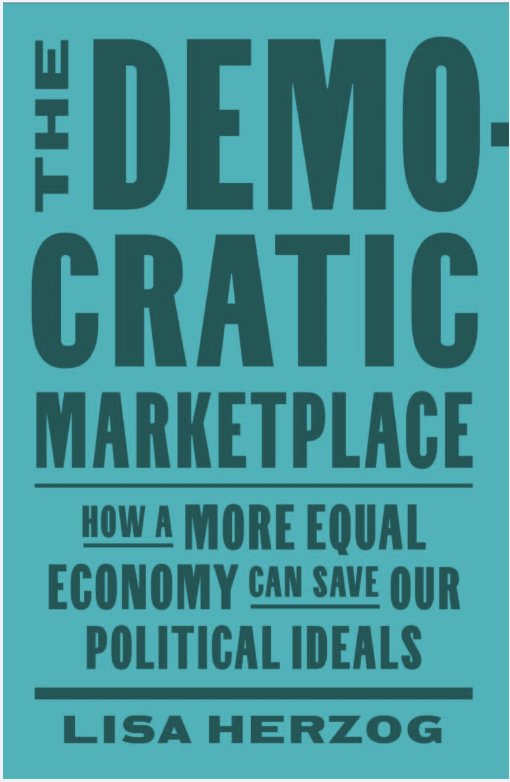
 If you want to know more about how the current form of capitalism is undermining (a thick conception of) democracy, and what can be done about this, then you should read Lisa Herzog’s latest book The Democratic Marketplace. The book is written for a broad audience, and I suspect that anyone who regularly reads this blog will enjoy Lisa’s book and learn something new; and it will also provoke debate and discussion on important questions regarding the state of our economic system, our democracies, and how these two are related.
Lisa argues that genuine democracy (which is much more demanding than merely elections/counting votes) requires that democratic values be embedded in all public spheres of life. And therefore we should democratize the economy. This requires, among other things, workplace democracy, reducing economic inequality, shifting our focus from economic growth to the functions of the economy, and adopting a different policy of time that allows citizens to do the much-needed democratic work.
This Thursday 20 November, between 14:00 and 16:00 hours CET, the Visions for the Future Project is organizing an online discussion of Lisa’s book. Julie Rose and Tom Parr will kick off with comments. The online book workshop will take place via MS Teams. To get the link (which you will get within the next working day after registering), you can register via the link on the bottom of the event’s announcement page. Enjoy the reading, and enjoy becoming inspired to take (more) civic action by reading (and discussing) Lisa’s book!
by Chris Bertram on November 16, 2025
by John Q on November 10, 2025
107 years ago*, the guns fell silent on the Western Front, marking a temporary and partial end to the Great War which began in 1914, and has continued, in one form or another, ever since. I once hoped that I would live to see a peaceful world, but that hope has faded away.
- As several readers noted, my arithmetic was off – this seems to be happening to me a bit lately. Fixed now. Also, while it was 11 Nov in Australia when I wrote it, it was 10 Nov in the US where our servers are located.
by Ingrid Robeyns on November 10, 2025
With another COP starting today, and the question of climate change having played no role at all in the Dutch elections recently, and, well, for a zillion different reasons – it seems like a good time to ask the question: what books can help to make people move on this topic? (or if you think books are the wrong medium, and we should only look at TikToks or cinema movies or Netflix series, I’d love to hear arguments for that view too).
 To me, the most magnificent fiction book on climate change is Kim Stanley Robinson’s The Ministry for the Future. It is phenomenal. I hadn’t read it yet when Henry organised a seminar on the book here at Crooked Timber, but I can only say: do read it. Admittedly, the book is very long – and this might be asking too much of many people, given the very many other demands on our lives. But there’s an easy solution: listen to it. This book is perfect as an audiobook. You listen while walking, and you’ll gradually get through the entire book while enjoying your daily walk. Given the many different voices in the book, it might even be better as an audio-book than to read it from paper/screen.
But since The Ministry for the Future already was discussed at length here, let me focus on two other books that might help to centre our awareness and political debates on climate change: Eleanor Catton’s Birnam Wood and Kimberly Nicholas’s Under the Sky We Make. The first is fiction, the second is non-fiction for citizens. Attention: one spoiler about Birnam Wood under the fold. [click to continue…]
by Lisa Herzog on November 10, 2025
If you’ve ever been at a Dutch PhD ceremony, you’ve come across the toga – which is, unfortunately not a Greek or Roman toga as pictured here. Instead, it’s a kind of black gown, made from heavy cloth, with velvet facings, accompanied by a white collar and a velvet hat that resembles the mortarboards that students around the world wear (and throw) at graduation. This outfit is worn not only at doctoral defenses, but also at inaugural lectures or the official opening of the academic year (here you get an impression of what this looks like in Groningen). Other countries and universities have their own versions of academic regalia, probably with Oxford and Cambridge leading the crowd.
As a foreigner (“international”, as they say in the Netherlands), I got introduced to this custom for the first time when being on a doctoral committee while still working outside the country. When asked whether I wanted to borrow a toga, I was baffled, and found some kind of excuse (probably that I wasn’t a full professor yet). I had an instinctive defensive reaction, which, at the time, I couldn’t quite make sense of. What had spontaneously come to my mind was a slogan of the German 1968 student movement that is hard to forget if you’ve heard it once: “Unter den Talaren, Muff von 1000 Jahren”, “Under the gowns, fug of 1000 years” (see e.g. here for a nice picture and historical account, in German). Although this has often been read as directed against a generation of professors many of whom had a Nazi past (the “1000 year Reich”), it was in fact directed mostly against academic hierarchies and the exclusion of students from university governance. And these latter points – especially the rejection of German university hierarchies, with permanent jobs only for professors – I wholeheartedly share.
[click to continue…]
by Chris Bertram on November 9, 2025
by Hannah Forsyth on November 5, 2025
Death comes for us all. We are outlived, as Barkandji man Woddy Harris would have it, by Mother Nature, who holds us in something that I think he would liken to ‘eternity’.
By what logic, then, must Mother Nature also die?
The Barkandji in Wilcannia and nearby Menindee had been protesting and putting their effort into protecting what they feared might be a dying river – the Barka, their mother – for years when in 2018 the first horrors of mass fish kills hit the news.
[click to continue…]
by Chris Bertram on November 4, 2025
I’ve been visiting family in Germany, with only a phone, so I couldn’t post on Sunday. But here are some crows from Hamburg.