by Ingrid Robeyns on November 10, 2025
With another COP starting today, and the question of climate change having played no role at all in the Dutch elections recently, and, well, for a zillion different reasons – it seems like a good time to ask the question: what books can help to make people move on this topic? (or if you think books are the wrong medium, and we should only look at TikToks or cinema movies or Netflix series, I’d love to hear arguments for that view too).
 To me, the most magnificent fiction book on climate change is Kim Stanley Robinson’s The Ministry for the Future. It is phenomenal. I hadn’t read it yet when Henry organised a seminar on the book here at Crooked Timber, but I can only say: do read it. Admittedly, the book is very long – and this might be asking too much of many people, given the very many other demands on our lives. But there’s an easy solution: listen to it. This book is perfect as an audiobook. You listen while walking, and you’ll gradually get through the entire book while enjoying your daily walk. Given the many different voices in the book, it might even be better as an audio-book than to read it from paper/screen.
But since The Ministry for the Future already was discussed at length here, let me focus on two other books that might help to centre our awareness and political debates on climate change: Eleanor Catton’s Birnam Wood and Kimberly Nicholas’s Under the Sky We Make. The first is fiction, the second is non-fiction for citizens. Attention: one spoiler about Birnam Wood under the fold. [click to continue…]
by Ingrid Robeyns on September 22, 2025
 I’m in the midst of doing research, teaching, and outreach activities on a set of questions around economic growth and its relationship to what we value. My research team has Tim Jackson visiting tomorrow, who will give a talk on postgrowth economics and also talk a bit about his new book, The Care Economy. The main claim of that book is that the economy should not be about welfare understood as GDP per capital, with the corresponding economic policy goal being economic growth. Rather, the economy should be about people’s health (using the WHO definition, which I interpret as ‘well-being’), and hence economic policy should be about what we do to preserve and improve our health, which is care – care for ourselves, for others, for the planet including its ecosystems that allows us to live well.
Now, contrast this with the first “mission” taken from the election manifesto of the Dutch VVD, which is the Dutch right-wing party, which sees itself as the defender of classical liberal values, democracy, rule of law and so forth. (note aside: many critical commentators see the VVD increasingly as a populist extreme-right party, but I won’t look into that yawning gap now).
The first mission of the VVD is: Radical Economic Growth. [click to continue…]
by Ingrid Robeyns on December 9, 2024
A few weeks ago, seven political philosophers at my department, who regularly meet to discuss issues related to sustainable futures, met to discuss Hannah Ritchie’s book Not the End of the World. That book quickly appeared on the bestseller’s lists. For everyone who read her book, or is perhaps thinking about reading her book, here’s what we thought about it (which, regular readers of this blog will notice, is an example of Team Philosophy which we discussed here a while ago.)
Our review can be found below the fold.
[click to continue…]
by Doug Muir on September 20, 2024
Every few years the UN publishes one of these big papers on “world population prospects”, which are… exactly what they sound like: a best guess at what’s going to happen with the world’s population over the next few decades.
Nut graph after the jump:
[click to continue…]
by John Q on July 23, 2023
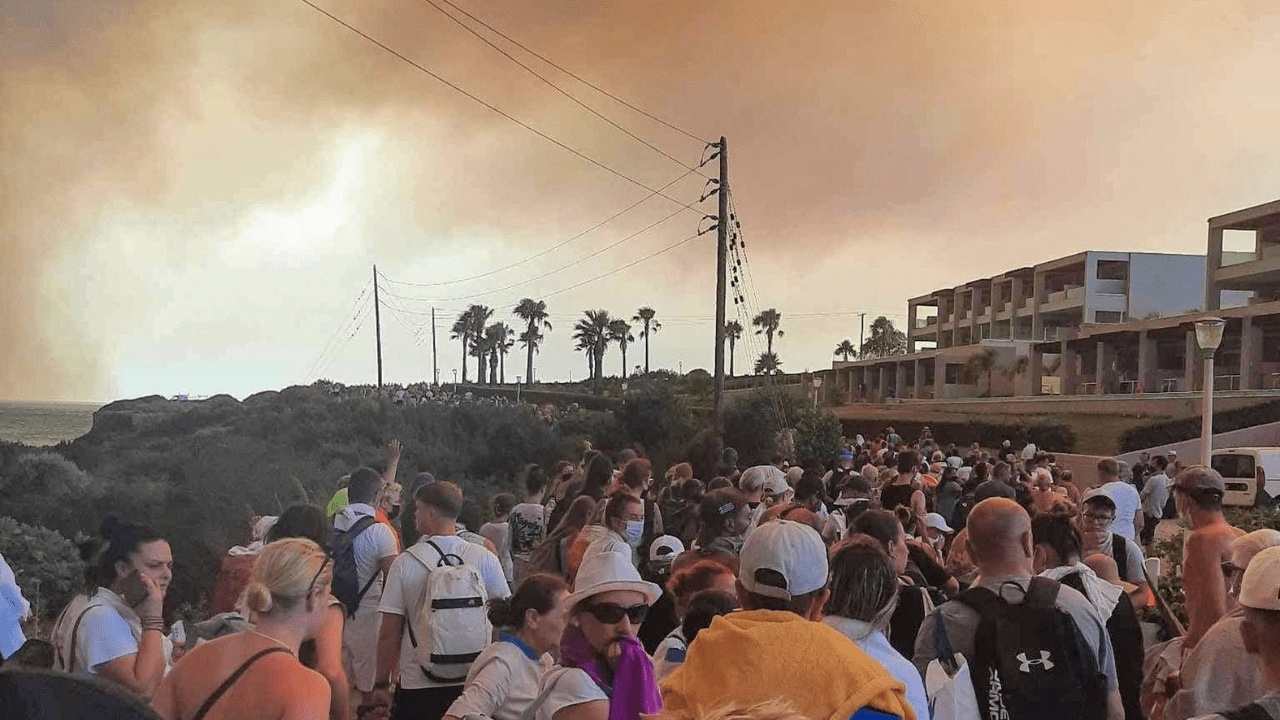
I was looking at this picture of people (mostly tourists, it appears) fleeing massive fires in Rhodes, feeling despair about the future of the world
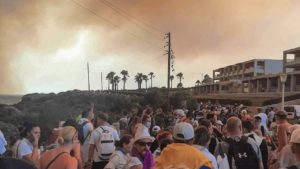
when I was struck by an even more despairing thought.
Almost certainly, a lot of the people in the picture are climate denialists. And even more certainly, they will mostly remain so despite this experience.
[click to continue…]
by Ingrid Robeyns on March 29, 2023
Earlier this week, I was at a meeting to discuss the question whether my university should cut its ties with the fossil industry, or else impose additional conditions on working with partners from fossil industries. There was quite some agreement that the university should think hard about spelling out and endorsing a moral framework, and based on those values and moral principles work out what (if any) forms of collaboration would remain legitimate in the future. This led our vice-chancellor to ask the question what else such moral framework would imply for university staff. “Should we perhaps completely stop flying?”, he asked.
And then there is, once again, a very depressing IPCC report and we must radically change our modes of production and consumption if we want to leave our children (and our older selves) a planet that will remain safe for the human species. And it’s not just about the future, but about the present: urgent action is needed to lower the number of the deadly climate-related events that we have seen over the last years, from increases in wildfires to deadly floodings – that led poor people, who have made almost zero contribution to this problem, lose their livelihoods, and many simply died. So to me it seems obvious that what we change in response to climate change is a very urgent moral question.
Hence the question: Do academics fly too much? Should we simply stop flying at all?
[click to continue…]
by Eric Schliesser on November 26, 2022
by Ingrid Robeyns on October 31, 2022
Yesterday I attended/watched four talks on climate action. The first three were at a festival in Amsterdam where Chris Armstrong, a new branch on our crooked tree, was also speaking, on his book on oceans politics. First I attended two talks by some Dutch-speaking people (including David Van Reybrouck, famous author of the colonial histories Congo and Revolusi, who is now fully dedicated to working on ecological causes). Then I attended Andreas Malm’s talk on how to fight in a world on fire. Nothing special to report for those who have read the book – but given the pretty critical discussion of my bookreview of his work here recently I’d thought I should mention that he came across as more nuanced than [how I read] his book. For example, he stressed that the vast majority of the climate movement will remain peaceful, and that those who want to move to sabotage must carefully choose their targets – focussing on targets that are part of the problem, and as part of an action that doesn’t alienate people but instead lets the climate movement grow.
But the most interesting talk of the day was by Greta Thunberg, who launched The Climate Book at the London Literature Festival. Thunberg has put together a one-stop-volume on climate change and climate action. You can watch her speech and subsequent interview here (it effectively starts at 14’35”). In essence, Thunberg believes that governments are not going to do what is needed without millions more climate activists putting pressure on those governments, so that they speed up action and put the interests of ordinary people central. At some point, she mentions that so many individuals have the opportunity to be an activist, but don’t. She clearly sees this as a [moral, political] duty (she also uses the word “burden” at some point), and calls upon everyone to join a local activist group. [click to continue…]
by Ingrid Robeyns on October 6, 2022
In his book How to Blog Up A Pipeline, Andreas Malm writes about the need for the climate movement to have a more radical wing (which would do things like blowing up pipelines, or other forms of property destruction). His view is that the climate movement is making a mistake by subscribing to radical forms of non-violence, since the climate crisis is getting worse year by year, while the tactics of the climate movement remain the same – and, in his view, have proven to be ineffective (or at least, insufficiently effective).
One of Malm’s targets is Extinction Rebellion (XR), one of the most visible groups within the climate movement. Local groups of XR are staging various forms of protest, but always non-violent; they do not destroy property. Malm argues that XR has a flawed understanding of how in the past movements operated who were fighting to abolish slavery or abolish apartheid in South Africa, or fighting for women’s political rights or equal civil rights in the US. They all first tried to reach their goals in a peaceful way, but at some point resorted to violence (against property, thereby doing their best to avoid hurting people). And that paid off, since it had the effect of making the claims of the non-violent part of the movement more acceptable to mainstream politics. Malm believes that what XR and other groups in the climate activist movement should learn from the history of the social justice movements, is to have a fraction or a wing in the movement that doesn’t shy away from destroying property. Hence the metaphor of blowing up a pipeline (in case anyone was wondering, Malm doesn’t tell his readers how to actually go about blowing up a pipeline).
This is a thought-provoking book, and I would recommend anyone interested in the future of life on our planet to read it. It is a much-needed book to stir up debate and get us into action, given the desperateness of the current climate situation and the lack of sufficiently effective action (which has been increasingly affecting my mood – as some of my posts here over the last months (one, two) probably revealed). But I don’t think Malm’s book will serve as a one-stop-answer to the question how to make the climate movement deliver results. Why not? [click to continue…]
by Ingrid Robeyns on August 9, 2022
When we ask the question what we should do about climate change, the answer to that question depends a lot on who the “we” in that sentence is. There have been many answers to the questions what governments should do, or more in general “what should be done” without specifying who the agent of change is, as in, for example, the list of action points provided by Project Drawdown. We might have responsibilities related to climate change that we have specifically in our roles as elected politicians and office holders, as professionals, as entrepreneurs, as investors, and so forth.
But what can citizens, in their capacity of citizens rather than any professional role, do? What can human beings, simply by the fact that they are human beings and thus sharing this planet with other living creatures, do about climate change and ecological degradation?
When searching for an answer to that question, I’ve been wondering whether we could help ourselves by making a compact version of what our action plan to deal with climate change could be. Something that is easy to remember; something that is put in langauge that is not just for insiders or specialists; something that could contribute to a wide range of efforts to get things in motion; something that could serve as a structure, starting point or aide in conversations; and something that can help us very concretely in deciding where to start or what to do next.
Because no matter what the already inevitable consequences of climate change are (such as more frequent extreme weather events, droughts, floodings, wildfires etc.), we can always aim to limit the even more harmful consequences that will come with additional increases in greenhouse gas emissions. Similarly, we have to prepare for what will come (even under the best-case scenarios). And in unfolding those strategies, it would help to be united as people in our capacity as citizens and inhabitants of this world, and also to feel united and empowered.
Here’s my proposal for a citizens’ climate action plan in 10 bullet points (so easy to remember!). I will only say a few words about each of these bullet points, not aiming at being comprehensive. [click to continue…]
by Ingrid Robeyns on July 17, 2022
“The fact of the matter is: we are in the decade of decision. What we do in the Twenties will determine the fate of the Earth for centuries and millenia to come. And there’s a lot we can do – we can speed the transition away from fossil fuels, losen the death grip of the fossil fuel industry on our government and the world’s energy supplies, build the renewables, protect the soil and the forests, and support all the incredible movements that have already done so much so far, and have ambitions to do exactly what we need to do.” (Rebecca Solnit, Start Making Sense Clips, July 14th)
Yesterday, I discussed with some international colleagues chapter 4 of my book-in-progress on the problems with extreme wealth. That chapter looks at the links between wealth concentration and the ecological and environmental crisis, and ends up offering multiple ecological arguments for economic limitarianism. I open the chapter with a few pages that make it clear that climate change is not a future worry but that it has arrived, and that time is of the essence. Given that global emissions are not coming down yet and that the remaining carbon budget (to stay below 1,5 degrees or even 2 degrees) is very limited, we need to act fast and in a drastic manner. There is no time to go slow, and no time to merely fiddle in the margins.
It doesn’t make for joyful reading, yet most of what I describe that made my colleagues gloomy was merely factual. The facts simply show that matters are very bad and the situation urgent. But that is no reason to despair, since there are various feasible plans for curbing the emissions and speeding up the green transition, and various groups and movements that one can join in order to contribute. The main problems are political, and problems of power. Perhaps we should simply talk much more about what can be done, and what we can concretely do, rather than either deny that climate change is happening (thought that group seems to be shrinking), ignore that it is happening, or believe it is beyond our powers to do anything.
Two years ago I was invited to write a short piece for WWF’s Living Planet Report and argued precisely this – when it comes to the climate crisis, we need to see ourselves first of all as citizens and unite and act as such.
In that spirit, I was delighted to come across a new initiative from Rebecca Solnit and Thelma Young Lutunatabua, called Not Too Late. They want to encourage everyone to join the climate movement, to act as citizens to force politics to establish structural solutions, and to share stories about what climate movements are achieving. [click to continue…]
by Ingrid Robeyns on April 30, 2022
About a year ago, the old second-hand car that my husband and I bought in 2007 was nearing its end. It had served us very well, but our car mechanic had been warning us for some years that it wouldn’t last for much longer. So we were contemplating what to do; we thought seriously about car-sharing combined with public transport, but for various reasons (the pandemic being one, having a child with special needs another), we decided to buy another car. We gathered information and decided to buy an electric car. The new car has been wonderful – I’ve never really liked driving a car but driving an EV is much more pleasant. And in Utrecht, the city where we live, the local authorities put new electric chargers in the streets at the same pace that new EVs are registered. So, at home we’ve never encountered any noteworthy difficulties with charging.
Until last week, I think we only had positive things to say about our experiences with driving an EV. But then we decided to go to France for a week. [click to continue…]
by Ingrid Robeyns on December 14, 2021
In the Board of the Human Development and Capability Association (HDCA), where I’m currently serving as past-president, there has been an intensifying of the debate on the climate consequences of the annual conference. The HDCA is an international association of mainly academics, though it also attracts policy makers, activists, and others, who are interested in the human development approach (best-known from the UNDP’s Human Development Reports) and one of the main theoretical frameworks underpinning it, the capability approach.
The essence of the tension is clear: there is a significant cost in terms of greenhousegas-emissions of flying to another corner of the world to attend a three-day conference; greenhousegas-emissions need to be reduced as drastically and fast as possible in order to protect the climate, and a stable climate is an important precondition for human flourishing/human development. So what should an organisation such as the HDCA, or its individual members, do with this tension? Clearly, all academics still flying to conferences should ask themselves this question. Hence, let’s open up the discussion here, and see what insights (or good ideas) you might have. [click to continue…]
by Ingrid Robeyns on July 24, 2021
As announced a few weeks ago, here is the first of a series of book chats – starting with Mariana Mazzucato’s Mission Economy. The idea is that this post opens up a space for anyone to talk about any aspect of the book they want to discuss (under the general rules that apply to discussion on this blog), as well as raise questions of clarification that we could put to eachother.
Mission Economy is about rethinking capitalism and rethinking government. Perhaps it is even more about rethinking government than about rethinking capitalism. Both need to be rethought in order to redirect the economy into what Mazzucato calls ‘a mission economy’, which will allow us to tackle problems facing humans and the planet that are currently not properly addressed: climate change, insufficient high-risk long-term investments in the real economy, real wage growth that is much lower than productivity growth, and so forth.
Mazzucato argues that right now we (that is, our governments) ask “how much money is there and what can we do with it?” but instead we should be asking “what needs doing and how can we restructure budgets and design innovation and collaborations between the government, industry, academia and other groups so as to meet those goals?” [click to continue…]
by Chris Bertram on May 26, 2021
One of the lessons of Branko Milanovic’s work on global inequality has been the realization that location, and perhaps more pertinently, nationality, is a more important explanation of how well and badly off people are than class is. Citizens of wealthy countries enjoy a “citizenship premium” over the inhabitants of poor ones that exists because they have access to labour markets and welfare systems that their fellow humans largely do not. Of course, there’s a sense in which this global difference also represents a class difference, with many of the workers simply located elsewhere while the residual “proletarians” of the wealthy world enjoy a contradictory class location (to repurpose a term from Erik Olin Wright). While it might be that world GDP would increase dramatically if barriers to movement were removed, as some economists have claimed, the relative position of the rich world poor depends upon those barriers being in place. Or to put it another way, free movement could make many poor people much better off and might not make the rich world poor any worse off in absolute terms, but it would erode their relative advantage. And people, however misguidedly care about their relative advantage.
What kind of politics would we expect to have in rich countries in a world like ours, if people were fully cognizant of this citizenship premium? I suspect the answer is that we would expect to see stronger nationalist movements seeking to preserve the advantage of members of the national collective over outsiders and correspondingly weaker parties based on class disadvantage within those countries. Which is, in fact, the tendency we do see in many European countries where traditional social democracy is struggling badly at the moment. In those same countries we might also expect to see some voters who are unthreatened by freer movement, or by the rise of new powers in the world, being more open to a more cosmopolitan politics and more preoccupied by other issues such as climate change and the environment. And this is, in fact, what we do see.
[click to continue…]
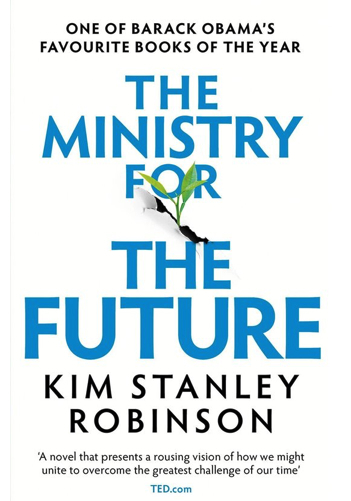 To me, the most magnificent fiction book on climate change is Kim Stanley Robinson’s The Ministry for the Future. It is phenomenal. I hadn’t read it yet when Henry organised a seminar on the book here at Crooked Timber, but I can only say: do read it. Admittedly, the book is very long – and this might be asking too much of many people, given the very many other demands on our lives. But there’s an easy solution: listen to it. This book is perfect as an audiobook. You listen while walking, and you’ll gradually get through the entire book while enjoying your daily walk. Given the many different voices in the book, it might even be better as an audio-book than to read it from paper/screen.