by Belle Waring on July 8, 2023
I did something both awesome and ill-timed. Well, first I should back up and remind you of something I told you before at some nebulous time in the past, and that is that I am an immersive daydreamer. I said that I was a maladaptive daydreamer but I didn’t even think that was right, because I was just having a great time. I have spent countless hours—wait, no, first I should back up further and say, remember the Belle Waring Unified Theory of American Political Life: Fuck You, It’s Racism Again? Looking pretty prescient now, hmm, isn’t it?
Plain People of Crooked Timber: Lovely to see you and everything, Belle, but haranguing us about racism with ever-more-extravagant uses of profanity is not actually the thing we miss about you.
Me: That’s hard cheese, brother.
Getting back to the plot, I have spent my life making up thrilling stories for an audience of one, usually; of two, for my brother starting when I was six and he three, and going up until I was thirteen and called it off, to his agony; of three, when I played “talking games” with the girls, the last round played when my elder was nineteen. My brother and I just called it “talking,” but with a significant accent, and it may have saved my life. We lived in Georgetown in D.C., in a narrow brick house. I was upstairs in my brother’s room having a sleepover so we could “talk,” for what would be the very last time, when someone broke in through the basement door into the room where I would have been sleeping. The fact that the man [makes unfair sexist generalization about burglary] was an idiot who only stole a lot of Indian-head nickels and was then scared away by the cockatiel is not evidence that he might not have hurt me, because people who commit that crime are desperate, violent morons.
[click to continue…]
by Henry Farrell on June 1, 2023
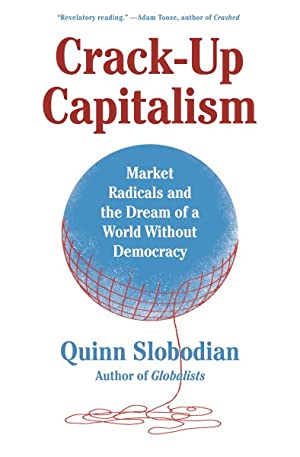
Quinn Slobodian’s new book, Crack-Up Capitalism is an original and striking analysis of a weird apparent disjuncture. Libertarians and classical liberals famously claim to be opposed to state power. So why do some of them resort to it so readily?
[click to continue…]
by Henry Farrell on April 27, 2023

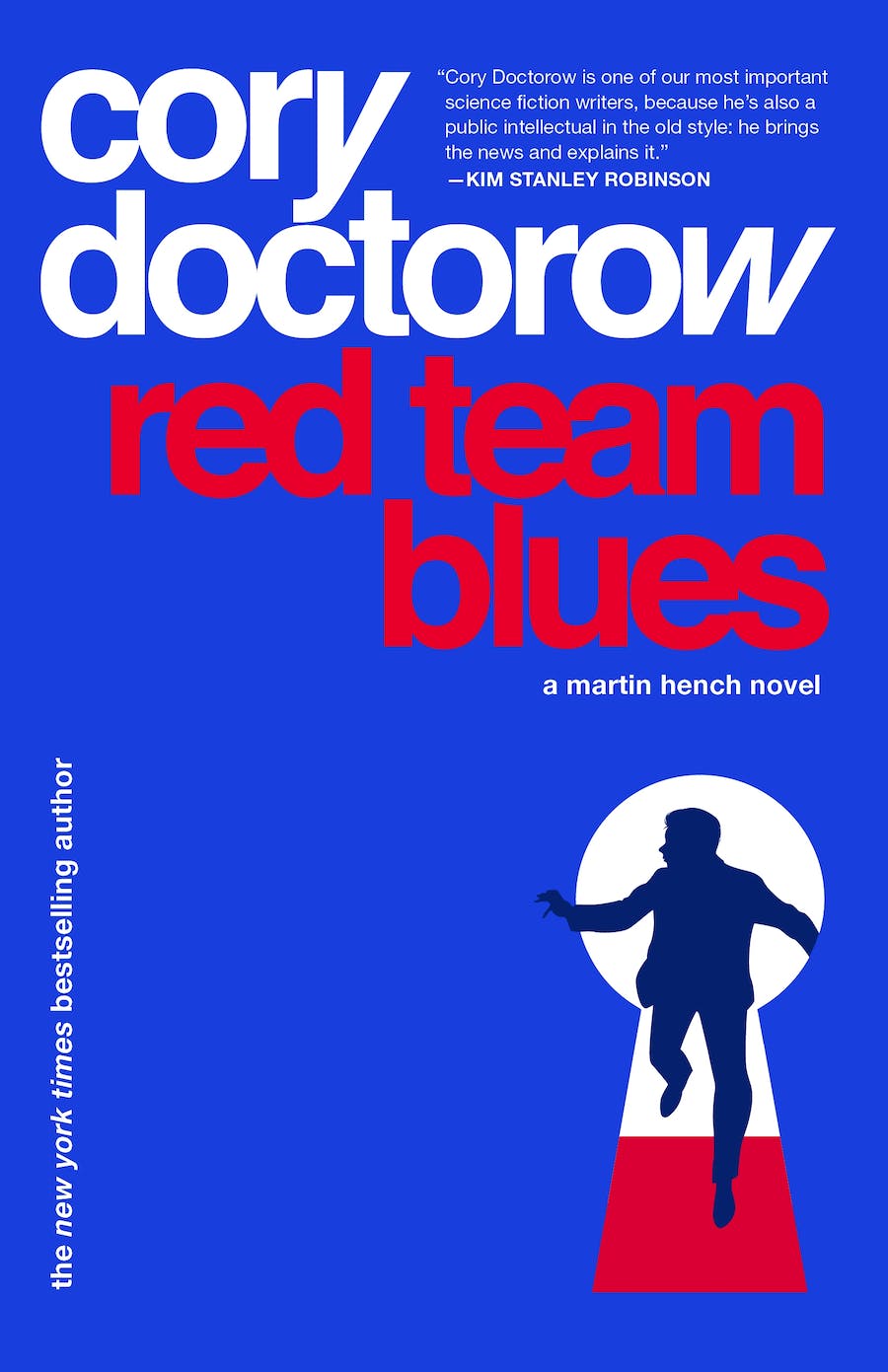
I’ve just finished reading Cory Doctorow’s great, fun novel, Red Team Blues, and I’ve been thinking about how well it exemplifies one of the strengths of good science fiction. Back when we ran our seminar on Francis Spufford’s novel, Red Plenty, there was a back-and-forth between Francis and Felix Gilman. As Francis described it post-hoc, he wanted to write the novel of the socialist calculation debate, in part because of the challenge:
I was positively attracted to the whole business of being the first person in thirteen years to consult Cambridge University Library’s volumes of The Current Digest of the Soviet Press; and in general to the challenge of taking on the most outrageously boring subject matter I could find, and wrestling it to the floor, and forcing it to disgorge its hidden jewel of interestingness
[click to continue…]
by Chris Bertram on February 24, 2023
I had a little exchange on twitter and Mastodon yesterday on reading habits. The initial cause of the exchange was the claim that book reading is in decline, and I asked for some evidence of this, which my interlocutor duly provided in the form of a link to a survey of British readers by Booktrust from 2013. The survey documents the reported reading habits of British people, showing them to be correlated with things like age and socio-economics status, with some worrying drop-off in book reading among the young. I’m sure that the advent of TV and even the radio also brought some declines, and it is always hard to know how seriously to take such worries: young people may be reader shorter pieces of writing on the internet, they aren’t just watching TikTok videos.
However my attention was caught by another statistic: a claim that 6 per cent of respondents, “bookworms”, get through around 12 books per month (or 144 per year). Now I read a lot – as I perceive it – and I complete between 50 and 60 books most years. When I read Les Misérables, albeit in French, that took up nearly a quarter of my annual reading. Ulysses, which needed a lot of looking up, reading on the side etc, took me about a fortnight, and I think I went too fast in places. My guess is that most of these super-readers are not reading such works, or the Critique of Pure Reason, but but rather short thrillers and the like. I can get through a PG Wodehouse in a day (and what a joy that is!), so that would be a way to boost the numbers if boosting the numbers alone were something worth caring about, which it isn’t.
There’s also a question about the density and complexity of the text: how fast should you read? Many literary texts demand close attention at the level of the sentence and below, whereas some genre fiction does not. Literary texts also require digestion and contemplation, which in turn demands time away from them while your brain does the processing. Sometimes they call for re-reading in the light of later passages that draw attention to the significance of an earlier element. So, no, having flinched at my inadequacy compared to the 6 per cent of super-readers, my considered view is that my own consumption is about right, if not a little too high.
by Ingrid Robeyns on December 28, 2022
I recently listened to the new book by Anand Giridharadas, who is well-known for his previous book Winner Takes All. That book was about how (some of) the superrich are happy trying to contribute to some of the world’s problems, but never ask any questions related to why the world is so unequal as it is, what power and the workings of capitalism have to do with all of this, and whether their capitalist strategies are at all suited to address these problems. I thought that was a great book.
So I was looking forward to his new book. It is called The Persuaders. Winning Hearts and Minds in a Divided Age. It is a book about why we shouldn’t just give up on people who have political or social views that we find wrong, perhaps even horrible. The book presents a series of cases, the activists involved, and the techniques or strategies they use – interspersed with some insights from social psychology and other sciences on what works (and what doesn’t) to make people change their mind in a non-manipulative way.
My take-away from the book is that there is no point in believing you are right (or have the right policy, or the right analysis on what needs to happen on matter X), and believing the only thing that is needed for change is airing those views and that analysis. It’s just not enough. We need to actually spend time and effort to persuade others that this is the right analysis/policy/direction, and this persuasion cannot be merely cognitive; it requires understanding “where people are”, what makes them believe what they believe, and showing respect for them as a person at the outset. All of that requires listening, and being willing to engage in a genuine conversation, and finding out why people believe what they believe. Just believing I am right (and having all the arguments sorted out in my head) and airing my views, is not enough to also make a difference in the world, especially not in deeply divided societies. And, very importantly, trying to persuade others, and being willing to be persuaded, should be an essential part of any democracy. Thus, this book is also, at a deeper level, about what contemporary democracies need. [click to continue…]
by Ingrid Robeyns on December 16, 2022
Once in a while, I listen to a book as an audiobook, rather than reading it on paper or on my electronic device. Especially during the pandemic, when I was walking a lot, I loved listening to stories while walking. And clearly, for people who are dyslectic, or who for another reason can’t read easily, they are a real blessing.
But I’ve noted something weird with audio-books that I can’t quite grasp – so perhaps someone here can help me understand what is going on. [click to continue…]
by Eszter Hargittai on November 8, 2022
A while back I posted that I was writing a book about Covid. Today is its official launch date!
I’m super excited about and proud of this work, because I don’t believe we’ll ever be able to capture people’s experiences during a global pandemic the way collecting data about it at the height of initial lockdowns allowed us (my research team) to do. Below the fold I explain what the book covers. In short, it has material of interest to those curious about misinformation, social media, and digital inequality.
Also, how awesome is this cover?! I can’t take credit for it, but am super grateful to its designer Ori Kometani for capturing the experiences of the time so well.

[click to continue…]
by Ingrid Robeyns on October 31, 2022
Yesterday I attended/watched four talks on climate action. The first three were at a festival in Amsterdam where Chris Armstrong, a new branch on our crooked tree, was also speaking, on his book on oceans politics. First I attended two talks by some Dutch-speaking people (including David Van Reybrouck, famous author of the colonial histories Congo and Revolusi, who is now fully dedicated to working on ecological causes). Then I attended Andreas Malm’s talk on how to fight in a world on fire. Nothing special to report for those who have read the book – but given the pretty critical discussion of my bookreview of his work here recently I’d thought I should mention that he came across as more nuanced than [how I read] his book. For example, he stressed that the vast majority of the climate movement will remain peaceful, and that those who want to move to sabotage must carefully choose their targets – focussing on targets that are part of the problem, and as part of an action that doesn’t alienate people but instead lets the climate movement grow.
But the most interesting talk of the day was by Greta Thunberg, who launched The Climate Book at the London Literature Festival. Thunberg has put together a one-stop-volume on climate change and climate action. You can watch her speech and subsequent interview here (it effectively starts at 14’35”). In essence, Thunberg believes that governments are not going to do what is needed without millions more climate activists putting pressure on those governments, so that they speed up action and put the interests of ordinary people central. At some point, she mentions that so many individuals have the opportunity to be an activist, but don’t. She clearly sees this as a [moral, political] duty (she also uses the word “burden” at some point), and calls upon everyone to join a local activist group. [click to continue…]
by Eric Schliesser on October 29, 2022
The decades long decline of the Humanities – the academic study of texts and/or the academic practice of criticism* – is often blamed on the latest fad in it, or its faddishness, when such diagnosis is not altogether ground in ideological, political, or theoretical culture-war score-settling (with structuralism, deconstruction, queer theory, critical race theory, etc.) To be sure, in North America and Europe, the decline is very real when measured along a whole range of intrinsic and extrinsic measures: relative undergraduate enrollments, the hiring of freshly minted PhDs, starting salaries of its college graduates, and cultural prestige.
By contrast, I suggest that the decline of the Humanities indicates a more general shift away from the cultural significance of texts in our societies. And put like that allows the real underlying culprit of the decline of the Humanities to come into view: it is fundamentally due to the declining significance of the Bible and of getting its meaning right among those that seek out higher education and social forces that are willing to sponsor the academy. The unfolding death of God — understood (with John 1:1) as the Word — is the source of the decline of the Humanities.
[click to continue…]
by Chris Bertram on October 21, 2022
In any society, certain needs have to be catered for, either socially or privately. At a minumum, those unable to work, because they are too young, too old, or too sick have to be cared for. Of course, they can be cared for in ways that are better or worse for them, but caring there must be, and that is going to take someone’s time, labour, and money.
I’ve been thinking about these rather obvious facts over the past few days partly because a report came out showing how many people – mainly women – are being driven out of the the UK workforce by the need to care for relatives, given that the social care system is broken. At present, there are also a lot of people out of the UK labour market either because they can’t work due to COVID and its after-effects, or because the underfunded National Health Service has been shattered by the pandemic and they can’t get the treatment they need in a timely fashion for other health problems they have. If left languishing, the skills these people have will atrophy. Many of them will never work again.
At the same time, our soon-to-be-former Prime Minister has been pushing her “pro-growth” agenda, which largely consisted of tax cuts, and her now-former Home Secretary mocked the anti-growth coalition of “Guardian-reading, tofu-eating, wokerati”, of which I am proud to consider myself a member.
Their central assumption is that growth is best served by a low-tax economy and that public spending needs radical reduction, with the fat-cutting exercise of the last twelve years now to be extended to the bones. Well, I hope readers can see the problem. You don’t get growth by pursuing policies that effectively force people to give up productive work either through their own sickness, or in order to care for other people. If these needs are not met socially, they will be met privately, and, again, because it bears repeating, in ways that are disproportionately damaging to women.
[click to continue…]
by Henry Farrell on September 7, 2022

Ruthanna Emrys’ new novel, A Half-Built Garden is out (Indybound, Amazon). If you want to know whether you should buy it, the answer is yes, if you like sociologically and politically sophisticated sf, if you are looking for a realistic but hopeful take on a post-climate change future, if you want a different kind of first contact story, or any combination of the above. If you’re looking for a proper review, go here.
This post does something quite different – it singles out just one of the political threads from the novel. In other words – read the book too or first to get the bigger narrative that gives it proper context. I do try to avoid big spoilers, but I can’t help giving some sense of the book’s background.
Short version: A Half-Built Garden thinks through the relationship between AI/machine learning and democracy from a very different perspective than our current one. It asks a question that very few people are asking, but that is plausibly pretty important. What would online democracy look like if AI/machine learning was used to counter individual bias rather than exacerbating it?
[click to continue…]
by Chris Bertram on August 13, 2022
A few years ago at Crooked Timber, I posted a review of Oscar Martinez’s book The Beast, about the migration route to the United States from Central America through Mexico. It was a horrifying catalogue of coercion, physical injuries, murders and rapes and one friend who read it on my recommendation told me he regretted having done so, because it was so disturbing. If anything a more horrible story is told in My Fourth Time We Drowned: Seeking Refuge on the World’s Deadliest Migration Route, by the Irish journalist Sally Hayden. It is a book that exposes the deadly migration route across the Sahara to Libya, the Libyan detention camps run by militias, and then the attempts to cross the Mediterranean that are often foiled by the EU-funded Libyan “coastguard”, that often lead to mass drownings and only sometimes to an arrival in Italy or Malta.
There are many nationalities trying to cross to Europe, but many of them, and a particular focus of Hayden’s narrative, are Eritreans. Eritrea is the most repressive state in Africa and by some measures more repressive than North Korea. The Eritreans who are trying to flee this police state are trying to escape a life of indefinite conscription, often punctuated by violence and by sexual abuse. European states, in an echo of their actions in trying to prevent Jews from fleeing Germany in the 1930s, act so as to make it as difficult for people to escape as possible. In doing so, they empower and enrich both the people smugglers who treat these escapees as exploitable assets and the various militias who run detention camps within Libya.
As they make their way across the desert, where many are abandoned and die, migrants fall into the hands of smugglers to whom they may already have paid a fee. They are held and their relatives receive pictures of them demanding more money for their onward transit, pictures of sons and daughter being tortured that resemble for all the world those pictures of Abu Ghraib. The smugglers who hold them in these coralls, not only torture for money and recreation, they also rape large numbers of the women held there.
[click to continue…]
by Ingrid Robeyns on July 4, 2022
As I might have mentioned here before, I am currently working on a book (provisionally) entitled Limitarianism. The Case Against Extreme Wealth. It will be what publishers call a trade book – that is, written for any reader of nonfiction. I’ve been doing this kind of writing (and talks) in Dutch for much longer; this book I write in English. It will be published by Astra House for North-America, and by Allen Lane/Penguin for the UK and the rest of the world (with translations also in Dutch, German, Italian, Spanish, Korean, Japanese and Russian).
As I am also engaged in academic-philosophical debates on limitarianism, it is striking to see what is considered relevant and important in each of those strands of writing. Some pre-occupations by academic philosophers are of little or no importance to the public, such as whether argument A for limitarianism is truly distinct from argument B, or whether limitarianism can be reduced to (a combination of) other distributive principles. For the public the most important question is whether this is an idea that makes sense, and some philosophical preoccupations are about other (more technical) issues. On the other hand, in my experience the public cares a lot about some things that many philosophers find irrelevant, such as what we can learn from the empirical facts (e.g. about the urgency of a problem, or whether a proposed intervention has ever worked in the past), and what a general (or abstract) discussion implies in a concrete context. Academic discussions can be at a level of abstractness that will make you lose most of your readers of nonfiction, even of serious nonfiction.
What else would make a public [political] philosophy book good? Here are my thoughts on this. [click to continue…]
by Chris Bertram on July 1, 2022
More than forty years ago, before I went to university, I was living in Paris and became an “organized sympathiser”, a candidate for membership, of the Trotskyist sect Lutte Ouvrière. The training for people like me consisted, of course, of reading some Marxist classics, but also of making one’s way through a list of novels that included, as I recall, Zola’s Germinal, Christiane Rochefort’s Les Stances à Sophie, Malraux’s Les Conquérants and La Condition Humaine, Orwell’s Homage to Catalonia, London’s The Iron Heel and certainly some others that I forget. One of the books that I never got round to was Ousmane Sembène’s Les Bouts de bois de Dieu, and I had more or less forgotten about it until a contact on social media with whom I share many mutual friends reported reading it after a trip to Senegal. So I thought I would give it a go.
It is one of the most remarkable novels I have read in the past several years and deserves to be widely knows as a classic. It is an epic constructed somewhat in the manner of a great Russian novel (think of Grossman’s Life and Fate, for example) and centres on a strike of African railway workers, against the French rail company and the colonial administration in 1947-8. The strikers are poor, many of them are illiterate, they are Muslims, many are in polygamous families and they are regarded by the French as savages and by their religious leaders as people who ought to be grateful and know their place. Yet they have their dignity and cannot accept that they are worth less than the whites who work on the railway, that they should have no entitlement to family support, or to a pension in their old age. So they strike, heedless of the advice of their elders who had done the same ten years before.
[click to continue…]
by Ingrid Robeyns on January 23, 2022
We were having birthday cake with my youngest son who turned 14 today, when CBS aired an item on the Sunday Morning Show for which I was interviewed. The item was on the question whether one can be too rich. As regular readers of this blog know, I’ve written a couple of papers (this one being open access) and more journalistic pieces (e.g. this) that we should answer this affirmatively. So now CBS decided the idea deserved an item, and I think they did a great job in putting several different relevant concerns together in a mere 8 minutes. It can be watched online here. (I believe they could have found more vocal opponents of limitarianism, but I guess these voices get plenty of airtime elsewhere?)
Abigail Disney has a line of critique from which I’ve so far tried to steer away – namely that becoming superwealthy changes a person and their character for the worse. That resonates with some of the findings in the intriguing book by Lauren Greenfield, Generation Wealth. Although I wrote very briefly (in Dutch, alas) on the scientific studies that we have that suggests that extreme wealth concentration might lead to unhappier people than being moderately well-off, I am hesitant to write more about this, for two reasons. One is that arguing that they are less happy and that therefore they should not be so rich is quit paternalistic (and most approaches in political philosophy and social ethics reject paternalistic arguments). Still, it also affects their children, so the paternalism objection might be less strong than at first sight. Arguing that they become less virtuous (read: bad people) is something that I cannot say since I haven’t tried to find the relevant studies (if they exist); moreover, it also seems a non-starter if we want to engage in a political debate that should include those that are superrich, or that defend the superrich. The other reason why I haven’t gone down this road so far is that I think the other arguments for limitarianism are strong enough in themselves to carry the claim – why then introduce a more contentious one, except if the evidence were to be overwhelming?
I don’t think I’ve announced on this blog the other news I have on limitarianism, which is that I’m writing a trade book on the topic, which is under contract with Allen Lane/Penguin (for the UK), Astra (for North America), and translations secured in Dutch, German, Korean, Italian, Japanese, Russian, and Spanish (the magic that working with an agent does!). The manuscript is due after the (Northern Hemisphere) Summer, so I’ll be having more posts on this matter over the next months.